The Short Answer
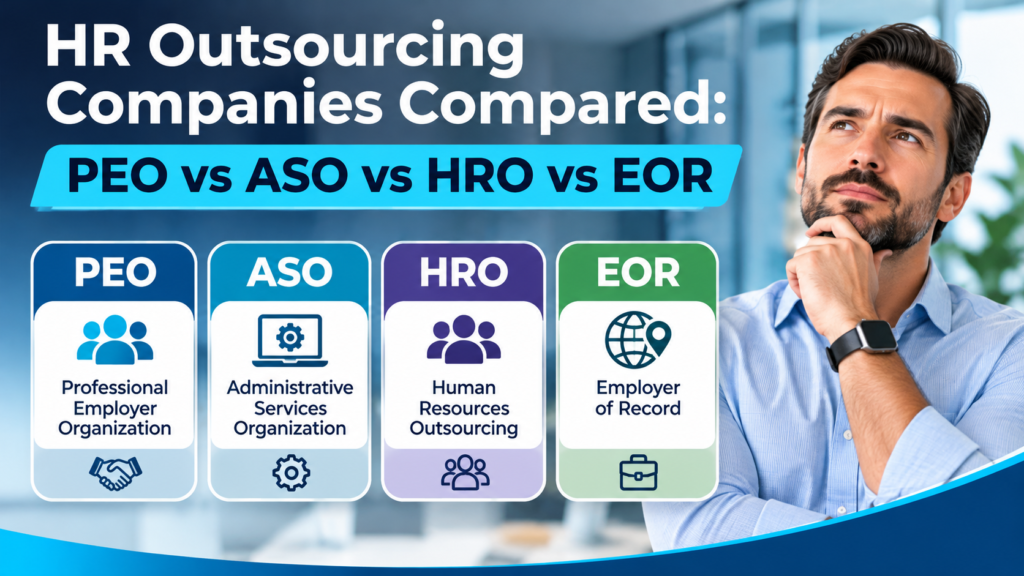
When comparing HR outsourcing companies, there are four primary models: PEO (Professional Employer Organization), ASO (Administrative Services Organization), HRO (Human Resources Outsourcing), and EOR (Employer of Record). Each model differs in who holds employer liability, what services are bundled, and how pricing is structured. Choosing the wrong model means paying for services you do not need or missing protections you do.
Why the Model You Choose Matters More Than the Vendor
Most business owners shopping for HR help start by comparing vendors — Gusto vs. Rippling, Insperity vs. TriNet. That is the wrong starting point. The model determines your legal exposure, your cost structure, and whether you can actually get the HR support your business needs at your stage of growth.
Based on our analysis of 40+ vetted PEOs and the businesses that work with them, the most common and costly mistake is selecting a model that fits a vendor’s sales pitch rather than the company’s actual risk profile and HR workload. This guide lays out the four models with no slant toward any one of them.
According to NAPEO, more than 500 PEOs operate in the United States, covering roughly 4 million worksite employees — but PEOs represent just one of several outsourcing structures worth evaluating.
Comparing PEOs is easier when you know your baseline cost. The PEO Calculator shows what a PEO would cost for your company in 60 seconds, with no call needed.
What Is a PEO (Professional Employer Organization)?
A PEO enters a co-employment relationship with your business. Your employees remain yours day-to-day, but the PEO becomes the employer of record for tax and benefits purposes. This means payroll taxes are filed under the PEO’s Employer Identification Number, and employees gain access to the PEO’s large-group benefit plans.
Who Holds Employer Liability in a PEO
Liability is shared. The PEO assumes responsibility for payroll tax compliance, benefits administration, and many HR compliance risks. You retain control over hiring, firing, and day-to-day management. This shared liability model is what distinguishes a PEO from every other outsourcing structure.
What Is Included in a PEO
- Payroll processing and tax filing under the PEO’s EIN
- Large-group health, dental, vision, and ancillary benefits
- Workers compensation coverage and claims management
- HR compliance support and employee handbook assistance
- Dedicated HR support (varies by provider)
- Access to 401(k) and other retirement plans
PEO Pricing Structure
PEOs typically charge either a percentage of gross payroll (most common, usually 2–6%) or a flat per-employee-per-month (PEPM) fee ranging from $80 to $200+. Benefits premiums are often separate. You can get a baseline number for your headcount and payroll using the PEO Calculator.
Ideal Company Profile for a PEO
PEOs deliver the most value for businesses with 5–250 employees that want to offer competitive benefits without paying large-group premiums on their own, need compliance infrastructure without hiring a full HR department, and are willing to operate within the PEO’s benefit plan structure. According to NAPEO, PEO clients grow 7–9% faster and have 10–14% lower employee turnover than companies not using a PEO.
What Is an ASO (Administrative Services Organization)?
An ASO provides the same administrative HR services as a PEO — payroll, compliance support, benefits administration — but without co-employment. You remain the sole employer of record. The ASO works as a service vendor, not a legal co-employer.
Who Holds Employer Liability in an ASO
You do. The ASO processes payroll and manages HR tasks on your behalf, but all employer tax liabilities, workers compensation obligations, and compliance risks stay with your business. The ASO does not absorb any legal employer risk.
What Is Included in an ASO
- Payroll processing under your EIN
- Benefits administration (you source and own the plans)
- HR compliance guidance and document management
- Employee self-service technology platforms
- Onboarding and offboarding support
ASO Pricing Structure
ASOs typically charge a flat PEPM fee ($20–$80 depending on service scope) or a percentage of payroll. Because you source your own benefits separately, the total cost of an ASO arrangement plus standalone benefits is often higher than a comparable PEO — especially for smaller companies that cannot negotiate group rates.
Ideal Company Profile for an ASO
ASOs work best for mid-size businesses (100+ employees) that already have competitive benefits in place, have an internal HR team that needs administrative support rather than strategic guidance, and want to retain full control over benefits plan design without joining a PEO’s master plan.
What Is an HRO (Human Resources Outsourcing)?
HRO is the broadest and most flexible category. It refers to outsourcing specific HR functions — recruiting, training, performance management, benefits consulting, compliance audits — to one or more specialized vendors. Unlike PEOs and ASOs, HRO is not a single bundled relationship; it is a menu of services assembled to fill gaps in an internal HR operation.
Who Holds Employer Liability in an HRO
You retain all employer liability. HRO vendors provide expertise and execution on defined deliverables. They do not assume any co-employment relationship or statutory employer obligations.
What Is Included in an HRO
- Recruiting and talent acquisition (RPO)
- Learning and development program delivery
- Benefits consulting and broker services
- HR technology implementation and support
- Compliance auditing and policy development
- Compensation benchmarking and total rewards design
HRO Pricing Structure
HRO pricing varies widely by function. Recruiting RPO engagements may be fee-per-hire or monthly retainer. Benefits consulting is often project-based or commission-based through broker relationships. Technology platforms charge PEPM fees. The total investment depends entirely on which functions are outsourced and at what scope.
Ideal Company Profile for an HRO
HRO is the right model for larger companies (250+ employees) with an established internal HR team that needs specialized support for specific functions, or for companies undergoing rapid growth that need recruiting or training capacity without permanent headcount. It is not efficient for small businesses that need broad HR coverage — the administrative overhead of managing multiple vendors quickly outweighs the flexibility.
What Is an EOR (Employer of Record)?
An EOR becomes the legal employer of your workers in a specific jurisdiction — most commonly used when hiring internationally or in states where you lack a legal entity. The EOR handles all local employment law compliance, payroll, taxes, and statutory benefits on your behalf. You direct the work; the EOR owns the employment relationship on paper.
Who Holds Employer Liability in an EOR
The EOR holds full employer liability in that jurisdiction. This is the most complete transfer of employer risk of any model — which also means less control over local benefits and employment terms than you would have with a local entity.
What Is Included in an EOR
- Legal entity in the target country or state
- Local payroll processing and tax remittance
- Statutory benefits compliance (health, leave, pension per local law)
- Employment contracts drafted to local standards
- Termination and offboarding in compliance with local law
EOR Pricing Structure
EOR providers typically charge $500–$2,000+ per employee per month depending on the country, local complexity, and service tier. Pricing is notably higher than domestic HR outsourcing because the EOR is absorbing full legal employer risk in a foreign or unfamiliar jurisdiction.
Ideal Company Profile for an EOR
EORs are purpose-built for companies expanding internationally without establishing a local entity, or hiring a small number of remote workers in states where they have no payroll registration. For domestic multi-state hiring at scale, the per-employee cost of an EOR usually makes a PEO the more economical option. The IRS guidance on employer identification provides useful context on EIN responsibilities that an EOR assumes on your behalf.
Side-by-Side Comparison: PEO vs ASO vs HRO vs EOR
| Feature | PEO | ASO | HRO | EOR |
|---|---|---|---|---|
| Co-employment | Yes | No | No | Yes (full) |
| Employer liability | Shared | Client only | Client only | EOR only |
| Payroll EIN | PEO’s EIN | Your EIN | Your EIN | EOR’s EIN |
| Benefits access | Large-group plans | Your own plans | Consulting only | Statutory only |
| Typical pricing | 2–6% payroll or $80–$200 PEPM | $20–$80 PEPM | Variable by function | $500–$2,000+ PEPM |
| Best employee count | 5–250 | 100+ | 250+ | 1–50 (international) |
| Workers comp included | Yes | No | No | Yes (local) |
| Use case | SMB full HR stack | Admin support, own benefits | Fill specific HR gaps | International or remote hiring |
How to Choose the Right HR Outsourcing Model
The right model depends on three variables: how many employees you have, how much employer liability you want to transfer, and whether benefits access is a strategic priority.
Choose a PEO if
You have 5–250 employees, want to offer Fortune 500-caliber benefits without self-insuring, and need broad HR compliance coverage without building an internal HR team. Businesses that want to save 20–40% on operational and benefit costs compared to managing benefits independently often find the PEO model the most cost-efficient path at this size. See how leading PEOs for small businesses compare on this criteria.
Choose an ASO if
You already have strong benefits in place, want to keep your own EIN and benefit plan design, and simply need better HR technology and administrative support. This is common for mid-size companies that have outgrown startup-era HR tools but are not ready for the co-employment structure a PEO requires.
Choose HRO if
You have an internal HR team and need to outsource specific, high-skill functions — talent acquisition, compensation benchmarking, or compliance auditing — without touching your core employer structure. The Department of Labor’s compliance assistance resources can help you identify which compliance gaps are most common at your size before engaging an HRO.
Choose an EOR if
You are hiring workers in countries or states where you have no legal entity and want zero exposure to local employment law complexity. EOR is a bridge solution, not a permanent infrastructure — most companies eventually establish their own entity once headcount in a region justifies it.
A Note on Hybrid Arrangements
Some providers offer combinations. A PEO may also offer EOR services for international contractors. An HRO vendor may bundle ASO-style payroll administration. In our experience matching hundreds of businesses with HR solutions, hybrid arrangements often signal that a provider is trying to cover a broader market rather than delivering specialized depth. Evaluate what you actually need before accepting a bundled offer that includes services you will not use.
If you are specifically evaluating PEO vendors side by side, the Gusto vs. Justworks comparison and the Insperity cost breakdown are useful starting points for understanding how pricing and service scope differ across named providers.
Next Steps
If you have identified the right model and want to compare specific providers within it, PEO Marketplace works with 40+ vetted PEOs and can match your business to the best-fit options based on your industry, headcount, and benefits priorities — without a sales push toward any single vendor.
Schedule a Matching Consultation →
Prefer to compare on your own timeline first. Run the Benefits Benchmark for your industry and we will email you a breakdown of what companies your size are paying for HR, benefits and workers comp.
Frequently Asked Questions
What is the difference between a PEO and an EOR?
A PEO enters a co-employment arrangement where employer liability is shared between the PEO and your business, and your employees are filed under the PEO’s EIN for payroll and benefits purposes. An EOR becomes the full legal employer in a specific jurisdiction, typically used for international or remote hires where you have no registered entity — the EOR assumes all local employer liability, not just a share of it.
Is a PEO or an ASO better for a small business?
For most businesses under 100 employees, a PEO delivers more value than an ASO because the co-employment structure unlocks large-group benefit rates that an ASO arrangement cannot access. An ASO makes more sense when you already have established, competitive benefit plans and primarily need administrative support and HR technology.
Does using an EOR mean I give up control of my employees?
An EOR becomes the legal employer on paper, but you retain full control over the work your employees perform, their daily management, and their role within your organization. The EOR’s control is limited to the employment law and payroll compliance side of the relationship in the relevant jurisdiction.
How do I know if my company needs HRO instead of a PEO?
If your business already has an internal HR team and you need to fill specific gaps — such as recruiting capacity, compliance auditing, or leadership training — HRO is likely the better fit because you are buying expertise for defined functions rather than a full HR infrastructure replacement. A PEO is better suited when you need end-to-end HR coverage and do not have a dedicated HR team managing day-to-day needs.
Can a company use more than one HR outsourcing model at the same time?
Yes, and many growing companies do. A common combination is a PEO for domestic employees paired with an EOR for international hires in countries where the company has no legal entity. The key is ensuring the two arrangements do not create conflicting employer-of-record designations for the same employees or jurisdictions.