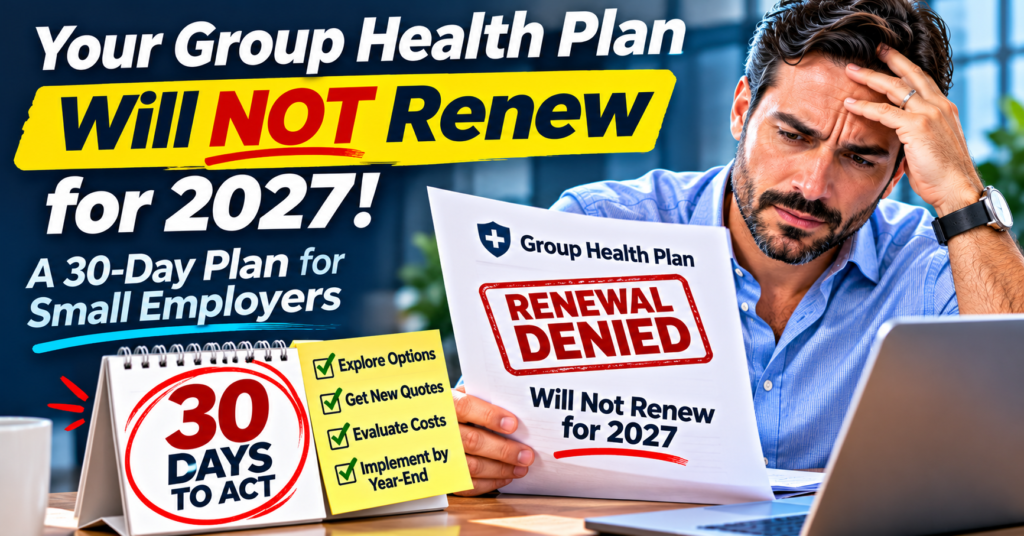
If your small group plan is not renewing for 2027, you are not alone. Carrier exits in markets like California (Health Net) and Texas (Memorial Hermann) have sent non-renewal letters to thousands of small employers this fall, leaving HR leads and business owners scrambling to replace coverage before the gap hits. The good news: 30 days is enough time to act — if you move in the right order.
What Does a Non-Renewal Notice Actually Mean?
A non-renewal notice means your insurance carrier has decided not to offer your current plan in the next plan year. It is not a cancellation mid-year — coverage runs through your current end date — but it does mean you must replace the plan or employees lose coverage on day one of the new year.
Under the ACA and state continuation rules, carriers are generally required to provide at least 60 days advance notice of non-renewal for small group plans. Some states require 90 days. If your letter arrived with less notice than that, contact your state’s Department of Insurance immediately. The U.S. Department of Labor’s Employee Benefits Security Administration outlines employer obligations and participant rights when group health coverage ends.
The practical impact depends on your company size and how your employees use their benefits. For employers with 5–50 employees, the individual market or a PEO master health plan are usually the two fastest replacement paths. For 50–100 employees, a fully insured small group replacement or a level-funded plan may also be on the table.
Run the numbers on better benefits for your team. The PEO Calculator shows what companies your size are paying.
Why Are Small Group Plans Not Renewing in 2026–2027?
Carriers are exiting small group markets primarily because the risk pool is too small to price predictably, claims costs have outpaced premiums, and state-level regulatory changes have made some markets less attractive. This is a structural issue in the small group market, not a reflection of your company’s claims history.
Several high-profile exits are driving the current wave of non-renewals heading into 2027:
- Health Net (California): Announced withdrawal from certain small group markets, affecting employers across multiple counties.
- Memorial Hermann Health Plan (Texas): Exited the fully-insured small group market, sending non-renewal notices to employers in the Greater Houston area.
- Several regional BCBS affiliates have tightened underwriting standards, effectively pricing out the smallest employer groups.
According to the Bureau of Labor Statistics Employer Costs for Employee Compensation data, health insurance represents the single largest benefit cost for most employers. When that cost becomes unpredictable at renewal, or disappears entirely, the downstream impact on recruiting and retention is significant.
Discussion threads on Reddit communities including r/humanresources and r/PrivatePracticeDocs in November 2024 reflected real frustration from small practice owners and HR managers who received non-renewal letters with 60 days or less to find replacement coverage. The common thread: most did not know a PEO master plan was an option until it was almost too late.
What Are Your Replacement Options When a Small Group Plan Does Not Renew?
When a small group plan is not renewing, employers generally have four replacement paths: a new fully insured small group plan, a level-funded plan, the individual ACA marketplace, or joining a PEO master health plan. Each has a different timeline, cost structure, and eligibility requirement.
Option 1: New Fully Insured Small Group Plan
Going back to market for a new fully insured plan is the most familiar path but often the most expensive for employers under 25 lives. Underwriting is based on your group’s claims history and demographics, and carriers may decline or rate up groups that have had high utilization. Expect a 4–6 week quoting process if you are starting from scratch.
Option 2: Level-Funded Plan
Level-funded plans combine a fixed monthly payment with a stop-loss layer. They are increasingly popular for groups of 10–100 employees because they offer cost transparency and partial refunds when claims come in below projections. They are not available in every state, and the application process still requires some medical underwriting. See how benefit costs compare by industry and company size before committing to any level-funded quote.
Option 3: Individual ACA Marketplace
For very small groups (under 10 employees), individual marketplace plans through Healthcare.gov can be a viable bridge. The employer can contribute through a Qualified Small Employer Health Reimbursement Arrangement (QSEHRA) or an Individual Coverage HRA (ICHRA). The IRS has clear guidance on both arrangements at IRS.gov/affordable-care-act/employers. The downside is administrative complexity and the loss of group negotiating power.
Option 4: PEO Master Health Plan
A PEO co-employs your workforce and places your employees on a large-group master health plan. Because the PEO pools hundreds or thousands of employees across its client base, it can access carrier networks and plan designs that are simply not available to a 15- or 40-person company buying coverage on its own. According to NAPEO, PEO clients grow 7–9% faster and have 10–14% lower employee turnover than comparable non-PEO businesses — benefits access is a major driver of both statistics.
In our experience matching hundreds of businesses to PEOs through our PEO matching service, employers who switch to a PEO master plan after a non-renewal often end up with richer benefits at a lower per-employee cost than their prior group plan offered. The tradeoff is that you are entering a co-employment relationship, which means sharing some HR responsibilities with the PEO.
Comparison: Small Group Replacement Options at a Glance
| Option | Best For | Typical Timeline | Underwriting | Cost Stability |
|---|---|---|---|---|
| Fully Insured Small Group | 25–100 employees | 4–6 weeks | Group-level | Moderate |
| Level-Funded Plan | 10–100 employees | 3–5 weeks | Individual + group | High (stop-loss) |
| ICHRA / QSEHRA | Under 10 employees | 2–3 weeks | None (individual) | High (fixed allowance) |
| PEO Master Health Plan | 5–100 employees | 2–4 weeks | PEO-level (pooled) | High (large group rates) |
What Is the 30-Day Action Plan After Receiving a Non-Renewal Notice?
A structured 30-day response gives you enough runway to compare options without rushing into a decision that costs more or covers less. Here are the four steps to follow in sequence.
Days 1–5: Confirm Your Deadline and Document Your Census
Read the non-renewal letter carefully and note the exact coverage end date. Pull a current employee census (name, date of birth, zip code, dependent counts) — every carrier and PEO will ask for this on day one. Confirm whether your state has a guaranteed-issue right that requires carriers to offer you a replacement plan in the same market. Many states do for groups under 50 lives.
Days 6–12: Request Quotes Across Multiple Paths Simultaneously
Do not sequence your quotes — run them in parallel. Contact a benefits broker for fully insured and level-funded options while also requesting a PEO analysis. Waiting to hear back from one path before starting another is the most common mistake small employers make in a non-renewal situation. Use the PEO Calculator to get a baseline on what PEO pricing looks like for your headcount before you have your first call.
Days 13–21: Compare Total Cost, Not Just Premiums
When quotes come back, compare total employer cost per employee per month — including administrative fees, payroll processing, and any PEO service fees. PEOs typically save businesses 20–40% on operational and benefit costs when the full picture is included. The best PEO for small businesses is not always the one with the lowest headline premium — plan design, network breadth, and HR support matter too.
Days 22–30: Select, Enroll, and Communicate
Once you have selected a replacement option, give employees at least one week to review plan summaries and complete enrollment paperwork. If you are moving to a PEO, your PEO implementation team will manage the carrier enrollment on your behalf. Send a written communication to employees that explains what is changing, what stays the same, and what action they need to take before the enrollment deadline. Document everything in writing for your HR file.
Is a PEO the Right Fit When Your Small Group Plan Is Not Renewing?
A PEO is a strong fit when you want to replace coverage quickly, improve plan quality, and reduce the ongoing administrative burden of managing benefits in-house. It is worth evaluating if your current plan was underperforming even before the non-renewal, or if you are spending significant HR time on benefits administration that could be better directed elsewhere.
Based on our analysis of 40+ vetted PEOs, the employers who get the most value from a PEO transition after a non-renewal tend to have 10–75 employees, are growing, and have been frustrated with annual premium increases that outpaced the value delivered. For a side-by-side look at how major PEO options compare, see our comparison of Gusto and Justworks and our Insperity cost comparison as reference points for what different tiers of PEO pricing look like.
A PEO is not the right answer if you have fewer than 5 employees, operate in a highly specialized industry where co-employment creates compliance complexity, or need total control over your benefits plan design. In those cases, a level-funded plan or ICHRA may serve you better.
Talk through your options with a PEO advisor. Schedule a consultation and get a recommendation based on your headcount, industry, and coverage end date.
Prefer to compare on your own timeline first. Run the Benefits Benchmark for your industry and we will email you a breakdown of what companies your size are paying for HR, benefits and workers comp.
Frequently Asked Questions
What should I do first when I receive a small group non-renewal notice?
Read the letter carefully to confirm your coverage end date and the reason for non-renewal, then pull a current employee census. These two steps — confirming the deadline and assembling your census data — are prerequisites for every replacement quote you will request, so completing them on day one prevents delays across all other paths.
How much notice is a carrier required to give before a small group plan is not renewed?
Federal law under HIPAA and the ACA generally requires at least 60 days advance notice for small group non-renewals, and many states require 90 days. If your notice arrived with less than 60 days remaining, contact your state’s Department of Insurance and the DOL’s Employee Benefits Security Administration to understand your rights.
Can a PEO actually replace group health coverage in 30 days or less?
Yes — in our experience matching businesses to PEOs through our network of 40+ vetted PEOs, implementation timelines for employers with clean census data typically run two to four weeks from signed agreement to coverage effective date. The PEO handles carrier enrollment on behalf of your employees, which removes most of the administrative burden from your internal team.
Will employees lose coverage during the transition to a new plan?
Employees will not lose coverage if the replacement plan effective date aligns with the non-renewal date, which is the goal of acting quickly. If there is a gap, employees may have COBRA continuation rights under federal law for groups of 20 or more, and state mini-COBRA rules may apply for smaller groups. Your HR team or PEO advisor should confirm state-specific continuation rules for your situation.
Is a small group plan not renewing for 2027 considered a qualifying life event for employees?
Yes. Loss of employer-sponsored coverage — including non-renewal — is a qualifying life event that triggers a Special Enrollment Period under the ACA. Employees who cannot enroll in a replacement employer plan have 60 days from the loss of coverage to enroll in an individual marketplace plan through Healthcare.gov. Employers should communicate this right to employees in writing as part of the transition notice.