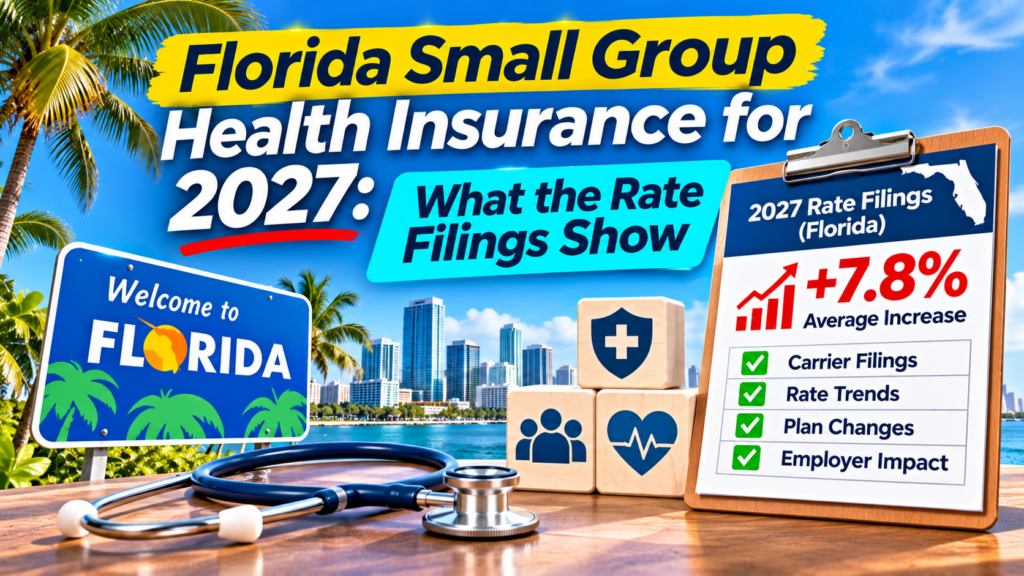
Florida small group health insurance 2027 renewal season is arriving with higher price tags. Preliminary rate filings submitted to Florida regulators show eight carriers remaining in the small-group market requesting increases that average 11.4% unweighted, with individual carrier requests ranging from 8.4% to 15.5% (source: ACASignups analysis of preliminary 2027 filings). One carrier — National Health Insurance Company, sold under the Allstate Benefits brand — has not appeared on the Florida CFO’s 2027 carrier list, indicating it is leaving Florida’s small-group market. For employers with 2–50 employees, this narrows the competitive field and makes understanding your options before renewal critical.
This guide breaks down what the 2027 filings show, what is driving the increases, and how to evaluate your options side by side before your plan year renews.
What Do the 2027 Florida Small-Group Rate Filings Actually Show?
The 2027 filings are preliminary requests, not approved rates. Florida’s Office of Insurance Regulation reviews submissions before final approval, so the numbers your carrier quotes at renewal may differ from the figures filed today.
That said, preliminary filings are the best forward-looking signal available right now. Based on ACASignups’ analysis of preliminary 2027 filings, here is the landscape:
| Market Metric | 2027 Figure (Preliminary) | Source |
|---|---|---|
| Carriers remaining in FL small-group | 8 | Florida CFO 2027 carrier list |
| Average requested rate increase (unweighted) | 11.4% | ACASignups, preliminary filings |
| Range of requests | 8.4% – 15.5% | ACASignups, preliminary filings |
| Carrier exiting FL small-group | National Health Insurance Company (Allstate Benefits) | Florida CFO 2027 carrier list |
These are requested increases, not final approved rates. Employers should monitor the Florida Office of Insurance Regulation (floir.com) for final approvals as they are issued.
Run the numbers on better benefits for your team. The PEO Calculator shows what companies your size are paying.
What Is Driving Florida Small-Group Rates Higher in 2027?
Several converging factors are pushing 2027 small-group premiums above recent historical norms, and understanding them helps you assess whether your carrier’s specific increase is in line with market forces or an outlier worth challenging.
Medical Cost Inflation
Hospital, pharmaceutical and specialist costs continue to rise faster than general inflation. The Bureau of Labor Statistics (BLS.gov) tracks medical care services as a component of CPI; sustained pressure in that index flows directly into carrier trend assumptions used to build rate filings.
Prescription Drug Spending
Specialty and GLP-1 medications have become a significant driver of group health costs. Carriers are building higher pharmacy trend factors into their 2027 filings to account for increased utilization of high-cost drug classes.
Florida-Specific Utilization Patterns
Florida’s aging population and historically high healthcare utilization rates mean that small-group risk pools in this state tend to run hotter than the national average. With only eight carriers in the market, there is less competitive pressure to absorb trend increases.
Carrier Consolidation in the Small-Group Segment
The exit of National Health Insurance Company (Allstate Benefits) reduces competition in the 2–50 employee market. When a carrier departs, its former policyholders need to migrate, which can affect the risk composition of remaining carrier pools and influence future pricing.
How Does Small-Group Insurance Pricing Work in Florida?
Florida small-group health insurance rates are community-rated with limited variation factors, meaning carriers cannot price based on your group’s specific health history — they rate based on age, geography, tobacco use, and plan design.
Key structural facts for 2027 planning:
- Rate lock period: Once your plan renews, your rate is generally fixed for 12 months. Lock in before year-end if your renewal falls in Q4 2026 or Q1 2027.
- ACA employer mandate: Employers with 50 or more full-time equivalent employees face shared responsibility requirements under the ACA. The IRS (IRS.gov) publishes updated affordability thresholds annually; consult those directly for 2027 figures, as they had not been published at the time this article was written.
- Minimum participation and contribution rules: Florida carriers typically require at least 70% of eligible employees to enroll and that the employer contribute a minimum percentage of the employee premium. Requirements vary by carrier.
- Open enrollment timing: Small-group plans in Florida can renew on any month, not just January 1. Your broker or HR platform should flag your renewal window 90–120 days in advance.
How Do Your Options Compare Side by Side?
Florida employers with 2–50 employees have more paths to group health coverage than a straight carrier-to-carrier comparison suggests. Here is how the main structures compare.
| Option | How It Works | Best For | Rate Stability |
|---|---|---|---|
| Fully Insured Small Group | Buy directly from one of 8 FL carriers; premium is fixed for the plan year | Groups wanting predictable monthly costs | Rate locked 12 months; subject to community rating trends |
| ICHRA (Individual Coverage HRA) | Employer sets a defined contribution; employees shop individual market plans | Variable workforce; employers wanting cost caps | Employer controls max exposure; individual market rates apply |
| Level-Funded Plan | Employer pays a fixed monthly amount; surplus may be refunded; stop-loss protects against large claims | Healthier groups of 10+ employees | More pricing flexibility than ACA community rating |
| PEO-Sponsored Benefits | Co-employment model; employer accesses the PEO’s large-group master plan | Employers wanting large-group carrier access and bundled HR | Large-group pricing not subject to small-group community rating rules |
Is a PEO a Realistic Option for a Small Florida Employer?
A Professional Employer Organization (PEO) is a viable alternative to the traditional small-group market, particularly when carrier options are contracting and rates are rising. Under a PEO co-employment arrangement, your employees join the PEO’s master benefits plan, which is priced on large-group actuarial rules — not the small-group community rating framework that governs Florida’s 8-carrier market.
According to the National Association of Professional Employer Organizations (NAPEO.org), businesses that use a PEO grow 7–9% faster and have 10–14% lower employee turnover than comparable businesses that do not. The practical implication for Florida employers: PEO clients often access Blue Cross, Aetna, UnitedHealthcare or other large carriers at rates their headcount alone could not negotiate.
Based on our analysis of 40+ vetted PEOs, employers that move from small-group fully insured plans to a PEO’s large-group benefits frequently see combined savings of 20–40% on operation and benefit costs when HR administration, payroll and workers’ compensation are bundled together. The benefits line item alone is not always lower — the value is in the full package.
To see which structure makes sense for your headcount and industry, the best PEO for small business comparison is a useful starting point. If you are evaluating specific vendors, the Insperity cost comparison breaks down how one of Florida’s most common PEO options stacks up against alternatives.
What Should Florida Employers Do Before the 2027 Renewal?
Acting 90–120 days before your renewal date gives you enough time to get competing quotes, run a benefits benchmark, and avoid being auto-renewed onto a higher-rate plan without reviewing alternatives.
Step 1: Pull Your Current Census and Claims Summary
Carriers and PEOs need an employee census (age, zip, dependents, tobacco status) and a benefits summary to quote. Have these ready before you start outreach.
Step 2: Get Quotes Across All Structures
Ask your broker or benefits advisor to quote fully insured small-group, level-funded and ICHRA side by side. If you have 5 or more employees, also request PEO proposals. The PEO matching service at PEO Marketplace runs your situation against 40+ vetted PEOs in one pass.
Step 3: Benchmark Against Your Industry
Before accepting or rejecting any quote, check it against what employers your size in Florida are actually paying. The Benefits Benchmark tool generates an industry-specific breakdown you can use as a reference point in carrier negotiations.
Step 4: Confirm Carrier Network Stability
With National Health Insurance Company exiting the Florida small-group market for 2027, verify that the network your employees currently use — including primary care physicians, specialists and hospitals — remains in-network under any replacement plan you are considering.
For a detailed side-by-side of platform-based options, the Gusto vs. Justworks comparison covers how modern HR platforms handle benefits administration differently from traditional PEOs.
Frequently Asked Questions
How many carriers offer small-group health insurance in Florida for 2027?
Eight carriers remain in Florida’s small-group market for 2027, based on the Florida CFO’s 2027 carrier list. National Health Insurance Company, sold under the Allstate Benefits brand, is not on that list, indicating it has exited the Florida small-group segment.
Are the 2027 Florida small-group rate increases approved or just proposed?
The increases reported — averaging 11.4% unweighted, ranging 8.4% to 15.5% — are preliminary requests submitted to Florida regulators, not approved rates. Florida’s Office of Insurance Regulation reviews all filings before they take effect, and final approved rates may differ from what was requested.
How long is a small-group rate locked in once the plan renews?
Florida small-group health insurance rates are generally fixed for 12 months from your plan’s renewal date. This means your premium will not change mid-year, but it also means you should evaluate alternatives before renewal rather than after.
Can a business with fewer than 50 employees access large-group health insurance rates?
Yes, through a co-employment arrangement with a Professional Employer Organization. When a small employer joins a PEO, its employees are added to the PEO’s large-group master plan, which is priced under large-group actuarial rules rather than Florida’s small-group community rating framework.
When should a Florida employer start shopping for 2027 coverage?
Employers should begin the process 90 to 120 days before their current plan’s renewal date. Starting early allows time to collect competing quotes across different coverage structures, run a benefits benchmark, and complete enrollment paperwork without being auto-renewed by default onto a higher-cost plan.
Talk Through Your 2027 Options With a Benefits Advisor
PEO Marketplace works with employers across Florida to compare fully insured small-group plans, level-funded options and PEO-sponsored benefits side by side. Schedule a consultation to see which structure fits your headcount, industry and budget before your renewal date arrives.
Prefer to compare on your own timeline first. Run the Benefits Benchmark for your industry and we will email you a breakdown of what companies your size are paying for HR, benefits and workers comp.