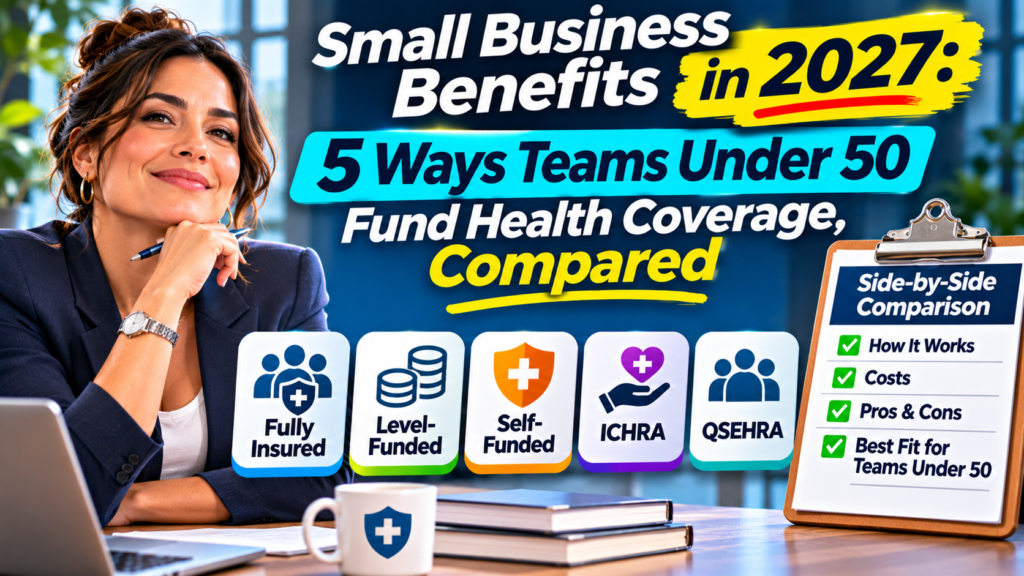
If you are evaluating small business benefits options in 2027, you have more paths available than most brokers show you. Group health insurance is not the only route—and for many teams under 50, it is not even the most cost-effective one. Below are five funding strategies laid out side by side, so you can see the tradeoffs before you commit to anything.
Why Are Small Business Health Benefits So Expensive in 2027?
Small group premiums continue to outpace inflation because insurers spread risk across fewer employees, leaving businesses with 5–50 workers absorbing more volatility than large employers. According to the Bureau of Labor Statistics, employer costs for health benefits rose again in 2024 and that trend has continued into 2027. Carriers price small group plans conservatively, which means a single high-cost claimant can spike your renewal by 20–40%. The result: many owners either drop coverage entirely or search for alternatives.
The good news is that the alternative market has matured significantly. ICHRA vendors, association health plans, and Professional Employer Organizations have all expanded their small-team offerings. The challenge is comparing them honestly, because each option has a different cost structure, compliance burden, and employee experience.
Run the numbers on better benefits for your team. The PEO Calculator shows what companies your size are paying.
What Are the 5 Main Small Business Benefits Options in 2027?
The five most widely used approaches for funding employee health coverage in a business with under 50 employees are: traditional small group insurance, Individual Coverage HRAs (ICHRA), Qualified Small Employer HRAs (QSEHRA), association health plans, and PEO-sponsored group plans. Each solves a different version of the affordability and administration problem.
1. Traditional Small Group Insurance
This is the plan most people picture—your company buys a group policy, splits the premium with employees, and everyone is on the same network. It is straightforward, employees understand it, and it satisfies most applicant expectations. The downside is cost and volatility. Small groups face steeper per-employee premiums than large employers, and your renewal rate depends heavily on your group’s claims history. For a team of fewer than 20, one or two high-cost employees can make renewal unaffordable.
Minimum participation requirements (typically 70% of eligible employees) add another layer of friction, especially if you have part-time or waiving employees who skew your numbers.
2. Individual Coverage HRA (ICHRA)
An ICHRA lets you reimburse employees tax-free for individual health insurance premiums they purchase on their own through the marketplace or directly from a carrier. There is no contribution cap, no minimum headcount, and you can set different allowance amounts for different employee classes (full-time vs. part-time, salaried vs. hourly). The IRS finalized ICHRA rules in 2019 and usage has grown steadily since.
The tradeoff is employee experience. Each person shops for their own plan, which requires more decision-making on their end. Some employees—particularly those used to employer-selected group plans—find this disorienting at first. ICHRA administration platforms (several are active in this space) have improved the onboarding experience considerably, but it still requires employee education.
3. Qualified Small Employer HRA (QSEHRA)
A QSEHRA works similarly to an ICHRA but is limited to employers with fewer than 50 employees who do not offer a group plan. The IRS sets annual contribution limits—in recent years capped around $6,000 for individual coverage and $12,000 for family coverage, adjusted annually for inflation. Everyone in the same class gets the same allowance, which is simpler than ICHRA but less flexible.
QSEHRAs are a solid starting point for businesses that want to offer something meaningful without committing to a group plan or navigating ICHRA’s class-distinction rules. The main limitation is the cap—if your employees are in a high-cost market, the QSEHRA allowance may not cover their full premium.
4. Association Health Plans
Association health plans let small businesses band together through a trade or professional association to access group coverage at rates typically reserved for larger employers. The theory is sound: more members, more negotiating power. In practice, the quality and pricing vary widely depending on the association, the carrier, and your state’s regulatory environment. Some associations offer genuinely competitive plans; others are primarily a marketing vehicle with thin benefits.
If you belong to a trade association already, it is worth requesting a quote to benchmark against your current options. Do not assume the association plan is better without comparing it directly to an ICHRA allowance or a PEO-sponsored plan.
5. PEO-Sponsored Group Health Plans
A Professional Employer Organization co-employs your workforce and adds your employees to its large-group master health plan. Because PEOs aggregate thousands of employees across many client companies, they negotiate large-employer rates and pass those savings to small businesses. According to NAPEO, PEO clients grow 7–9% faster and have 10–14% lower employee turnover than comparable non-PEO businesses—partly because the benefits package is more competitive.
The PEO model bundles HR administration, payroll, compliance, and workers’ comp with the benefits plan, so you are not just buying insurance—you are offloading the HR infrastructure that makes benefits manageable. For teams between 10 and 50 employees, this bundled approach often delivers a better per-employee cost than a standalone small group plan. Based on our analysis of 40+ vetted PEOs, businesses using a PEO typically see 20–40% savings on operations and benefit costs compared to building the same stack independently.
The tradeoff is that you are entering a co-employment relationship, which involves a PEO service agreement and some shared HR responsibilities. For most SMBs, the administrative relief outweighs that adjustment period. If you want to compare PEO-sponsored benefits against your current plan, the best PEO for small business guide walks through what to look for by company size.
How Do These 5 Options Compare Side by Side?
The table below summarizes the key variables most business owners care about: cost predictability, administrative burden, employee experience, and flexibility.
| Option | Best For | Cost Predictability | Admin Burden | Employee Experience | Contribution Cap |
|---|---|---|---|---|---|
| Small Group Insurance | Teams wanting uniform coverage | Low — renewal volatility | Moderate | High familiarity | None |
| ICHRA | Mixed workforce, varied needs | High — fixed allowance | Low (with platform) | Requires employee education | None |
| QSEHRA | Under 50 employees, simple setup | High — fixed allowance | Low | Requires employee education | IRS annual cap |
| Association Health Plan | Members of qualifying associations | Moderate | Low to moderate | Similar to group | None |
| PEO-Sponsored Plan | 10–50 employees seeking bundled HR | High — large-group rates | Very low — HR bundled | High — large-employer plans | None |
Which Option Makes Sense Based on Your Headcount?
The right choice depends on where your business sits today and where you expect to be in 12–24 months. Headcount is the most practical starting filter.
5–15 Employees
At this size, traditional group insurance is often unaffordable or unavailable due to participation requirements. QSEHRA is the simplest entry point—it requires no group plan and lets you offer a defined monthly allowance with minimal administration. ICHRA works here too if you have varied employee classes. Some PEOs accept clients as small as five employees; check the small business PEO guide for providers with low minimums.
16–35 Employees
This range is where PEO-sponsored plans start to show a clear cost advantage over small group alternatives. You have enough employees to make co-employment administratively efficient, and the HR bundling (payroll, compliance, onboarding) tends to pay for itself. ICHRA remains viable if you prefer defined contribution simplicity. Association plans are worth a quote if you are already a member.
36–50 Employees
At this headcount you are approaching the ACA’s large employer threshold and HR complexity increases noticeably. PEO co-employment provides the most leverage—both on benefits cost and on compliance support. It is also worth benchmarking your current spend against what a PEO would cost using the PEO Calculator before your next renewal.
What Does a PEO Actually Cost Compared to Going It Alone?
PEO pricing is typically structured as a per-employee per-month (PEPM) fee or a percentage of payroll, usually ranging from 2–12% of gross payroll depending on the provider and services included. That sounds like a cost, but it replaces line items you are probably already paying: HR software, payroll processing, benefits administration, workers’ comp premiums, and compliance consulting. When those are stacked against the PEO fee, most businesses with 15 or more employees find the PEO is cost-neutral or favorable—before accounting for the savings on health premiums themselves.
In our experience matching hundreds of businesses to PEO partners across our network of 40+ vetted PEOs, the clearest savings show up in health premiums (access to large-group rates) and workers’ comp (PEOs often carry better loss ratios). For a detailed breakdown by provider, the Insperity cost comparison is a useful reference point for mid-market PEO pricing.
Frequently Asked Questions
What is the most affordable health benefit option for a small business in 2027?
For teams under 15 employees, a QSEHRA or ICHRA typically offers the most cost control because you set a fixed monthly allowance and the cost does not vary based on claims. For teams between 15 and 50 employees, a PEO-sponsored group plan frequently delivers the lowest per-employee premium because the PEO negotiates large-group rates on your behalf.
Is an ICHRA better than a traditional group plan for small businesses?
An ICHRA gives you more cost predictability because your contribution is fixed regardless of what employees choose or what claims occur. A traditional group plan provides a more uniform employee experience but exposes you to renewal volatility driven by your group’s claims history. The right answer depends on your workforce demographics and how much administrative simplicity matters to your team.
Do I have to offer benefits if I have fewer than 50 employees?
Under the ACA, employers with fewer than 50 full-time equivalent employees are not required to offer health coverage. However, offering competitive benefits remains one of the most effective ways to attract and retain employees in a tight labor market, and options like QSEHRA and ICHRA make it possible to do so without taking on the full cost of a group plan.
What is a PEO and how does it help with small business benefits?
A Professional Employer Organization co-employs your workforce and provides access to its large-group benefits plan, payroll processing, HR support, and compliance infrastructure under a single agreement. Because a PEO pools employees across many client businesses, it can negotiate health insurance rates that a small employer could not access independently, which is why PEO clients typically see meaningfully lower benefit costs than comparable businesses without a PEO.
How do I compare PEO options without spending weeks on demos?
The most efficient approach is to work with an independent matching service that has already vetted a broad range of providers. PEO Marketplace works with 40+ vetted PEOs and can align your headcount, industry, and budget to the providers most likely to offer competitive terms, so you see several options side by side rather than evaluating each one in isolation.
Ready to see which option fits your team
PEO Marketplace matches businesses with 5–50 employees to vetted PEOs and benefits strategies based on your headcount, industry, and budget. Schedule a no-pressure conversation with an advisor who can show you multiple options side by side.
Prefer to compare on your own timeline first. Run the Benefits Benchmark for your industry and we will email you a breakdown of what companies your size are paying for HR, benefits and workers comp.