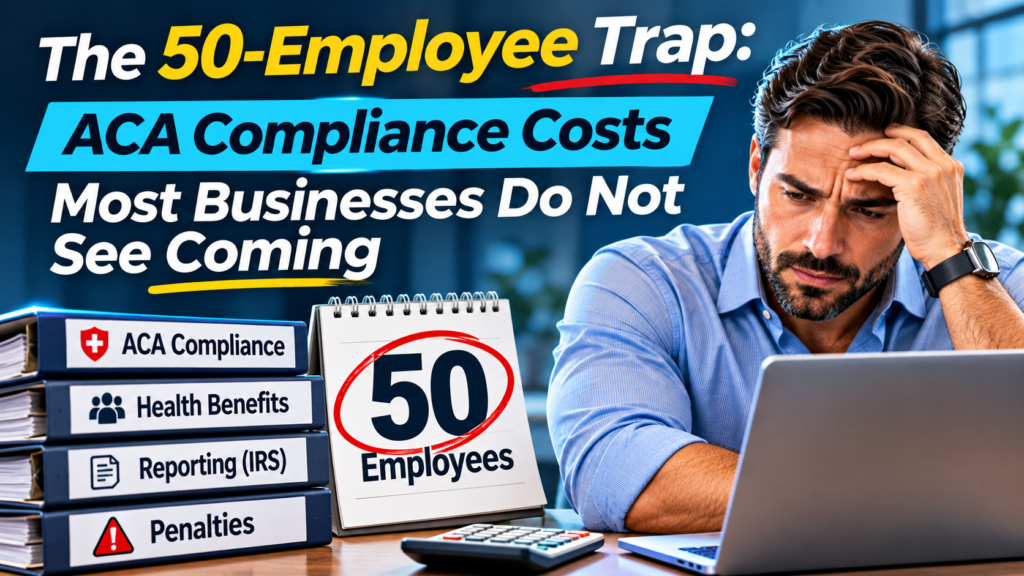
When your headcount crosses 50 full-time equivalent employees, the IRS classifies you as an Applicable Large Employer (ALE) under the Affordable Care Act — and the compliance costs that come with that label catch most growing businesses completely off guard. The affordability requirements, variable-hour tracking, and IRS reporting obligations represent a significant hidden cost that does not show up in a simple hiring plan. Understanding ACA compliance costs before you cross that threshold is the difference between a smooth growth year and a five-figure penalty bill.
Why 50 Employees Is a Legal Turning Point
The 50-employee threshold under the ACA is not a suggestion — it is a hard federal trigger. Under IRS Code Section 4980H, once you average 50 or more full-time equivalent (FTE) employees over the prior calendar year, you become an Applicable Large Employer. That status brings a set of mandatory obligations that simply do not exist for smaller employers.
Here is what changes overnight:
- You must offer health coverage to at least 95% of your full-time employees (those working 30+ hours per week) and their dependents up to age 26.
- That coverage must meet affordability standards — in 2026, an employee’s share of the lowest-cost single plan cannot exceed 9.02% of their household income (using IRS safe harbors).
- Coverage must meet minimum value — the plan must cover at least 60% of total allowed costs.
- You must file IRS Forms 1094-C and 1095-C annually, reporting health coverage details for every full-time employee.
Most business owners at 42 or 47 employees think they have time. The reality: the ACA counts your prior-year average, meaning you could already be an ALE right now without realizing it. According to the IRS ALE guidance, part-time and seasonal workers are converted into FTE equivalents and counted — which means a 38-person company with heavy part-time staff could already be above 50 FTEs on paper.
Worried about staying compliant as you grow? Our free PEO calculator shows what it costs to offload payroll, compliance, and HR to a PEO — 60 seconds, no call needed.
Breaking Down the Real ACA Compliance Costs
ACA compliance costs are not just about buying health insurance. They are about the operational infrastructure you need to stay legally protected. Here is where the money actually goes.
1. Variable-Hour Employee Tracking
The ACA requires you to track and measure hours for every variable-hour, part-time, and seasonal employee to determine whether they qualify as full-time. This is done through a formal measurement period — either a standard or initial measurement period lasting 3 to 12 months — followed by an administrative period and a stability period during which you must offer (or not offer) coverage based on what you measured.
If your payroll system is not built for this, you are looking at manual spreadsheet tracking, which introduces error risk — and errors lead to penalties. Upgrading to an ACA-compliant HR and payroll system typically costs $3,000 to $8,000 per year for a company your size, depending on the platform.
2. Affordability Calculation and Plan Design
The 2026 affordability threshold is 9.02% of an employee’s W-2 wages (one of three IRS safe harbors). You need someone — an HR professional or benefits advisor — to calculate the maximum employee contribution for every plan you offer, then verify your plans qualify as minimum value. Get this wrong and the IRS can assess a penalty of $4,460 per employee per year (2026 indexed amount) for plans that fail affordability — even if you offered coverage.
3. IRS Reporting: Forms 1094-C and 1095-C
Every ALE must file Form 1094-C (the transmittal) and a Form 1095-C for each full-time employee by the March 31 deadline for electronic filers. This is not a simple form — each 1095-C requires you to accurately code Line 14 (offer of coverage), Line 15 (employee required contribution), and Line 16 (safe harbor codes) for every month of the year.
Outsourcing this reporting to a CPA or benefits firm typically runs $2,000 to $6,000 annually for a 50-employee company. Doing it in-house requires significant staff time — industry estimates put it at 80 to 120 hours per year when you include data gathering, coding, employee distribution, and IRS filing.
4. ACA Penalty Exposure
The IRS enforces ACA compliance through Employer Shared Responsibility Payments (ESRP). There are two categories:
- 4980H(a) Penalty — “A” Penalty: Triggered if you fail to offer coverage to 95% of full-time employees and even one employee gets a premium tax credit on the marketplace. The 2026 penalty is approximately $2,900 per full-time employee (minus the first 30), annually.
- 4980H(b) Penalty — “B” Penalty: Triggered if you offer coverage but it fails affordability or minimum value and an employee gets a marketplace subsidy. The 2026 penalty is approximately $4,460 per affected employee annually.
For a 52-employee company, an “A” penalty would run roughly $63,800 per year. That is not a theoretical number — the IRS is actively issuing Letter 226-J notices to employers who undercounted their FTEs or missed filing deadlines. According to the Department of Labor, ACA enforcement activity has increased significantly heading into 2026.
DIY vs. PEO: What ACA Compliance Actually Costs You
Let us put real numbers on the table. Based on our analysis of 100+ PEO providers and the companies we have helped match, here is a realistic cost comparison for a 50-employee business managing ACA compliance.
| Compliance Task | DIY Annual Cost | Through a PEO |
|---|---|---|
| ACA-compliant payroll/HR system | $3,000–$8,000 | Included |
| Variable-hour tracking setup and maintenance | $2,000–$5,000 (staff time) | Included |
| 1094-C / 1095-C filing (outsourced or internal) | $2,000–$6,000 | Included |
| Benefits advisor / broker fees | $3,000–$10,000 | Included |
| HR staff time (compliance research, audits) | $5,000–$15,000 | Included |
| Penalty risk exposure (if errors occur) | $4,460–$63,800+ | PEO assumes liability |
| Total Estimated Annual Cost | $15,000–$44,000+ | $12,000–$24,000 (avg PEO fee) |
The cost of a PEO often comes out close to or below what you would spend managing compliance in-house — without the liability exposure. According to NAPEO research, businesses that use a PEO grow 7 to 9 percent faster and have 10 to 14 percent lower employee turnover than those that do not. The compliance infrastructure is one big reason why.
What Is a PEO and How Does It Handle ACA Compliance?
A Professional Employer Organization (PEO) is a company that co-employs your workforce alongside you, taking on the administrative and legal responsibilities of being an employer — including ACA compliance. You keep full control of your day-to-day operations and who you hire. The PEO handles payroll, benefits, HR compliance, tax filings, and reporting.
When it comes to ACA compliance costs specifically, a PEO:
- Tracks variable-hour employees through their platform automatically
- Calculates affordability for your workforce and flags issues before they become penalties
- Files 1094-C and 1095-C under their EIN in many arrangements, absorbing the filing obligation
- Provides access to large-group health insurance rates that can be 10 to 30 percent cheaper than what a 50-person company can negotiate directly
- Responds to IRS Letter 226-J notices on your behalf if they arise
If you are not familiar with PEOs yet, our guide to the best PEOs for small businesses is a good starting point. You can also see how specific providers handle these compliance layers in our comparison of Gusto and Justworks or our Insperity cost breakdown.
When Should You Start Preparing?
The answer is before you hit 50 employees — ideally when you are at 40 to 45. Here is why timing matters so much:
- The ACA looks at your prior calendar year average, so if you cross 50 FTEs this year, your obligations start January 1 of next year — but the measurement period that determines who gets coverage offers starts now.
- Setting up a compliant tracking system after the fact is expensive and creates retroactive risk.
- Health plan design needs to happen during open enrollment, which means you need your affordability calculations done months in advance.
- If you plan to use a PEO, onboarding takes 4 to 6 weeks — you want that done before the compliance clock starts ticking.
In our experience matching hundreds of businesses, the companies that call us at 42 employees have a smooth transition. The ones who call us at 52 employees — already in ALE status with no systems in place — are scrambling. Use our free PEO matching service to get ahead of it.
Bottom Line: The 50-Employee Threshold Is a Business Decision, Not Just an HR Problem
Crossing 50 employees is an exciting milestone. It means your business is growing, your team is expanding, and you are building something real. But the ACA compliance costs that come with that milestone are significant, concrete, and enforceable. The good news is that the infrastructure to handle them does not have to be built from scratch inside your company. A PEO can absorb the complexity, reduce your liability, and often lower your total cost at the same time.
You have built too much to let a compliance gap become a six-figure problem.
Ready to Stop Worrying About ACA Compliance?
Book a free 20-minute consultation with a PEO Marketplace advisor. We will review your headcount, your current HR setup, and match you with the right PEO for your industry and size — at no cost to you.
Not ready to book a call? Get a free Benefits Benchmark Report for your industry — we will email you a breakdown of what companies your size are paying for HR, benefits, and workers comp so you can compare on your own timeline.
Frequently Asked Questions
How does the ACA count employees to determine if I am an Applicable Large Employer?
The ACA counts full-time employees (averaging 30+ hours per week) plus full-time equivalents, which are calculated by adding all part-time hours in a month and dividing by 120. If your total averaged 50 or more FTEs across the prior calendar year, you are an ALE subject to ACA employer mandate requirements for the current year.
What is the ACA affordability threshold for 2026?
For 2026, a health plan is considered affordable under ACA rules if the employee’s required contribution for the lowest-cost single-coverage plan does not exceed 9.02% of their household income. Employers typically use one of three IRS safe harbors — W-2 wages, rate of pay, or federal poverty line — to establish affordability without knowing each employee’s actual household income.
What happens if I miss filing Forms 1094-C and 1095-C?
Failure to file or furnish correct 1095-C forms to employees can result in penalties of $310 per return in 2026, with a maximum annual penalty of $3,783,000 for large filers. Intentional disregard of the filing requirement raises the per-return penalty significantly higher, with no annual cap.
Can a PEO actually take on my ACA compliance liability?
Yes — in a co-employment arrangement, many PEOs file ACA reporting under their own EIN and assume responsibility for the accuracy of that filing, which shifts significant compliance liability away from you as the client employer. However, the specifics vary by PEO, so it is important to review the contract terms carefully, which is something PEO Marketplace helps clients do during the matching process.
Is it cheaper to manage ACA compliance in-house or through a PEO?
Based on our analysis of 100+ PEO providers and the businesses we match, most 40-to-55-employee companies spend $15,000 to $44,000 per year managing ACA compliance in-house when you account for software, staff time, outside advisors, and penalty risk — while a PEO typically costs $12,000 to $24,000 annually and includes compliance as part of the service. Use our free PEO cost calculator to run the numbers for your specific situation.