PEO Employee Benefits

Insperity and TriNet are two of the largest and most recognized PEOs in the United States, both targeting mid-market businesses that need robust HR infrastructure, enterprise-grade benefits, and dedicated support. Insperity leans toward high-touch service with a team-based support model, while TriNet is known for industry-specialized HR and a technology-forward platform. Depending on your company size, industry, and priorities, the right choice between these two can mean a significant difference in cost, service quality, and long-term satisfaction.


Who Are Insperity and TriNet?

Before diving into the head-to-head comparison, it helps to understand where each company comes from and who they are built for.


Insperity: The Full-Service Benchmark

Founded in 1986 and headquartered in Houston, Texas, Insperity is one of the oldest and most established PEOs in the country. They serve over 100,000 businesses and co-employ more than 2 million workers. Insperity is built around a high-touch, team-based service model — each client gets a dedicated HR team rather than a single point of contact. Their core sweet spot is companies with 50–5,000 employees, though they have products for smaller businesses too.


TriNet: The Industry Specialist

TriNet was founded in 1988 and is headquartered in Dublin, California. The company serves over 16,000 small and medium businesses across the U.S. and is publicly traded on the NYSE. TriNet differentiates itself by organizing its HR solutions around vertical industries — technology, financial services, life sciences, nonprofit, and professional services — giving clients access to benefits packages and compliance expertise tailored to their sector. Their sweet spot is companies with 20–500 employees.


Comparing PEOs is easier when you know your baseline cost. Our free calculator shows what a PEO would cost for your company in 60 seconds — no call needed.

Try the Free Calculator →

Insperity vs TriNet: Pricing Compared

Pricing is often the first question business owners ask, and neither Insperity nor TriNet makes it easy to get a straight answer upfront. Both use customized pricing based on headcount, industry, and benefits selections — but here is what we know based on our analysis of 40+ PEO providers and hundreds of client proposals.

Insperity Pricing

Insperity typically charges a per-employee-per-month (PEPM) fee ranging from $150 to $250 PEPM, depending on company size and selected services. Some pricing is structured as a percentage of payroll, typically in the range of 2–4%. Insperity’s pricing tends to run higher than average because it bundles extensive HR services, a dedicated HR team, and premium benefits access into the base cost. For a detailed cost breakdown, see our Insperity cost comparison guide.

TriNet Pricing

TriNet’s pricing is also customized but generally lands in the range of $125 to $200 PEPM, with some industry verticals priced higher due to premium benefits packages. TriNet has historically bundled its HR platform fees into the overall cost, though recent pricing models have moved toward more modular structures. Businesses in high-cost industries like tech or biotech may see TriNet pricing climb significantly due to the richer benefits offerings.

Side-by-Side Cost Overview

CategoryInsperityTriNet
Typical PEPM Range$150 – $250$125 – $200
Pricing ModelPEPM or % of payrollPEPM (modular)
Setup FeeVaries / negotiableVaries / negotiable
Mid-Market Sweet Spot50–5,000 employees20–500 employees
Price TransparencyLow (custom quotes)Low (custom quotes)

Neither provider publishes a price list publicly, so comparing them without a formal proposal is difficult. That is exactly where a PEO broker like PEO Marketplace can help — we pull competing proposals so you can see real numbers side by side.

Support Models: How Each PEO Handles Your Day-to-Day HR

Support quality is where Insperity and TriNet diverge most sharply, and it is often the deciding factor for business owners who have been burned by impersonal service at larger HR vendors.

Insperity’s Team-Based Support

Insperity assigns each client a dedicated HR team that includes an HR specialist, a payroll specialist, and an HR consultant. This team-based model means you are not relying on a single person and are not calling into a generic support queue. Insperity also maintains over 90 physical office locations across the U.S., which matters for companies that value in-person access. Client satisfaction scores for Insperity’s support model are consistently strong, and this is frequently cited as their top differentiator in client reviews.

TriNet’s Vertical-Specialist Support

TriNet assigns dedicated HR advisors to client accounts, and those advisors are organized by industry vertical. This means the HR rep supporting your tech startup understands stock options, multi-state remote hiring, and contractor classification issues that are common in that space — rather than giving you generic HR guidance. TriNet also offers 24/7 phone and digital support through their HR platform. The trade-off is that TriNet has fewer physical office locations and has occasionally received criticism for support responsiveness during high-volume periods.

Benefits Carriers and Coverage Quality

One of the primary reasons companies join a PEO is to access large-group health insurance that would otherwise be unavailable or unaffordable for a small or mid-size business. According to NAPEO, PEO clients save an average of 27% on health insurance costs compared to going it alone — and the carrier quality matters significantly.

Insperity Benefits

Insperity offers health benefits through major national carriers including UnitedHealthcare, Aetna, and Blue Cross Blue Shield. Their master health plan is the backbone of their benefits offering, and they provide access to competitive group rates due to the sheer size of their employee base — over 2 million co-employed workers. They also offer dental, vision, life insurance, disability coverage, HSAs, FSAs, and 401(k) plan administration. Their benefits are generally considered among the strongest in the PEO space.

TriNet Benefits

TriNet’s benefits strength lies in their industry-specific packaging. They work with carriers including Aetna, Kaiser, Blue Shield, and others depending on the vertical and geography. For tech companies, TriNet is particularly well-regarded for its ability to offer rich benefits packages that help startups compete with large employers for talent. They also offer a 401(k) through a third-party administrator and a robust employee perks platform. TriNet’s benefits are strong, but coverage options can vary more by region than Insperity’s more standardized national offering.

Technology Platforms: HR Software Comparison

Both Insperity and TriNet offer proprietary HR technology platforms, but they take different approaches to design and functionality.

Insperity Workforce Acceleration

Insperity’s platform — Workforce Acceleration — covers payroll, time and attendance, benefits administration, HR analytics, and performance management. The interface is functional and comprehensive, though some users find it less intuitive than newer SaaS-first platforms. Insperity has invested heavily in platform improvements in recent years and has added self-service features that reduce administrative burden. Integration with third-party tools like QuickBooks and ATS systems is available but can require setup support.

TriNet’s HR Platform

TriNet’s platform is generally regarded as more modern and user-friendly. It covers payroll processing, benefits enrollment, compliance management, time tracking, and HR reporting. TriNet has a mobile-first design and strong employee self-service capabilities, which is important for distributed and remote workforces — a common profile among their tech and professional services clients. Their platform also includes built-in tools for equity management and multi-state compliance, which are differentiators for growth-stage companies. For a broader look at how these platforms compare to other options, see our Gusto vs Justworks comparison.

Contract Terms and Exit Flexibility

Contract terms are an underappreciated factor when choosing a PEO, and both Insperity and TriNet have historically drawn criticism here.

Insperity Contract Terms

Insperity typically requires a one-year minimum contract with automatic renewal clauses. Termination requires 30–60 days written notice, and early termination fees can apply depending on how the agreement was structured. Insperity’s contracts are negotiable, particularly for larger clients, but the default terms favor the vendor. Always read the renewal and termination clauses carefully before signing.

TriNet Contract Terms

TriNet also uses annual contracts with similar 30–60 day notice requirements. One area where TriNet has drawn scrutiny is rate transparency — some clients have reported unexpected fee increases at renewal that were not clearly communicated. This is worth watching closely when reviewing any TriNet proposal. For a broader look at hidden fees in PEO contracts, our guide on hidden fees with ADP TotalSource covers the red flags that apply across the industry.

Insperity vs TriNet: Full Comparison Table

FeatureInsperityTriNet
Best ForCompanies wanting high-touch HR supportIndustry-specific HR needs
Support ModelDedicated HR teamIndustry-specialized HR advisor
Benefits CarriersUHC, Aetna, BCBSAetna, Kaiser, Blue Shield + others
TechnologyWorkforce Acceleration (comprehensive)TriNet Platform (modern UX)
Physical Offices90+ locations nationwideLimited physical presence
Contract LengthAnnual (negotiable)Annual (negotiable)
Pricing TransparencyLowLow
IRS Certified PEOYes (CPEO)Yes (CPEO)

Which PEO Should You Choose?

Based on our experience matching hundreds of businesses with PEO providers, here is the short version:

Choose Insperity if: You want the gold standard in hands-on HR service, you have 50–500+ employees, you value a dedicated HR team over a single account manager, or your workforce is geographically spread and you want local office access. Insperity’s support model is genuinely exceptional for companies that want HR to feel like an internal department, not a vendor helpdesk.

Choose TriNet if: You are in a specialized industry like tech, financial services, or life sciences, you want an HR platform that feels modern and mobile-friendly, or your benefits competition requires you to offer Silicon Valley-caliber perks to attract talent. TriNet’s vertical expertise is a real differentiator for companies where industry-specific compliance and compensation norms matter.

According to the U.S. Department of Labor, HR compliance errors cost businesses billions annually — and the right PEO reduces that exposure significantly. According to NAPEO research, businesses that use PEOs grow 7–9% faster and have 10–14% lower employee turnover. The question is not really whether to use a PEO — it is which one fits your business best. You can explore your options and get matched for free at our Find Your PEO service.

FAQ: Insperity vs TriNet

Is Insperity or TriNet more expensive?

Insperity generally runs slightly higher than TriNet on a per-employee-per-month basis, typically ranging from $150 to $250 PEPM compared to TriNet’s $125 to $200 PEPM range. However, final pricing for both providers is customized based on headcount, industry, and benefits selections, so you should always request competing proposals before making a decision.

Which PEO has better benefits: Insperity or TriNet?

Both offer access to major national carriers and large-group plan rates that small businesses cannot access on their own. Insperity offers more standardized national coverage through UnitedHealthcare, Aetna, and BCBS, while TriNet’s benefits shine in specific industries — particularly technology and financial services — where rich benefits packages are needed to attract competitive talent.

Do Insperity and TriNet require long-term contracts?

Both Insperity and TriNet typically require annual contracts with 30 to 60 days written notice for termination. Early termination fees may apply depending on the agreement terms. Contracts are often negotiable, especially for larger clients, so it is worth pushing back on renewal clauses and rate-lock provisions before signing.

Are Insperity and TriNet certified PEOs?

Yes, both Insperity and TriNet hold IRS Certified PEO (CPEO) status, which provides important tax protections for clients regarding federal employment tax liabilities. CPEO certification requires meeting strict financial, reporting, and background standards set by the IRS and is an important mark of credibility when evaluating any PEO.

How do I get the best deal on Insperity or TriNet?

The best way to get competitive pricing from either Insperity or TriNet is to have multiple PEO proposals in hand at the same time — providers negotiate more aggressively when they know they are competing. Working with a PEO broker like PEO Marketplace is free to the business owner, and we handle the proposal process across 40+ vetted providers so you can compare real numbers without the sales runaround. Use our free PEO cost calculator to get your baseline before any conversations start.

Ready to See How Insperity and TriNet Actually Price for Your Business?

We pull competing proposals from both — and 38 other vetted PEOs — so you can compare real numbers side by side. No sales pressure, no obligation.

Book a Free PEO Comparison Call →

Not ready to book a call? Get a free Benefits Benchmark Report for your industry — we will email you a breakdown of what companies your size are paying for HR, benefits, and workers comp so you can compare on your own timeline.

Get My Free Benchmark Report →

Best PEO for Restaurants & Food Service (2026)

A PEO for restaurants handles the HR, payroll, and compliance headaches that make running a food service operation so difficult — tip reporting, seasonal hiring spikes, high workers’ comp rates, and benefits for hourly staff. Based on our analysis of 100+ PEO providers, the right PEO can save a restaurant group 20–30% on workers’ comp premiums alone while keeping your business fully compliant with federal and state wage laws. This guide breaks down exactly what to look for in 2026.

Why Restaurants Need a Different Kind of PEO

Most PEOs are built for office-based businesses. Restaurants are a different animal. Your workforce is primarily hourly, tips create complex payroll compliance requirements, turnover routinely exceeds 70% annually according to the Bureau of Labor Statistics, and kitchen roles like line cooks and dishwashers carry some of the highest workers’ comp risk codes in any industry.

A generic PEO might handle standard payroll fine. But tip allocation errors, FICA Tip Credit miscalculations, or improperly classified seasonal staff can expose your restaurant to IRS audits and DOL investigations — penalties that can easily run into six figures. You need a PEO that has already solved these problems for food service clients at scale.

The Four Core Challenges a Restaurant PEO Must Solve

  • Tip reporting and FICA compliance — Accurate tip allocation, Form 8027 filing, and FICA Tip Credit maximization
  • Seasonal and high-turnover hiring — Rapid onboarding, easy offboarding, and ACA compliance for variable-hour workers
  • Kitchen staff workers’ compensation — Access to favorable rates in high-risk SIC codes (food preparation, cooking, bussing)
  • Hourly benefits that actually attract workers — Medical, dental, and voluntary benefits priced for part-time and hourly eligibility

Curious what a PEO would cost for a Restaurants & Food Service (2026) company? Our free calculator gives you a realistic cost range in under 60 seconds — no call, no commitment.

Try the Free Calculator →

Tip Reporting: The Compliance Minefield Most PEOs Miss

Tip reporting compliance is the single most common payroll failure point for restaurants. Under IRS rules, employers must report all tips received by employees — including credit card tips, cash tips, and tip pool distributions. The IRS requires that any food or beverage establishment with more than 10 employees file Form 8027 annually to report tip income versus charged receipts.

A strong PEO for restaurants will handle all of this automatically — allocating tips when reported tips fall below 8% of gross receipts, calculating FICA taxes on tip income, and managing the FICA Tip Credit (Section 45B), which can return thousands of dollars to your business at tax time. In our experience matching restaurants with PEOs, this credit alone often offsets a significant portion of PEO fees.

What to Ask Any PEO About Tip Reporting

  • Does your payroll system automatically calculate tip allocation when reported tips fall below IRS minimums?
  • Do you file Form 8027 on our behalf or does that fall to us?
  • How do you handle tip pooling arrangements — both traditional and tip credit models?
  • Do you proactively track and apply the FICA Tip Credit (Section 45B) to our payroll taxes?

Seasonal Workers and High Turnover: Hiring Without the Headache

Restaurant and food service businesses deal with workforce volatility that most employers never experience. Summer hiring surges, holiday rushes, and the reality that many employees stay less than 90 days mean your HR processes need to be fast, simple, and largely automated.

The best PEOs for food service offer mobile-first onboarding so a new line cook or server can complete their I-9, W-4, direct deposit setup, and benefits enrollment from their phone before their first shift. This matters in 2026 because candidates who encounter slow or paper-heavy onboarding often don’t show up at all.

ACA Compliance for Variable-Hour Employees

If any of your employees average 30 or more hours per week over a measurement period, they’re ACA-eligible — even if they’re technically “part-time.” For restaurants with large hourly workforces, this creates real exposure. According to the Department of Labor, failing to offer compliant coverage to eligible employees can result in employer shared responsibility payments of $2,900+ per full-time employee per year.

A restaurant-savvy PEO will automatically track hours across your variable workforce, flag employees approaching ACA eligibility thresholds, and manage the look-back measurement periods required under the monthly measurement or look-back methods — so you don’t get a surprise penalty letter 18 months after the fact.

Kitchen Staff Workers’ Comp: Getting the Right Rate

Workers’ compensation is a major cost center for food service operators. Kitchen roles — cooks, prep workers, dishwashers, delivery drivers — carry high-risk classification codes that result in elevated premiums. A restaurant owner buying workers’ comp on their own is often stuck with standard market rates. A PEO changes that equation.

Because PEOs co-employ your workforce, they aggregate headcount across hundreds or thousands of client businesses. This buying power lets them access better workers’ comp rates through their master policy, even for high-risk codes. In our experience matching food service businesses, restaurant operators frequently see workers’ comp savings of 15–35% after joining a PEO — sometimes more when there’s a clean claims history.

Workers’ Comp Features That Matter for Restaurants

  • Pay-as-you-go workers’ comp — Premiums calculated on actual payroll each period, eliminating large upfront deposits and year-end audits
  • Claims management support — Dedicated claims specialists who handle injured worker coordination so you’re not navigating it alone
  • Safety resources and training — Slip-and-fall prevention, knife safety, and burn protocols that reduce claim frequency over time
  • Return-to-work programs — Light-duty options that get injured employees back faster and reduce total claim costs

Benefits That Actually Attract and Retain Hourly Workers

Offering benefits used to be a differentiator for restaurants. In 2026, it’s table stakes for retention. According to NAPEO, businesses that use a PEO experience 10–14% lower employee turnover — a meaningful number when replacing a single server or cook can cost $3,000–$5,000 in recruiting and training time.

The key is finding a PEO that offers benefits packages designed for mixed workforces — full-time kitchen managers eligible for rich medical plans alongside part-time servers who need affordable access to voluntary benefits like telemedicine, dental, and hospital indemnity. Not every PEO structures benefits this way, and forcing a one-size plan onto a restaurant workforce often means either over-spending or under-serving your team.

Benefits to Look for in a Restaurant PEO

  • Tiered medical plans with low-cost options for hourly employees
  • Telemedicine and mental health access (increasingly expected by younger food service workers)
  • Voluntary benefits: dental, vision, life, short-term disability
  • 401(k) access — a strong recruiting tool even for hourly staff
  • Earned wage access (EWA) / on-demand pay options

PEO Comparison: What Matters Most for Food Service

FeatureMust-Have for RestaurantsNice to HaveWatch Out For
Tip ReportingAutomated allocation + Form 8027FICA Tip Credit trackingManual tip entry only
Workers’ CompPay-as-you-go, high-risk codes coveredSafety training resourcesExcluded kitchen classifications
OnboardingMobile-first, same-day capableBilingual supportPaper-heavy processes
BenefitsTiered plans for hourly + FTEarned wage accessOne-plan-fits-all structures
ACA TrackingAuto hours tracking + alertsLook-back period managementManual hour monitoring
Pricing ModelPer-employee flat fee or % of payrollVolume discounts for seasonal spikesHidden fees on tip payroll runs

If you’re weighing specific providers, our Gusto vs. Justworks comparison covers two popular options for smaller restaurant groups. For mid-size or multi-location operators, the Insperity cost comparison is worth reading before you commit. And if you’re looking at larger national providers, check out our breakdown of hidden fees with ADP TotalSource before signing anything.

How to Choose the Right PEO for Your Restaurant

Choosing the right PEO for restaurants comes down to matching the provider’s strengths to your specific operational profile. A single fast-casual location with 15 employees has different needs than a 12-location full-service group with 400 hourly workers and tip pooling across every site.

Here’s a practical framework for your evaluation:

  1. Define your non-negotiables — Tip reporting automation and kitchen workers’ comp coverage should be at the top of every restaurant operator’s list
  2. Get quotes from at least 3 PEOs — Pricing in the restaurant space varies significantly; use our PEO cost calculator to get a baseline before you start calls
  3. Ask for food service references — A PEO that can’t name restaurant clients they’ve served for 2+ years probably isn’t your best fit
  4. Review the contract for exclusions — Some PEOs exclude certain workers’ comp classification codes; make sure your kitchen roles are fully covered
  5. Evaluate implementation support — The first payroll run with tip income is where most transitions stumble; ask specifically how they handle the cutover

Working with a PEO broker like PEO Marketplace takes most of this off your plate. We’ve already vetted 40+ providers on exactly these criteria, and we match you with the two or three best fits for your situation — free, with no obligation. You can start your search here.

Frequently Asked Questions

Can a PEO handle tip reporting and FICA Tip Credit for my restaurant?

Yes — the best PEOs for restaurants include automated tip reporting, tip allocation calculations, and proactive tracking of the Section 45B FICA Tip Credit, which can significantly reduce your annual tax burden. Make sure to confirm these features explicitly during your evaluation, as not every PEO supports them natively.

How does a PEO reduce workers’ comp costs for kitchen staff?

A PEO co-employs your workforce and pools headcount across hundreds of client businesses, giving it leverage to negotiate lower workers’ comp rates — even for high-risk kitchen classifications like cooks and dishwashers. Pay-as-you-go workers’ comp through a PEO also eliminates large upfront deposits and year-end audit surprises that are common when restaurants buy coverage independently.

Are PEOs worth it for restaurants with mostly part-time or seasonal workers?

PEOs are often especially valuable for high-turnover, part-time-heavy workforces because they automate onboarding, ACA eligibility tracking, and offboarding — tasks that consume disproportionate HR time in restaurant environments. According to NAPEO, PEO clients experience 10–14% lower employee turnover, which translates directly to lower recruiting and training costs in food service.

What is the average cost of a PEO for a restaurant?

PEO pricing for restaurants typically runs $80–$180 per employee per month depending on the provider, your headcount, and the services included — with workers’ comp often bundled in. Use our free PEO calculator to get a more precise estimate based on your actual employee count and payroll before comparing provider quotes.

Do PEOs work for multi-location restaurant groups?

Yes, and multi-location operators often see the greatest benefit because a PEO creates consistent HR, payroll, and compliance processes across all locations under one system. It also simplifies multi-state compliance for groups that operate across different jurisdictions with varying tip credit laws and minimum wage rules.

Ready to Find the Right PEO for Your Restaurant?

Our team has matched hundreds of food service businesses with PEOs that actually understand tip reporting, kitchen workers’ comp, and hourly benefits. It’s free, unbiased, and takes about 15 minutes.

Book a Free PEO Consultation →

Not ready to book a call? Get a free Benefits Benchmark Report for your industry — we will email you a breakdown of what companies your size are paying for HR, benefits, and workers comp so you can compare on your own timeline.

Get My Free Benchmark Report →

Justworks vs ADP TotalSource: Quick Answer

Justworks is a transparent, flat-rate PEO built for small businesses that want predictable pricing and a clean self-service platform. ADP TotalSource is a full-service PEO with deep HR infrastructure, better suited to mid-size and growing companies that need customization and can navigate a bundled pricing model. Which one wins for your business depends almost entirely on your headcount, HR complexity, and tolerance for pricing opacity.

If you’re researching Justworks vs ADP TotalSource for 2026, this side-by-side breakdown covers the pricing models, benefits quality, technology, contract flexibility, and the company size each PEO actually serves best — based on our experience matching hundreds of businesses across 40+ vetted PEO providers.

Why the PEO You Choose Matters More Than You Think

A PEO (Professional Employer Organization) becomes your co-employer — handling payroll, benefits administration, workers’ comp, and HR compliance under a shared employer arrangement. According to NAPEO, businesses that use PEOs grow 7–9% faster and have 10–14% lower employee turnover than non-PEO companies. The catch: not every PEO is built for every business. A mismatch on pricing model, benefits, or tech can cost you time, money, and employee trust.

Both Justworks and ADP TotalSource are IRS-certified PEOs — a credential that matters for tax compliance and liability protection. But they operate very differently. Here’s how they stack up.

Comparing PEOs is easier when you know your baseline cost. Our free calculator shows what a PEO would cost for your company in 60 seconds — no call needed.

Try the Free Calculator →

Pricing: Transparent Flat-Rate vs Bundled Percentage Model

This is the biggest practical difference between Justworks and ADP TotalSource, and it affects how you budget from day one.

Justworks Pricing

Justworks uses a per-employee-per-month (PEPM) flat-rate model with pricing published on their website — a rarity in the PEO industry. As of 2026, Justworks charges roughly $59–$99 PEPM depending on your plan tier and company size, with the lower rate kicking in at 50+ employees. The Basic plan covers payroll, compliance, and access to benefits. The Plus plan adds medical, dental, and vision administration.

What you see is largely what you pay. There are some add-ons for workers’ comp and 401(k), but the core fees are predictable and easy to model. This is ideal for founders and small business owners who want to budget HR costs without scheduling a discovery call first.

ADP TotalSource Pricing

ADP TotalSource uses a bundled percentage-of-payroll model, typically ranging from 2–4% of total payroll, though exact pricing is quote-based and varies significantly by industry, headcount, and benefits elections. This means your PEO costs grow automatically as you hire and give raises — something that catches many growing companies off guard.

ADP bundles a wide range of services into that percentage, including HR advisory support, risk management, workers’ comp, and its proprietary HR tech suite. But because the pricing isn’t transparent upfront, it’s harder to compare on an apples-to-apples basis. We’ve covered the hidden fees in ADP TotalSource in detail — worth reading before you sign anything.

Side-by-Side Pricing Comparison

FactorJustworksADP TotalSource
Pricing ModelFlat PEPM% of payroll
Pricing TransparencyPublished onlineQuote-based only
Typical Cost Range$59–$99 PEPM2–4% of payroll
Scales With RaisesNoYes
IRS-Certified PEOYesYes

Company Size Fit: Who Each PEO Actually Serves Best

Company size is the single fastest filter when choosing between these two providers.

Justworks: Best for 1–200 Employees

Justworks was built for startups and small businesses. The platform is intuitive enough that a non-HR founder can run payroll and onboard employees without dedicated HR staff. Their support model leans on self-service and chat, which works well when your HR questions are fairly standard. If you have fewer than 50 employees, Justworks is one of the most cost-effective PEOs on the market. Beyond 200 employees, you may start to feel the limits of their customization and dedicated service options.

ADP TotalSource: Best for 50–5,000 Employees

ADP TotalSource is built to scale. With dedicated HR business partners, robust compliance support across all 50 states, and deep integration with ADP’s broader payroll and HR ecosystem, it’s better equipped for companies with complex org structures, multi-state employees, or industry-specific compliance needs. If you’re in construction, healthcare, or manufacturing — sectors with heavier workers’ comp and regulatory exposure — ADP’s risk management infrastructure is a meaningful advantage. See how ADP stacks up against Insperity if you’re also considering that tier of provider.

Benefits: Coverage Quality and Carrier Access

One of the core PEO value propositions is access to large-group health insurance rates that small businesses can’t get on their own. Both Justworks and ADP TotalSource deliver this, but in different ways.

Justworks Benefits

Justworks offers medical, dental, and vision through major carriers including Aetna, United Healthcare, and Kaiser (in select markets). The plan selection is solid but curated — you’re choosing from pre-packaged options rather than designing a custom benefits strategy. This is fast and easy to manage, but limits flexibility for companies with specific workforce demographics or benefit philosophy preferences. Justworks also offers a 401(k) through Slavic401k and access to commuter benefits and FSAs.

ADP TotalSource Benefits

ADP TotalSource provides a broader carrier selection and more plan options, including ancillary benefits like life insurance, disability, and employee assistance programs (EAPs). Dedicated benefits consultants help design packages that align with your company culture and industry norms. For companies competing for talent in tight labor markets, this deeper benefits bench matters. The Bureau of Labor Statistics Employee Benefits Survey consistently shows that health insurance remains the top driver of employee satisfaction — and ADP gives you more tools to compete on this front.

Technology: Platform Experience and HR Tools

Justworks Platform

Justworks has one of the cleanest user interfaces in the PEO space. The employee-facing portal is modern, mobile-friendly, and easy to navigate without training. Payroll runs are simple. Onboarding is mostly self-service. Time tracking is available as an add-on. If your team is remote-first and tech-comfortable, Justworks feels native to that environment. The platform does less than ADP’s enterprise suite, but what it does, it does cleanly.

ADP TotalSource Technology

ADP TotalSource runs on ADP Workforce Now, a full-featured HRIS that handles payroll, time and attendance, performance management, learning, and analytics in one system. It’s powerful, but it has a steeper learning curve. For companies that need robust reporting, multi-location management, or integrations with enterprise software (ERP, accounting platforms, etc.), Workforce Now is a stronger fit. Smaller teams or less tech-fluent HR staff may find the interface overwhelming at first.

Contract Flexibility and Exit Terms

Contract flexibility is often overlooked until it matters — usually when you need to leave.

Justworks

Justworks operates on a month-to-month basis after an initial onboarding period, with relatively straightforward exit terms. This is a genuine competitive advantage for early-stage companies that don’t want to be locked in long-term. You can offboard without significant penalty, which reduces the risk of trying the platform.

ADP TotalSource

ADP TotalSource typically requires an annual contract, and early termination fees can apply. Migration off the platform takes planning, especially if you’re moving payroll history and benefits data. This isn’t unusual for enterprise-grade PEOs, but it’s worth negotiating clearly upfront. If you want to understand what to watch for in the contract language, our guide on ADP TotalSource hidden fees covers the key clauses.

Full Comparison Table: Justworks vs ADP TotalSource (2026)

CategoryJustworksADP TotalSource
Best Company Size1–200 employees50–5,000 employees
Pricing Transparency✅ High❌ Low
Benefits DepthGood (curated)Excellent (customizable)
Technology Ease of Use✅ Very easy⚠️ Powerful but complex
HR Support ModelSelf-service + chatDedicated HR business partner
Multi-State ComplianceGoodExcellent
Contract Flexibility✅ Month-to-month⚠️ Annual contract
IRS-Certified PEO✅ Yes✅ Yes
Workers’ Comp CoverageAdd-onIncluded in bundle

Which PEO Should You Choose?

Based on our analysis of 40+ PEO providers and the businesses we’ve matched, here’s the honest summary:

Choose Justworks if: You have fewer than 150 employees, want upfront pricing, prefer a modern self-service platform, and value flexibility over enterprise depth. It’s particularly strong for tech startups, professional services firms, and remote-first teams.

Choose ADP TotalSource if: You have 75+ employees, operate across multiple states, need a dedicated HR partner, or are in a regulated or high-risk industry. The bundled model is less transparent but more comprehensive, and the scale of ADP’s infrastructure is genuinely useful as you grow.

Neither is a bad choice — but picking the wrong one for your stage means paying for features you don’t need, or outgrowing your provider faster than you expect. If you’re also weighing other options, our Justworks vs Gusto comparison and our guide to finding the right PEO for your business can help narrow the field further. You can also use our free PEO cost calculator to model what either option would cost for your headcount before getting on a single sales call.

The IRS maintains a list of certified PEOs — verifying certification is a non-negotiable first step before signing with any provider.

Frequently Asked Questions

Is Justworks or ADP TotalSource better for small businesses?

Justworks is generally the better fit for small businesses under 150 employees because its flat-rate pricing is predictable, the platform is easy to use without dedicated HR staff, and its month-to-month flexibility reduces commitment risk. ADP TotalSource becomes more competitive as headcount grows and HR complexity increases.

How does ADP TotalSource pricing work compared to Justworks?

ADP TotalSource charges a percentage of total payroll — typically 2–4% — bundled with a wide range of HR services, though the exact rate requires a custom quote. Justworks charges a flat per-employee-per-month fee that is published online, making it much easier to estimate costs before speaking with a sales rep.

Can I switch from Justworks to ADP TotalSource if my company grows?

Yes, businesses routinely migrate from one PEO to another as their needs evolve, though the transition requires careful planning around payroll history, benefits continuity, and contract timing. Working with an independent PEO broker can help you time and manage the transition without disruption to employees.

Do both Justworks and ADP TotalSource offer health insurance benefits?

Both PEOs provide access to major medical, dental, and vision plans through large-group carrier agreements that give small businesses access to better rates than they could secure independently. ADP TotalSource offers a broader and more customizable benefits menu, while Justworks provides a solid curated selection that is faster to set up and administer.

What is an IRS-certified PEO and why does it matter?

An IRS-certified PEO (CPEO) has met rigorous financial, reporting, and background standards set by the IRS, and is solely responsible for paying federal employment taxes on wages it pays to worksite employees. Certification protects businesses from certain tax liabilities that can arise with non-certified PEO arrangements — both Justworks and ADP TotalSource hold this certification.

Not Sure Which PEO Is Right for You?

Our team has matched hundreds of businesses with the right PEO across 40+ vetted providers — with no sales pressure and no cost to you. Book a free 15-minute consultation and we’ll tell you exactly which PEO fits your company size, industry, and budget.

Book My Free PEO Consultation →

Not ready to book a call? Get a free Benefits Benchmark Report for your industry — we will email you a breakdown of what companies your size are paying for HR, benefits, and workers comp so you can compare on your own timeline.

Get My Free Benchmark Report →

A PEO workers comp program pools your employees under the PEO’s master insurance policy, which means you get large-group rates, pay-as-you-go billing, and professional claims management. For most small and mid-size businesses, this alone can cut workers comp costs by 15–30% compared to buying coverage on the open market. Here is exactly how it works and why it matters for your bottom line.

What Is PEO Workers Comp and How Does It Work?

PEO workers comp is coverage provided through a Professional Employer Organization’s master insurance policy rather than a standalone policy you purchase directly from an insurer. When you co-employ your workforce through a PEO, your employees are added to the PEO’s existing policy — one that covers tens of thousands of workers across dozens of industries. That scale is the entire game.

Here is the mechanics in plain terms:

  • You join the master policy. Instead of applying for your own workers comp policy with your own claims history front and center, you are underwritten as part of a much larger pool. Insurers view large, diversified pools as lower risk.
  • Your premiums are calculated on actual payroll. Pay-as-you-go billing means your workers comp premium is deducted each payroll cycle based on real wages — not a lump-sum estimate you reconcile at year-end.
  • The PEO manages claims. When an employee is injured, the PEO’s dedicated risk management and claims team handles the process — from first report of injury through return-to-work coordination.
  • Your experience modification rate is protected. More on this below, but in many PEO arrangements your individual experience mod is either blended into the master policy or managed in a way that shields your future premiums from a single bad year.

According to NAPEO, businesses that use a PEO grow 7–9% faster and have 14% lower employee turnover than non-PEO companies. A big part of that stability is predictable, affordable insurance costs — and workers comp is usually the first place savings show up.

Overpaying for workers comp is more common than most businesses think. Our free PEO calculator breaks down what you would actually pay through a PEO — try it in 60 seconds.

Try the Free Calculator →

The Experience Modification Rate: Why It Kills Small Business Premiums

Your experience modification rate — or experience mod — is a multiplier applied to your workers comp base premium. A mod of 1.0 is average. If yours is 1.25, you pay 25% more. If it is 0.80, you pay 20% less. The problem for small businesses is volatility: one serious injury claim can spike your experience mod for three years and make coverage extremely expensive — or in some cases nearly impossible to obtain.

How PEOs Reduce Experience Mod Risk

When your employees are covered under a PEO’s master policy, the calculation works differently depending on the PEO structure. In a fully bundled master policy arrangement, your claims experience is blended across the entire PEO client base. One bad year for your company does not crater your mod the way it would on a standalone policy. Some PEOs operate under a guaranteed-cost program where your rate is locked regardless of individual claims activity during the policy year.

In our experience matching hundreds of businesses with PEOs, companies in industries with high baseline workers comp rates — construction, manufacturing, home health care, landscaping — see the most dramatic savings. A roofing company paying $18 per $100 of payroll on an open-market policy might pay $11–$13 per $100 through a PEO master policy. That difference compounds quickly across a 20-person crew.

What Happens to Your Mod When You Leave a PEO?

This is a critical question most brokers do not bring up. If you have been under a PEO’s master policy for several years, you may not have built up your own individual experience mod record. When you exit the PEO, your new standalone policy may start you at a neutral 1.0 mod — or in some states, the insurer will reconstruct your history using the claims data from your PEO years. This is not necessarily bad, but you need to understand it before you exit. Always request your loss runs before transitioning.

Pay-As-You-Go Workers Comp: Eliminating the Audit Problem

Traditional workers comp policies require you to estimate your annual payroll at the start of the policy year and pay premiums based on that estimate. At year-end, the insurer audits your actual payroll and you either owe more money or receive a refund. These audits are stressful, time-consuming, and often result in unexpected bills — sometimes months after your policy year closes.

PEO workers comp eliminates this entirely through pay-as-you-go billing integrated directly into payroll.

How Pay-As-You-Go Works in Practice

  • Each payroll run, the PEO calculates your workers comp premium based on actual gross wages by employee classification code.
  • The premium is collected at the same time as payroll taxes and benefits deductions.
  • Because premiums track real payroll in real time, there is no year-end audit shortfall.
  • Seasonal businesses and companies with variable headcount benefit most — you never overpay during slow months or get caught underpaying during a busy hiring surge.

The U.S. Department of Labor notes that workers comp compliance obligations vary significantly by state, and pay-as-you-go systems help ensure businesses stay current without manual intervention. For businesses operating in multiple states, the PEO handles different state rate schedules automatically — a compliance headache that disappears entirely.

Claims Management: The Hidden Value Most Businesses Miss

Workers comp premiums are only part of the cost equation. How claims are handled — and how quickly — has a direct impact on your total cost of risk. Poorly managed claims drag out, inflate medical costs, and drive up your mod for years.

What PEO Claims Management Includes

Reputable PEOs assign dedicated risk management professionals to their client base. When a workplace injury occurs, the PEO’s team typically:

  • Files the first report of injury with the insurer promptly (delays increase claim costs significantly)
  • Coordinates medical treatment with preferred provider networks, which reduces medical costs
  • Manages return-to-work programs to reduce lost-time days — lost-time claims cost 3–5x more than medical-only claims according to industry benchmarks
  • Disputes fraudulent or inflated claims on your behalf
  • Tracks OSHA recordables and helps you manage your injury log correctly

Based on our analysis of 40+ PEO providers, claims management quality varies considerably. National PEOs like Insperity and ADP TotalSource have large dedicated risk teams. Smaller regional PEOs may outsource claims handling. When comparing PEOs, always ask who handles claims — and how. You can see how these providers compare on cost and service in our Insperity cost comparison guide.

PEO Workers Comp Cost Comparison

To make this concrete, here is how PEO workers comp stacks up against traditional coverage options across several key dimensions:

FactorStandalone PolicyPEO Master Policy
Premium RatesMarket rate based on your individual historyGroup rates — often 15–30% lower
Billing MethodAnnual estimate + year-end auditPay-as-you-go, each payroll cycle
Experience Mod ExposureHigh — one claim can spike your mod for 3 yearsReduced — blended into master policy pool
Claims ManagementYou manage or hire a TPAHandled by PEO risk team
Multi-State ComplianceSeparate policies per state requiredCovered under single master policy
Year-End AuditYes — potential for surprise billsNo — eliminated by real-time billing
Best ForBusinesses with excellent mod and stable payrollMost small/mid-size businesses, high-risk industries

Which Businesses Benefit Most from PEO Workers Comp?

Not every business is in the same position, but PEO workers comp tends to deliver the biggest wins for:

  • High-risk industries — Construction, roofing, landscaping, manufacturing, home health, trucking, and staffing companies where open-market rates are high and insurers are selective.
  • Businesses with a checkered claims history — If your experience mod is above 1.0 and rising, pooling into a master policy can stabilize your costs immediately.
  • Fast-growing companies — Payroll estimates become inaccurate quickly when you are hiring rapidly. Pay-as-you-go eliminates the reconciliation problem.
  • Multi-state employers — Managing separate workers comp policies with different state rate schedules, forms, and compliance requirements is a significant administrative burden that disappears under a PEO.
  • Companies with fewer than 100 employees — Small employers lack the bargaining power to negotiate better rates. The PEO’s scale does that for them.

If you want to compare how specific PEOs price workers comp alongside their full HR service packages, our Gusto vs. Justworks comparison is a useful starting point for smaller businesses, and our free PEO matching service can identify which providers fit your industry and headcount.

It is also worth noting that the IRS has a formal certification program for PEOs (CPEO status) that provides additional employer tax protections. Working with a CPEO adds a layer of compliance assurance that standalone workers comp policies cannot offer.

What to Ask Before Choosing a PEO for Workers Comp

Based on our analysis of 40+ PEO providers, here are the questions that separate good deals from great ones:

  1. Is workers comp included in the PEO fee or billed separately? Some PEOs bundle it; others pass through the actual premium as a separate line item. Know what you are paying for.
  2. Who is the underlying insurer? A financially stable A-rated carrier matters. Ask for the carrier name and rating.
  3. How are claims handled — in-house or outsourced? In-house risk teams generally produce better outcomes.
  4. What is your experience with my industry classification codes? A PEO that covers many construction companies understands construction risk. Generalists may not.
  5. What happens to my loss runs when I leave? Get this in writing before you sign.

Use our free PEO cost calculator to get a baseline estimate before you start talking to providers — it takes 60 seconds and gives you a number to negotiate against.

Book a Free PEO Consultation

PEO workers comp is one of the most powerful cost levers available to small and mid-size businesses — but only if you choose the right provider for your industry and risk profile. At PEO Marketplace, we match businesses with vetted PEOs from our network of 40+ providers at no cost to you. We know which ones have the strongest risk management programs, the most competitive master policy rates, and the best claims outcomes for your specific industry.

Schedule Your Free PEO Consultation →

Not ready to book a call? Get a free Benefits Benchmark Report for your industry — we will email you a breakdown of what companies your size are paying for HR, benefits, and workers comp so you can compare on your own timeline.

Get My Free Benchmark Report →

Frequently Asked Questions

Does a PEO workers comp policy replace my own policy?

Yes. When you join a PEO, your employees are covered under the PEO’s master workers comp policy and you typically cancel your standalone policy. You are no longer the policyholder — the PEO is — which is why you benefit from their group rates and claims infrastructure rather than your own individual policy terms.

Will my workers comp rates go up if one of my employees files a claim?

In most PEO master policy arrangements, your individual claims are blended into the larger pool, which significantly reduces the impact on your costs compared to a standalone policy where a single serious claim can raise your experience mod for three consecutive years. The exact impact depends on your PEO’s policy structure, so it is worth asking your PEO how individual client claims affect pricing at renewal.

Can a PEO get me workers comp coverage if I have been denied on the open market?

Often, yes. Because PEOs underwrite coverage at the master policy level across thousands of employees, they can typically provide coverage to businesses that have been declined by standard carriers due to claims history or high-risk classification codes. This is one of the most common reasons businesses in construction, roofing, and home health seek out a PEO.

What is pay-as-you-go workers comp and why does it matter?

Pay-as-you-go workers comp means your insurance premium is calculated and collected each payroll cycle based on actual wages rather than an annual lump-sum estimate. This eliminates the year-end audit process, prevents surprise bills when your payroll grows faster than projected, and improves cash flow by spreading premium payments evenly throughout the year.

How do I know if a PEO is saving me money on workers comp versus my current policy?

Request your current policy’s rate per $100 of payroll by class code, then ask any PEO you are evaluating for their equivalent rate — making sure both quotes use the same class codes. You can also use our free PEO cost calculator at peo-marketplace.com to get an instant estimate of potential savings before you start the formal quoting process.

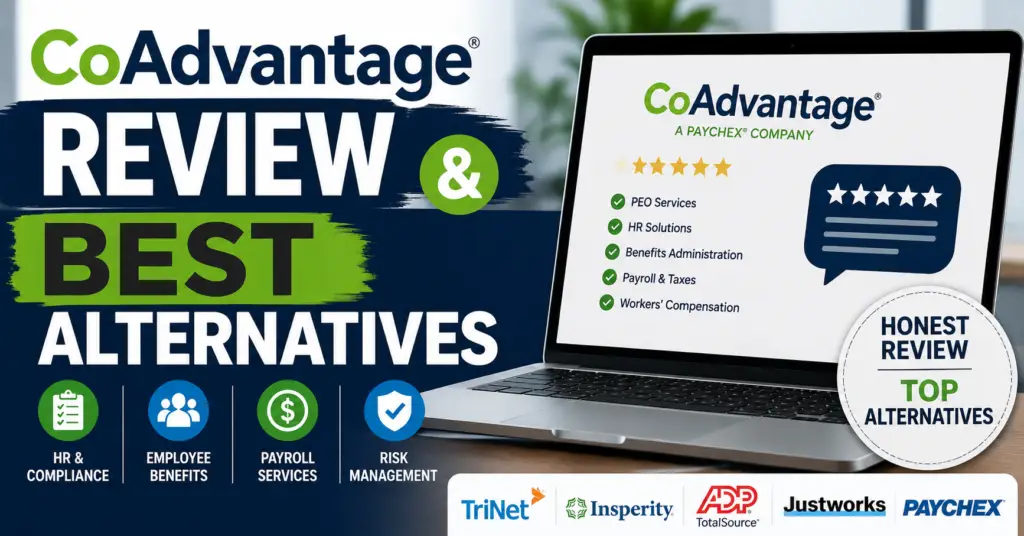
CoAdvantage is a regional PEO with a strong foothold in the Southeast U.S., offering payroll, HR administration, benefits, and workers’ compensation to small and mid-size businesses. It’s a solid mid-market option for companies that want dedicated support without the enterprise price tag — but it’s not the right fit for everyone. This CoAdvantage review breaks down real pricing, honest pros and cons, and the top three alternatives so you can make a confident decision in 2026.

What Is CoAdvantage and How Does It Work?

CoAdvantage is a Professional Employer Organization (PEO) headquartered in Tampa, Florida. Founded in 1994, it operates as a co-employer — meaning it legally shares employer responsibilities with your business. Under this model, CoAdvantage handles payroll processing, tax filings, benefits administration, HR compliance, and workers’ comp coverage, while you retain full control over day-to-day operations and hiring decisions.

According to NAPEO, businesses that use a PEO grow 7–9% faster and have 10–14% lower employee turnover than those that don’t. CoAdvantage aims to deliver those results specifically for businesses with 10 to 150 employees, particularly in industries like construction, professional services, healthcare, and hospitality.

CoAdvantage is IRS-Certified (CPEO) and ESAC-accredited — two credibility markers that matter when you’re handing over payroll and benefits responsibilities. Not every PEO holds both, so this puts CoAdvantage in a trusted tier of the market.

Not sure if a PEO makes sense for your business? Our free calculator shows you the real cost in 60 seconds — no call, no email, no commitment.

Try the Free Calculator →

CoAdvantage Pricing: What Does It Actually Cost?

CoAdvantage does not publish pricing on its website — which is common across the PEO industry but still frustrating for business owners doing early-stage research. Based on our analysis of 100+ PEO providers and direct market data, here is what you can realistically expect:

  • Per-employee, per-month (PEPM) model: Typically $125–$175 per employee per month for core HR and payroll services
  • Percentage of payroll model: Some clients are quoted 3%–6% of gross payroll, depending on employee count and benefits elected
  • Minimum headcount: CoAdvantage generally works best with 10+ employees; smaller teams may find pricing less competitive
  • Benefits costs: Quoted separately based on plan selections — CoAdvantage pools employees across clients for group buying power

There are also setup fees and potential add-on costs for things like HR consulting, time and attendance software, or ACA compliance reporting. Always request a fully itemized quote and ask specifically what is and isn’t included in the base fee. If you want a benchmark before that conversation, our free PEO cost calculator gives you a realistic range in under a minute.

CoAdvantage Pros: What It Does Well

Dedicated HR Support

CoAdvantage assigns dedicated HR account managers rather than routing you through a generic call center. For small businesses without an in-house HR team, this is a meaningful differentiator. You get a real person who knows your account and can advise on compliance, terminations, and employee issues — not just process transactions.

Strong Southeast Regional Presence

If your business is based in Florida, Georgia, Texas, or another Southeast or Sun Belt state, CoAdvantage has deep expertise in local labor law compliance, state tax nuances, and workers’ comp regulations in those markets. Regional expertise reduces compliance risk for businesses operating in those states.

CPEO and ESAC Accreditation

CoAdvantage holds IRS Certified PEO (CPEO) status and ESAC accreditation. CPEO status means the IRS has vetted their financial controls and compliance practices — a meaningful assurance that your payroll tax obligations are protected. Per the IRS, CPEO status transfers federal employment tax liability to the PEO, which is a significant protection for clients.

Workers’ Comp Coverage Access

For industries like construction, landscaping, and healthcare where workers’ comp rates are high, CoAdvantage’s group purchasing power can deliver real savings. Clients pay into a shared pool rather than shopping individually, which lowers rates for higher-risk employee classifications.

Mid-Market Sweet Spot

CoAdvantage is built for companies in the 10–150 employee range. Larger PEOs like ADP TotalSource or Insperity often prioritize enterprise clients, leaving smaller businesses feeling under-served. CoAdvantage tends to give mid-market clients more attention and more customized service than you might get at a giant national platform.

CoAdvantage Cons: Where It Falls Short

Technology Platform Limitations

CoAdvantage’s HR technology platform has historically lagged behind competitors like Rippling, Justworks, and even Gusto. The self-service employee portal and mobile app experience are functional but not modern. If your team expects a sleek, app-first HR experience, CoAdvantage may feel dated compared to tech-forward alternatives.

Limited National Footprint

While CoAdvantage operates nationally, its deepest expertise and infrastructure are concentrated in the Southeast. If you have employees in multiple states — particularly in the Northeast, Midwest, or West Coast — you may encounter slower support or less nuanced compliance guidance in those regions.

Pricing Transparency

Like many PEOs, CoAdvantage does not publish pricing online. This makes it harder to comparison-shop without going through a full sales process. Business owners who want quick, no-pressure pricing comparisons will need to work harder to get an apples-to-apples view. Our free PEO matching service can shortcut this process significantly.

Smaller Benefits Network

Compared to national PEOs with hundreds of thousands of worksite employees, CoAdvantage’s benefits pool is smaller — which can limit negotiating power on health insurance premiums in some markets. Companies with 50+ employees may find better benefits pricing at a larger provider.

Who Is CoAdvantage Best For?

In our experience matching hundreds of businesses with PEO providers, CoAdvantage tends to be the strongest fit for:

  • Southeast-based businesses with 10–100 employees who want regional compliance expertise
  • Industries with complex workers’ comp needs — construction, healthcare, hospitality, staffing
  • Business owners who want a dedicated HR person, not a ticketing system
  • Companies that don’t need cutting-edge HR tech and prioritize service over software

It is likely not the best fit for remote-first companies spread across many states, businesses that want a self-service tech platform, or companies with 150+ employees who would benefit more from enterprise PEO pricing.

Top 3 CoAdvantage Alternatives for 2026

If CoAdvantage doesn’t feel like the right match, here are three strong alternatives worth evaluating — each with a different strength profile.

ProviderBest ForPricing ModelTech RatingMin. Employees
CoAdvantageSoutheast, dedicated HR supportPEPM or % of payroll⭐⭐⭐⭐10+
InsperityEstablished companies, premium service% of payroll⭐⭐⭐⭐5+
JustworksStartups, remote teams, tech-forwardFlat PEPM⭐⭐⭐⭐⭐1+
ADP TotalSourceLarger companies, national presence% of payroll⭐⭐⭐⭐5+

Alternative 1: Insperity

Insperity is one of the largest PEOs in the country and offers a premium full-service HR experience with strong benefits packages and a robust technology platform. It tends to cost more than CoAdvantage but delivers more comprehensive support, especially for companies with 25–500 employees. If budget allows, the jump in service quality is noticeable. Read our Insperity cost comparison to see how it stacks up on price.

Alternative 2: Justworks

Justworks is the go-to PEO for startups, remote teams, and tech-forward companies that want transparent flat-rate pricing and a modern self-service platform. Pricing is published online, which is rare in this industry. It’s not the strongest choice for high-risk industries or complex workers’ comp situations, but for white-collar professional services businesses it competes strongly. See our full Justworks vs. Gusto comparison for more detail.

Alternative 3: ADP TotalSource

ADP TotalSource is the enterprise-grade option — best for companies with 50+ employees that want the backing of the largest HR company in the world. The technology is mature, the benefits network is enormous, and national compliance coverage is unmatched. The tradeoffs are higher cost and a more impersonal service experience. Before you sign, read about hidden fees to watch for with ADP TotalSource.

How to Decide: CoAdvantage vs. The Alternatives

The right PEO isn’t the one with the most features — it’s the one that matches your size, industry, geography, and the level of human support you want. According to the Department of Labor, employer compliance obligations continue to grow in complexity, which means the cost of getting this decision wrong is rising.

Here’s a simple framework from our experience matching hundreds of businesses:

  • Choose CoAdvantage if: You’re in the Southeast, need hands-on HR support, operate in a high workers’ comp industry, and have 10–100 employees
  • Choose Insperity if: You want premium service, strong benefits, and can afford a higher price point
  • Choose Justworks if: You’re a startup or remote-first team that wants tech-forward, transparent pricing
  • Choose ADP TotalSource if: You have 50+ employees and need enterprise-scale infrastructure

The fastest way to get clarity is to compare proposals side by side — which is exactly what we do for free at PEO Marketplace. We’ve vetted 100+ providers so you don’t have to start from scratch.

Get Your Free PEO Match — No Sales Pressure

Tell us about your business and we’ll match you with the 2–3 PEOs that fit your size, industry, and budget. Free, unbiased, and done in one call.

Book Your Free PEO Strategy Call →

Not ready to book a call? Get a free Benefits Benchmark Report for your industry — we will email you a breakdown of what companies your size are paying for HR, benefits, and workers comp so you can compare on your own timeline.

Get My Free Benchmark Report →

Frequently Asked Questions

Is CoAdvantage a legitimate PEO?

Yes, CoAdvantage is a fully legitimate and accredited PEO. It holds IRS Certified PEO (CPEO) status and ESAC accreditation, which are two of the most rigorous third-party validations in the industry. CoAdvantage has been in operation since 1994 and serves thousands of businesses across the United States.

How much does CoAdvantage cost per employee?

CoAdvantage pricing typically falls in the range of $125–$175 per employee per month for core services, though quotes vary by company size, industry, and benefits selections. Some clients are quoted on a percentage of payroll basis, generally between 3% and 6%. Always request an itemized proposal to understand exactly what is included.

What states does CoAdvantage operate in?

CoAdvantage operates nationally but has its deepest expertise and infrastructure in Southeast states including Florida, Georgia, Texas, and the broader Sun Belt region. It can support businesses in all 50 states but may be a stronger fit for companies primarily operating in the Southeast.

How does CoAdvantage compare to Insperity?

CoAdvantage tends to be more affordable than Insperity and offers more personalized service for smaller companies in the 10–100 employee range. Insperity offers a broader benefits network, more robust HR technology, and stronger national coverage — but at a higher price point. The right choice depends on your budget, location, and how much you value technology versus human support.

Can I switch PEOs if CoAdvantage isn’t working out?

Yes, businesses can switch PEOs, though it requires careful timing — typically aligned with a benefits renewal date or the start of a new calendar year to minimize payroll tax complications. PEO Marketplace helps businesses evaluate and transition between providers at no cost, making the process much smoother than navigating it alone.

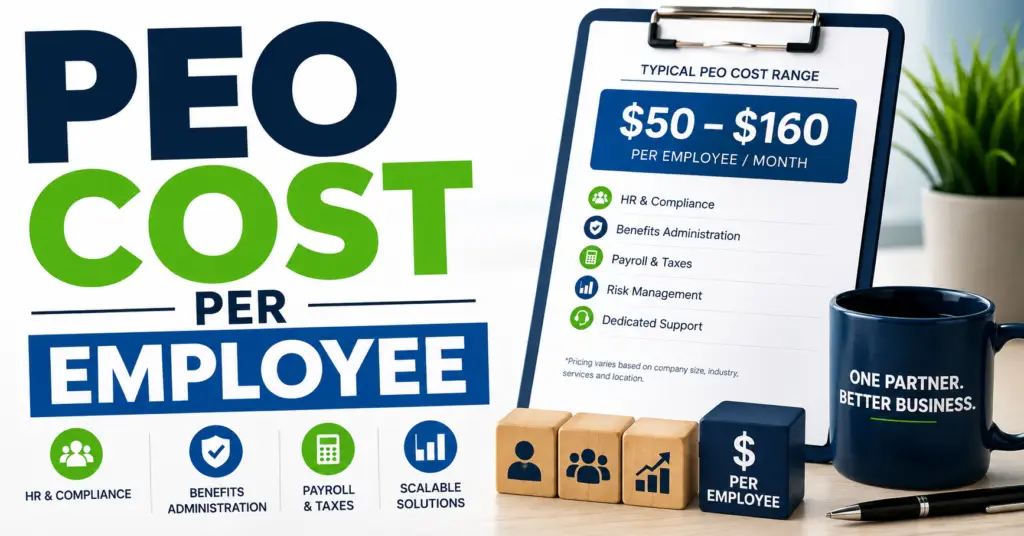
A PEO typically costs between $80 and $200 per employee per month, or 2%–12% of total payroll, depending on your company size, industry, and the pricing model your provider uses. Bundled PEOs tend to run $100–$175 PEPM (per employee per month), while unbundled models let you pay only for what you use. The wide range exists because PEO pricing is driven by several variables that most vendors don’t spell out upfront.

If you’re evaluating a PEO for the first time — or comparing quotes you’ve already received — this breakdown gives you the real numbers, the pricing structures to know, and the hidden cost drivers that can quietly inflate your bill.

What Is PEO Pricing and How Does It Work?

PEO pricing is the fee a Professional Employer Organization charges to co-employ your workforce, administer payroll, provide access to group benefits, manage HR compliance, and handle workers’ compensation. It is separate from your actual payroll dollars and benefits premiums — think of it as the service fee layered on top of those hard costs.

There are two dominant pricing structures in the market:

Bundled Pricing (Flat PEPM)

With bundled pricing, you pay a flat dollar amount per employee per month regardless of what services you use. This is the most common model at larger PEOs like Insperity and TriNet. It’s predictable, easier to budget, and often includes a comprehensive suite of services. The tradeoff: you may be paying for HR technology or compliance tools you don’t actually need. Based on our analysis of 40+ PEO providers, bundled fees typically land between $100 and $175 PEPM for companies with 10–100 employees.

Percentage of Payroll Pricing

Some PEOs charge a percentage of your gross payroll instead of a flat fee. This model scales with your payroll spend — which can work in your favor if you have lower-wage employees, but becomes expensive fast as salaries rise. The typical range is 2%–6% of gross payroll for most small and mid-size businesses. For a company with $1 million in annual payroll, that’s $20,000–$60,000 per year just in PEO admin fees.

Unbundled (à la Carte) Pricing

A smaller but growing segment of PEOs — including some tech-forward platforms — offer unbundled pricing where you select and pay only for the modules you need. This works well for companies that already have strong HR infrastructure or only need the PEO for benefits access and payroll. Costs are harder to generalize but often start around $40–$80 PEPM for core payroll and compliance.

Want to see the actual numbers before talking to anyone? Our free PEO calculator gives you a realistic cost range based on your company size and payroll — no commitment, no call.

Try the Free Calculator →

PEO Cost Per Employee: Comparison Table by Company Size

PEO cost per employee doesn’t scale linearly — larger headcounts typically command lower per-employee rates due to volume leverage. Here’s how fees generally break down by company size based on our experience matching hundreds of businesses with PEO providers:

Company SizeTypical PEPM Range% of Payroll RangeEst. Annual Cost
2–10 employees$150–$2005%–12%$3600 – $34,000
11–50 employees$120–$1753%–8%$72,000–$105,000
51–150 employees$100–$1402%–5%$60,000–$84,000
151–500 employees$80–$1202%–4%Varies significantly

Note: These are admin/service fees only. Benefits premiums, workers’ comp, and payroll taxes are separate line items billed in addition to the above.

What’s Actually Included in the PEO Fee?

Understanding what the PEO cost per employee covers — and what it doesn’t — is the most important step before comparing quotes. Most bundled PEO fees include the following core services:

Payroll Processing and Tax Administration

Your PEO handles payroll runs, direct deposit, W-2 filing, and federal/state/local payroll tax deposits. According to the IRS, in a PEO arrangement the PEO becomes the employer of record for tax purposes, taking on withholding and remittance obligations that would otherwise sit with you.

Benefits Administration

Access to large-group health, dental, vision, life, and disability plans. This is often where small businesses see the most tangible ROI — a 10-person company can access the same carrier rates as a 5,000-person company. The National Association of Professional Employer Organizations (NAPEO) reports that PEO clients pay 15% less on average for health insurance than comparable non-PEO businesses.

HR Compliance and Risk Management

Employee handbooks, ACA compliance, FMLA administration, state leave law tracking, I-9 verification, and OSHA guidance are typically bundled in. This is where the compliance value compounds for companies operating across multiple states.

Workers’ Compensation

Most PEOs include workers’ comp coverage under a master policy, often eliminating large upfront deposits. The cost is either embedded in the PEPM fee or billed separately as a percentage of payroll per job classification — something to clarify during any demo.

HR Technology Platform

Onboarding, time tracking, PTO management, performance tools, and an employee self-service portal. Platform quality varies significantly — this is one area where PEOs like Gusto and Justworks have historically differentiated themselves on user experience.

The Real PEO Cost Drivers You Need to Know

The five factors below will move your actual quote up or down more than anything else. Understanding them helps you negotiate and compare apples to apples.

1. Industry and Workers’ Comp Risk Class

High-risk industries — construction, manufacturing, healthcare staffing, food service — pay significantly more in workers’ comp premiums, which flows directly into PEO cost. A 20-person construction crew will get a very different quote than a 20-person SaaS company, even with the same employee count.

2. Average Employee Salary

If your PEO uses percentage-of-payroll pricing, higher salaries mean higher fees. A company with $120,000 average salaries paying 4% of payroll is spending nearly twice what a company with $65,000 average salaries pays for the same headcount. This is one reason flat PEPM pricing often makes more sense for professional services firms and tech companies.

3. Benefits Election Rates

The more employees who elect benefits, the higher your total benefits premium spend — but that’s not the PEO’s service fee. What matters here is whether your PEO charges admin markup on benefits (some do). Ask specifically whether the benefits premium you see is net or gross of any PEO margin.

4. Multi-State Complexity

Operating in California, New York, or Washington adds compliance overhead. Some PEOs charge more for multi-state clients or add fees for state-specific filings. If you’re growing across state lines, factor this in when reviewing how larger PEOs like Insperity price their multi-state support.

5. Contract Length and Minimums

Annual contracts typically get lower per-employee rates than month-to-month. Most PEOs require a minimum of 5–10 employees to onboard. Going below your contracted headcount mid-year can trigger minimum fees — always read the termination and true-up clauses.

Hidden PEO Fees That Can Inflate Your Cost

The quoted PEPM is rarely the final number. In our experience matching hundreds of businesses with PEO providers, these are the add-on charges that most commonly surprise buyers after they’ve signed:

  • New hire / termination fees: Some PEOs charge $25–$75 per onboarding or offboarding event
  • Year-end W-2 fees: Occasionally billed separately at $5–$15 per employee
  • Benefits open enrollment fees: Admin charges for running annual enrollment campaigns
  • Off-cycle payroll fees: Running a bonus or correction payroll outside the normal schedule can cost $50–$150 per run
  • State registration fees: Expanding into a new state mid-contract may trigger a one-time filing fee
  • COBRA administration fees: Often charged per qualifying event, not included in base PEPM

For a deep dive into where these surprises most commonly appear at one major provider, see our post on hidden fees with ADP TotalSource.

Is the PEO Cost Per Employee Worth It?

The ROI question matters more than the sticker price. According to NAPEO research, businesses that use a PEO grow 7–9% faster than comparable non-PEO businesses, have 10–14% lower employee turnover, and are 50% less likely to go out of business. The Department of Labor enforcement environment has also intensified for small employers, making the compliance infrastructure a PEO provides increasingly valuable.

The math typically works like this: if a PEO saves your company one HR compliance penalty, reduces health insurance premiums by 10%, and keeps one $80,000 employee from leaving by improving benefits, the service fee pays for itself several times over. Use our free PEO cost calculator to model the actual numbers for your specific headcount and payroll.

That said, PEOs are not right for every business. Very small companies (under 5 employees), businesses in very low-complexity industries, or companies with strong existing HR infrastructure may find better value staying independent or using a payroll-only solution.

How to Get an Accurate PEO Cost Quote

To get a quote that reflects your real PEO cost per employee, you’ll need to come prepared with:

  • Current headcount and projected growth over 12 months
  • Total annual gross payroll (not just base salaries — include bonuses and commissions)
  • State(s) where employees are located
  • Current health insurance carrier, plan structure, and employer contribution rate
  • Workers’ comp class codes and current experience mod (EMR)
  • List of HR services you currently have vs. what you need

At PEO Marketplace, we use this information to match you with pre-vetted providers from our network of 40+ PEOs and run a side-by-side cost comparison — so you’re not starting from scratch with each vendor. You can start your free PEO match here or book a call with our team below.

Get a Free PEO Cost Comparison

We’ll match you with 2–3 vetted PEOs that fit your size, industry, and budget — and show you side-by-side pricing. No sales pressure, no commitment.

Book a Free 20-Minute Call →

Not ready to book a call? Get a free Benefits Benchmark Report for your industry — we will email you a breakdown of what companies your size are paying for HR, benefits, and workers comp so you can compare on your own timeline.

Get My Free Benchmark Report →

Frequently Asked Questions

How much does a PEO cost per employee per month on average?

A PEO typically costs between $80 and $200 per employee per month in admin fees, with most small and mid-size businesses landing in the $100–$175 PEPM range for a bundled full-service arrangement. Your actual rate depends on your headcount, industry, states of operation, and which pricing model (flat PEPM vs. percentage of payroll) the provider uses.

Is PEO pricing based on employee count or payroll?

PEOs use one of two methods: a flat per-employee-per-month (PEPM) fee, or a percentage of gross payroll (typically 2%–6%). Flat PEPM pricing is more predictable and favors companies with higher average salaries, while percentage-of-payroll models can be cost-effective for businesses with lower-wage workforces. Always ask your provider which model they use before comparing quotes.

What’s not included in a PEO’s per-employee fee?

The PEPM admin fee does not include your actual benefits premiums, payroll taxes, or workers’ compensation premiums — those pass through at cost (or near cost) on top of the service fee. Some PEOs also charge separately for off-cycle payroll runs, new hire onboarding events, and year-end tax filings, so always request a full fee schedule before signing.

At what company size does a PEO make financial sense?

PEOs typically deliver the strongest ROI for companies with 10–150 employees — large enough to absorb the service fee but small enough to benefit from the group buying power on benefits and outsourced HR compliance expertise. Companies under 5 employees may find the minimum fees prohibitive, while companies over 500 often have enough scale to build internal HR infrastructure more cost-effectively.

Can I negotiate PEO pricing?

Yes — PEO pricing is negotiable, especially on PEPM rates, implementation fees, and contract length. Providers have flexibility, and working with an independent broker like PEO Marketplace means you’re bringing competitive quotes to the table, which strengthens your negotiating position. In our experience, buyers who compare 2–3 providers typically save 10%–20% off the first quote they receive.

A Professional Employer Organization (PEO) is a company that partners with your business to co-manage HR, payroll, benefits, and compliance under a shared employment arrangement called co-employment. PEOs give small and mid-size businesses access to Fortune 500-level benefits and HR infrastructure at a fraction of the cost of building it in-house. According to NAPEO, businesses that use a PEO grow 7–9% faster and have 10–14% lower employee turnover than those that don’t.

What Is a PEO and How Does It Work?

A PEO — Professional Employer Organization — enters into a co-employment relationship with your business. In practical terms, the PEO becomes the employer of record for tax and benefits purposes, while you retain full control over day-to-day operations, hiring decisions, job assignments, and culture. Think of it as a back-office partnership, not a staffing agency. Your employees still report to you. The PEO just handles the administrative weight so you don’t have to.

Here’s how the mechanics work step by step:

  1. You sign a Client Service Agreement (CSA) with the PEO outlining shared responsibilities.
  2. Your employees are co-employed — they appear on the PEO’s master FEIN for payroll tax purposes, but they remain your employees operationally.
  3. The PEO pools your workforce with thousands of other businesses to access group-rate health insurance, workers’ comp, and retirement plans.
  4. You run your business normally — the PEO processes payroll, files taxes, administers benefits, and handles compliance in the background.

There are roughly 500 PEOs operating in the United States today, serving approximately 4 million worksite employees, according to NAPEO. Based on our analysis of 40+ PEO providers at PEO Marketplace, no two PEOs are identical — technology, pricing models, industry focus, and service depth vary significantly.

Not sure if a PEO makes sense for your business? Our free calculator shows you the real cost in 60 seconds — no call, no email, no commitment.

Try the Free Calculator →

What Is Co-Employment? Understanding the Legal Structure

Co-employment is the legal framework that makes a PEO relationship possible. It means two entities — your company and the PEO — simultaneously share employer responsibilities for the same employees. This is not a loophole or a grey area; it’s a well-established legal structure recognized by federal and state governments.

What the PEO Is Responsible For

  • Payroll processing and direct deposit
  • Federal and state payroll tax filing (under the PEO’s FEIN)
  • Benefits administration — health, dental, vision, 401(k)
  • Workers’ compensation insurance and claims management
  • Employment-related compliance (FMLA, ACA, FLSA, COBRA)
  • HR policies, employee handbooks, and risk management support

What You — the Business Owner — Control

  • Who you hire and who you let go
  • Day-to-day supervision and work assignments
  • Compensation decisions and raises
  • Company culture, values, and direction
  • Business strategy and operations

The IRS formally recognizes the co-employment model. You can review guidance on employer responsibilities at IRS.gov. Many states have also passed PEO-specific licensing laws to protect businesses and employees in these arrangements.

What Does a PEO Actually Cost?

PEO pricing typically falls into one of two models: a percentage of total payroll (usually 2–6%) or a per-employee-per-month (PEPM) flat fee (typically $100–$200 per employee). The right model depends on your average employee compensation — higher-wage workforces often do better with a flat PEPM structure.

Pricing ModelTypical RangeBest For
% of Payroll2%–6% of gross payrollLower-wage workforces, service industries
Per Employee Per Month (PEPM)$100–$200/employee/monthHigher-wage workforces, tech, professional services
Hybrid ModelBase fee + % of payrollMid-size companies with varied compensation levels

What you need to watch for are hidden fees — setup charges, W-2 fees, offboarding costs, and benefits administration add-ons that aren’t always disclosed upfront. We’ve seen this repeatedly in our experience matching hundreds of businesses to PEOs. Before you sign anything, read our breakdown of hidden fees with ADP TotalSource to understand what questions to ask any provider.

You can also use our free PEO cost calculator to estimate what a PEO would cost your business versus handling HR in-house.

The Real Benefits of Using a PEO

The primary reason businesses join PEOs is access to better benefits at lower cost. Because PEOs pool thousands of employees across their client base, they negotiate health insurance at group rates that a 20-person company could never access on its own. But the advantages go well beyond insurance.

Better Benefits, Lower Cost

Small businesses using a PEO can offer the same caliber of health, dental, vision, and 401(k) benefits that large employers use to attract top talent. According to the Bureau of Labor Statistics, access to employer-sponsored benefits is a top factor in employee retention decisions. A PEO helps level that playing field.

Compliance Protection

Employment law changes constantly — ACA reporting, FMLA administration, state-specific wage and hour laws, workers’ comp requirements. PEOs employ dedicated compliance specialists who monitor regulatory changes and update your policies accordingly. For businesses operating in multiple states, this alone can be worth the cost.

Time Savings for Leadership

The average small business owner spends 25–35% of their time on HR-related administrative tasks, according to NAPEO research. Offloading payroll, benefits administration, and compliance frees that time for revenue-generating work.

Reduced Liability Exposure

Because the PEO co-employs your staff, they share employment-related liability. That includes workers’ comp claims, unemployment insurance management, and certain HR compliance risks. This shared liability model is one of the most underappreciated advantages for growing businesses.

Risks and Limitations of PEOs You Should Know

PEOs are not the right fit for every business. Understanding the risks before you sign is just as important as understanding the benefits.

You Lose Some Flexibility

PEOs offer standardized benefit plans and payroll processes. If you have highly customized HR workflows or niche benefit structures, you may find a PEO’s systems limiting. Ask any provider upfront how configurable their platform is.

Minimum Employee Requirements

Most PEOs require a minimum of 3–5 employees to enter a co-employment relationship. Some larger providers set minimums as high as 10–25 employees. If you’re a solo operator or very early stage, a PEO may not be available to you yet.

Exit Complexity

Leaving a PEO mid-year can be disruptive — particularly around benefits enrollment windows, payroll transitions, and tax ID conversions. Always understand the exit terms before you sign. In our experience matching hundreds of businesses to PEOs, the businesses most satisfied with their PEO relationships are those who did due diligence on contract terms upfront.

Not All PEOs Are Equal

A PEO carrying IRS Certified Professional Employer Organization (CPEO) status has met federal financial standards and bonding requirements. Non-certified PEOs may still be excellent — but you should verify their credentials, state licensing, and financial health before signing. Look for ESAC accreditation as an additional trust signal.

How to Choose the Right PEO for Your Business

Choosing a PEO isn’t just about price — it’s about fit. Industry experience, technology platform, benefits carrier relationships, and dedicated service model all matter. Here’s what to evaluate:

  • Industry specialization: Some PEOs focus on construction, healthcare, or nonprofits. A PEO with experience in your industry will understand your compliance landscape.
  • Technology: Does their HR platform integrate with your existing tools? Is it intuitive for employees?
  • Service model: Dedicated account manager vs. call center support makes a significant difference when you have an urgent HR issue.
  • Benefits carriers: Which health insurance networks do they work with? Is there coverage in your geography?
  • Pricing transparency: Can they give you an all-in cost breakdown before you commit?

If you want a side-by-side look at how major providers stack up, our comparison guides on Gusto vs. Justworks and the Insperity cost comparison are a good place to start.

At PEO Marketplace, we’ve vetted 40+ providers across pricing, technology, service quality, and industry fit. Our matching process is free, unbiased, and takes about 10 minutes. Start your PEO search here and we’ll shortlist the best options for your business specifically.

FAQ: What Is a PEO?

Is a PEO the same as a staffing agency?

No — a PEO is fundamentally different from a staffing agency. A staffing agency recruits and places workers at your business, while a PEO co-employs your existing workforce to manage HR, payroll, and benefits administration. Your employees stay your employees operationally; the PEO just handles the back-office work.

How many employees do you need to use a PEO?

Most PEOs work with businesses that have at least 3–10 employees, though minimums vary by provider. Some boutique PEOs serve very small teams, while national providers like ADP TotalSource or Insperity typically prefer companies with 10 or more employees. The sweet spot for PEO value is generally 10–200 employees.

Does a PEO control my employees?

No — you retain full operational control over your employees. You decide who to hire, how to manage them, what they work on, and what you pay them. The PEO only handles the administrative employer functions like payroll processing, tax filing, and benefits administration.

What happens to my employees’ benefits if I leave the PEO?

When you exit a PEO, your employees’ benefits through the PEO’s group plan will end, and you’ll need to set up replacement coverage. This is one of the most important transition considerations — most PEOs recommend exiting at year-end to align with benefits renewal cycles and minimize disruption.

How much does a PEO save businesses?

According to NAPEO, businesses using a PEO save an average of $1,775 per employee per year when factoring in HR administrative costs, workers’ comp savings, and reduced turnover costs. The actual savings for your business will depend on your industry, headcount, current HR spend, and the specific PEO you choose.

Ready to Find Your PEO?

We match small and mid-size businesses to the right PEO from our vetted network of 40+ providers — free, unbiased, and no pressure. Book a 15-minute call and we’ll do the legwork for you.

Book My Free PEO Consultation →

Not ready to book a call? Get a free Benefits Benchmark Report for your industry — we will email you a breakdown of what companies your size are paying for HR, benefits, and workers comp so you can compare on your own timeline.

Get My Free Benchmark Report →

Justworks is a Professional Employer Organization (PEO) that enters a co-employment relationship with your business. Gusto is payroll and HR software that keeps you as the sole employer. Both handle payroll, but they operate on fundamentally different models — and choosing the wrong one at the wrong stage of your business can cost you time, money, and talent. Here’s how to tell which one actually fits where you are right now.

What Is the Core Difference Between Justworks and Gusto?

The short answer: Justworks is infrastructure. Gusto is software. That distinction sounds simple, but it changes everything from your liability exposure to the quality of benefits you can offer employees.

When you join Justworks, you enter a co-employment arrangement. Justworks becomes the employer of record for tax and benefits purposes, pools your employees with thousands of other small businesses, and uses that collective size to negotiate Fortune 500-level health insurance, 401(k) plans, and workers’ comp coverage. You still run your business and manage your team day-to-day — but Justworks shoulders significant compliance and administrative risk alongside you.

Gusto works differently. You remain the sole employer. Gusto automates payroll runs, files payroll taxes, and offers a self-service HR portal. It’s genuinely excellent software — but it’s a tool you use, not a partner that shares employer responsibility with you. According to NAPEO, PEO clients grow 7–9% faster and have 10–14% lower employee turnover than businesses that go it alone. That data reflects the full co-employment model — not software.

Comparing PEOs is easier when you know your baseline cost. Our free calculator shows what a PEO would cost for your company in 60 seconds — no call needed.

Try the Free Calculator →

Justworks vs Gusto: Feature-by-Feature Comparison

Before we dig into which platform suits which business, here’s a side-by-side look at how they stack up on the features that matter most to small and mid-size employers.

FeatureJustworks (PEO)Gusto (Payroll Software)
ModelCo-employment (PEO)SaaS payroll software
Payroll Processing✅ Full service✅ Full service
Payroll Tax Filing✅ Included✅ Included
Health Insurance Access✅ Group rates via PEO pool⚠️ Open market (small business rates)
401(k)✅ Pooled plan, lower fees✅ Available, standard rates
Workers’ Comp✅ Included in PEO pool⚠️ Partner integration only
HR Compliance Support✅ Shared liability, HR team⚠️ Guidance only, no shared liability
EPLI / Employment Practices Liability✅ Included❌ Not included
Dedicated HR Support✅ Named HR specialists⚠️ Chat/email support only
IRS Certified✅ CPEO certified❌ Not a PEO
Pricing ModelPer employee/month ($59–$99+)Base + per employee ($40–$80+/mo)
Best For5–200 employees, growth stage1–50 employees, early stage

How Does Justworks Work as a PEO?

Justworks is an IRS-certified Certified PEO (CPEO), which matters for tax purposes. As a CPEO, Justworks takes on federal employment tax liability — something standard payroll software can’t do. When you join, your employees technically become co-employed by both your company and Justworks.

In practice, that means Justworks can offer your 15-person startup access to the same Aetna or United Healthcare group rates as a 5,000-person corporation. A 15-person company shopping for health insurance on its own gets priced as a 15-person company. Through Justworks’ PEO pool, you get priced as part of a much larger group. That difference in premium alone can offset a significant portion of Justworks’ monthly fee.

Justworks also provides employment practices liability insurance (EPLI), which protects against wrongful termination claims, harassment claims, and discrimination lawsuits — a coverage most small businesses skip because it’s expensive to buy standalone. When your HR decisions are shared with a co-employer, the legal exposure is also shared.

If you want a deeper look at how Justworks stacks up against other full-service PEOs, see our breakdown in Comparing PEO, Gusto, and Justworks: Which Is Best?

How Does Gusto Work as Payroll Software?

Gusto is genuinely good at what it does. The interface is clean, onboarding new hires is fast, and it automates federal, state, and local payroll tax filings in all 50 states. For a founder running a 5-person team who needs payroll handled without complexity, Gusto is often the right call.

The key limitation is that Gusto’s compliance tools are advisory, not protective. Gusto will remind you about labor law changes and flag potential issues — but if you get hit with a misclassification audit from the Department of Labor or a discrimination claim from a former employee, that’s entirely your liability. Gusto doesn’t share it.

Gusto’s health insurance marketplace connects you to carriers, but your premium is based on your own employee pool. For a small team with any older or health-challenged employees, those rates can be brutal. You’re not benefiting from anyone else’s risk pool the way you would inside a PEO.

Which Business Stage Fits Each Platform?

Choose Gusto If…

  • You have fewer than 10 employees and your primary need is clean, automated payroll
  • Your team is healthy and relatively young, so individual health insurance rates are manageable
  • You’re pre-revenue or in very early stages and every dollar of overhead is scrutinized
  • You have no full-time HR person and just need basic self-service tools
  • You’re comfortable taking on employment compliance risk yourself or have outside counsel

Choose Justworks (or Another PEO) If…

  • You have 5–200 employees and are actively competing for talent with larger companies
  • You want to offer competitive health benefits without paying large-group premiums out of pocket
  • You’re scaling fast and don’t have time to build an HR infrastructure from scratch
  • You operate across multiple states and need multi-state compliance coverage
  • You’ve had — or are worried about — an employment claim or compliance issue

Based on our analysis of 40+ PEO providers, the most common switch we see is businesses moving from Gusto to a PEO around the 15–25 employee mark, when benefits costs and compliance risk start to outweigh the simplicity of pure software.

What Does Each Platform Actually Cost?

Justworks charges per employee per month. Their base PEO plan starts around $59/employee/month for smaller teams, with pricing scaling based on headcount and benefits selections. That fee covers payroll, HR support, EPLI, and access to the pooled benefits — so the sticker price isn’t the whole story. Use our free PEO cost calculator to model what a PEO would actually cost versus your current setup.

Gusto’s pricing starts with a base fee (around $40/month) plus a per-employee charge (around $6–$12/month per person depending on the plan tier). Their Plus and Premium tiers add HR tools and dedicated support, pushing costs higher. What Gusto doesn’t include: the cost of your health insurance premiums, workers’ comp policy, or any HR consulting you’d need to buy separately.

The honest comparison isn’t Justworks’ fee vs. Gusto’s fee. It’s Justworks’ total cost vs. Gusto’s fee plus your standalone benefits, workers’ comp, and any compliance costs. For many businesses in the 15–50 employee range, that math favors the PEO. It’s also worth reviewing how Insperity’s costs compare if you’re weighing multiple PEO options.

Justworks vs Gusto: The Honest Verdict

These aren’t really competing products — they’re different tools for different moments in a company’s life. Gusto wins on simplicity and price for very early-stage businesses. Justworks wins on benefits access, compliance protection, and HR infrastructure for growing businesses that need more than software.

The mistake we see most often is businesses staying on Gusto (or a similar payroll tool) three or four years longer than they should because switching feels complicated. Meanwhile, they’re paying individual-market health insurance rates, carrying unprotected compliance risk, and losing candidates to competitors who can offer better benefits through a PEO. If that sounds familiar, it’s probably time for an honest evaluation.

And if you want to see exactly where you stand, our free PEO matching service narrows down the right providers for your industry, headcount, and budget — no sales pressure, just a clear comparison.

Not Sure If You’re Ready for a PEO?

Talk to a PEO specialist at PEO Marketplace. We’ll tell you honestly whether a PEO makes sense for your business right now — or whether staying on payroll software is the smarter move. Free, unbiased, no commitment.

Book a Free Consultation →

Not ready to book a call? Get a free Benefits Benchmark Report for your industry — we will email you a breakdown of what companies your size are paying for HR, benefits, and workers comp so you can compare on your own timeline.

Get My Free Benchmark Report →

Frequently Asked Questions

Is Justworks actually a PEO or just payroll software?

Justworks is a certified PEO (Professional Employer Organization) and holds IRS CPEO certification, which means it takes on federal employment tax liability as a co-employer alongside your business. This is fundamentally different from payroll software like Gusto, which automates payroll processing but does not share employer legal responsibility with you.

Can I get better health insurance through Justworks than through Gusto?

Yes — in most cases, significantly better. Justworks pools your employees with thousands of other small businesses to negotiate group health insurance rates that individual small companies can’t access on their own. Gusto connects you to a broker marketplace, but your premiums are based solely on your own employee population, which typically means higher rates for smaller teams.

Is Gusto enough for a business with 20 employees?

Gusto can technically handle payroll for a 20-person team, but at that size most businesses start feeling the limitations — particularly around benefits costs, compliance exposure, and lack of dedicated HR support. In our experience matching hundreds of businesses to the right platform, 15–25 employees is the typical inflection point where a PEO starts delivering measurable ROI over standalone payroll software.

What happens to my employees if I switch from Gusto to a PEO like Justworks?

Your employees will go through a re-enrollment process and technically become co-employed by the PEO for tax and benefits purposes. From their day-to-day perspective, they’ll see a new employer of record on their paystubs and gain access to better benefits — most employees view this positively. You remain in full control of hiring, managing, and directing your team.

Are there better PEO options than Justworks for larger or more complex businesses?

Justworks is well-suited for businesses in the 5–150 employee range, particularly in professional services and tech. For businesses with more complex needs, higher headcounts, or specific industry requirements, other PEOs like Insperity, TriNet, or providers in our vetted network may be a stronger fit. PEO Marketplace works with 40+ vetted providers and matches you based on your specific situation at no cost.

TriNet, Insperity, and ADP TotalSource are the three largest PEOs in the U.S., each serving thousands of businesses — but they are built for very different types of companies. TriNet targets venture-backed startups and professional services firms. Insperity leans toward established small and mid-size businesses that want white-glove HR service. ADP TotalSource is the enterprise-adjacent option with deep payroll infrastructure and broad integrations. Choosing the wrong one can cost you tens of thousands of dollars and months of frustration. This guide breaks all three down across every dimension that matters so you can go from three options to one confident choice.


What Is a PEO and Why Does the Provider Choice Matter So Much?


A Professional Employer Organization (PEO) enters a co-employment arrangement with your business, taking on employer-of-record responsibilities for payroll, benefits, workers’ compensation, and HR compliance. According to NAPEO, businesses that use a PEO grow 7–9% faster and have 10–14% lower employee turnover than those that go it alone. The right PEO amplifies those results. The wrong one creates service gaps, surprise fees, and an HR team that’s constantly calling a support line with no answer.


In our experience matching hundreds of businesses across 100+ vetted PEO providers, the single biggest mistake we see is choosing a PEO based on brand recognition alone. All three of these providers have strong brands. That doesn’t mean all three are right for your headcount, industry, or budget.


Comparing PEOs is easier when you know your baseline cost. Our free calculator shows what a PEO would cost for your company in 60 seconds — no call needed.

Try the Free Calculator →


TriNet vs Insperity vs ADP: Side-by-Side Comparison


Before diving into the detail, here’s a quick reference table covering the metrics that decision-makers ask us about most often.

CategoryTriNetInsperityADP TotalSource
Best ForStartups, VC-backed, techEstablished SMBs wanting premium HRMid-market, payroll-first companies
Typical Company Size5–500 employees5–5,000 employees10–1,000+ employees
Pricing ModelPEPM or % of payroll% of payroll (custom)PEPM or % of payroll
Estimated Monthly Cost$100–$200 PEPM2–5% of gross payroll$100–$175 PEPM
Dedicated HR RepShared team modelYes, dedicatedShared team model
IRS CPEO CertifiedYesYesYes
Benefits QualityExcellent (Fortune 500-level)Excellent (comprehensive)Good (broad but less curated)
Payroll TechnologyGood (proprietary platform)Good (proprietary platform)Excellent (industry-leading)
Contract FlexibilityAnnual contractsAnnual contractsAnnual contracts
Hidden Fee RiskMediumLow-MediumHigher (see notes below)


TriNet: Best for Startups and High-Growth Companies


What TriNet Does Well


TriNet has carved out a specific lane: fast-growing, often venture-backed companies in tech, professional services, financial services, and life sciences. Their benefits packages are genuinely competitive at Fortune 500 levels, which matters enormously when you’re trying to recruit engineers or senior talent. TriNet also offers industry-specific HR expertise, meaning your HR team actually understands the compliance nuances of your vertical — not just generic employment law.


Their technology platform is clean and functional. Onboarding, benefits enrollment, and payroll visibility are all reasonably intuitive for employees and administrators. For companies that need to move fast and look credible to new hires, TriNet delivers.


Where TriNet Falls Short


TriNet operates on a shared HR service model. You won’t get a dedicated HR rep who knows your company inside and out — you get a team. For some businesses, that’s fine. For others, especially those dealing with complex employee relations issues or multi-state compliance, that lack of continuity is a real friction point. TriNet’s pricing is also on the higher end of the PEPM spectrum, and cost can escalate quickly as headcount grows. If you’re a stable, headcount-steady business, TriNet may be overbuilt and overpriced for your needs.


Insperity: Best for Established SMBs That Want Premium HR Service


What Insperity Does Well


Insperity is widely regarded as the gold standard for service quality among large PEOs. Based on our analysis of 100+ PEO providers, Insperity consistently earns the highest satisfaction scores for dedicated HR support. Every client gets a dedicated HR specialist — a real person who learns your business, your culture, and your employee roster. That relationship-based model is rare at this scale and it genuinely shows in day-to-day experience.


Insperity’s benefits offerings are also top-tier. They offer access to comprehensive health, dental, vision, life, and disability plans through major carriers, plus strong 401(k) options. Their risk management and workers’ comp programs are mature and well-managed. For companies in industries with meaningful liability exposure — construction-adjacent services, healthcare, manufacturing — Insperity’s risk expertise adds real value. You can read more about how Insperity’s cost stacks up against other PEOs in our dedicated breakdown.


Where Insperity Falls Short


Insperity’s pricing is typically percentage-of-payroll based, and at 2–5% of gross wages, it can get expensive — particularly for companies with higher average salaries. A 50-person tech company paying $120K average salaries could find Insperity significantly more expensive than a per-employee-per-month alternative. Their technology platform is functional but not as sleek as some newer competitors. And like the others, they require annual contracts, so you’re committed once you sign.


ADP TotalSource: Best for Payroll-First, Mid-Market Businesses


What ADP TotalSource Does Well


ADP is the most recognized name in payroll, and ADP TotalSource — their PEO offering — inherits that infrastructure. If your business already runs on ADP payroll, the migration path to TotalSource is relatively smooth. Their compliance technology is robust, their tax filing accuracy is industry-leading, and their integrations with accounting platforms, time-tracking tools, and benefits providers are extensive. According to the Bureau of Labor Statistics, payroll compliance errors cost U.S. businesses billions annually — ADP’s strength here is real and measurable.


For mid-market companies with 50–500+ employees who prioritize payroll accuracy, ADP compliance depth, and broad integrations over boutique HR service, TotalSource is a serious contender.


Where ADP TotalSource Falls Short


ADP’s reputation for hidden fees is well-documented — and it’s one of the most common complaints we hear from businesses that come to us after a bad PEO experience. Implementation fees, W-2 fees, year-end processing charges, and module add-ons can stack up in ways that weren’t obvious during the sales process. We’ve covered this in detail in our post on ADP TotalSource hidden fees — it’s worth a read before you sign anything. ADP also operates on a shared service model, so the personal HR relationship that Insperity offers is generally not available here.


ADP TotalSource’s size can also work against smaller clients. If you’re a 15-person company, you’re not a priority account. Service responsiveness tends to correlate with revenue size at ADP, and smaller businesses often feel that gap.


Pricing Deep Dive: What Will You Actually Pay?


Pricing is where most business owners get tripped up because all three providers quote differently and negotiate differently. Here’s what to expect in practice:

    • TriNet typically quotes $100–$200 per employee per month depending on your industry, headcount, and benefits selections. Startups in tech often land at the higher end due to richer benefit packages.
    • Insperity quotes as a percentage of gross payroll, typically 2–5%. A company with $3M annual payroll could pay $60,000–$150,000 per year. The spread is wide and heavily negotiated.
    • ADP TotalSource offers both PEPM and percentage-of-payroll structures. Quoted rates often look competitive, but the all-in cost including add-ons and fees frequently lands higher than initial estimates.

All three are negotiable, especially if you’re bringing 50+ employees. Don’t accept first-round pricing on any of them. And always ask for a line-item breakdown of every fee — not just the headline rate. The IRS CPEO certification that all three hold does guarantee certain tax liability protections, which is a meaningful financial safeguard worth factoring into your total cost analysis.

If you’re comparing PEOs and want to understand what a fair price looks like for your specific situation, our free PEO cost calculator gives you a realistic baseline in under a minute.


Which PEO Should You Choose?


Choose TriNet If:


  • You’re a startup or high-growth company needing to attract top talent with competitive benefits
  • You’re in tech, professional services, life sciences, or financial services
  • You want strong industry-specific HR expertise without paying for a dedicated rep
  • Your headcount will grow significantly over the next 12–24 months

Choose Insperity If:


    • You want a dedicated HR partner who genuinely knows your business
    • You’re an established company with 20–500 employees and stable payroll
    • HR service quality matters more than bottom-line pricing
    • You have complex compliance needs or meaningful employee relations risk

Choose ADP TotalSource If:


    • You’re already in the ADP ecosystem and want to upgrade to full PEO services
    • Payroll accuracy and compliance infrastructure are your top priorities
    • You have 50+ employees and need robust integrations with accounting and ERP systems
    • You have dedicated internal HR staff who need a strong technology backbone — not hand-holding

Consider Alternatives If:


If none of these profiles fit your business perfectly, that’s actually the most common outcome we see. The PEO market has 100+ credible providers, and many of the best fits for small businesses are regional or mid-tier PEOs that offer better pricing, more flexibility, and more attentive service than the big three. Before you commit, it’s worth seeing a full comparison. Our post on Gusto vs Justworks covers two strong alternatives for smaller companies, and our PEO matching service can surface the right fit for your specific situation at no cost.


The Bottom Line on TriNet vs Insperity vs ADP


All three are legitimate, CPEO-certified PEOs with real track records. The question is never “which is best overall” — it’s which is best for your company’s size, industry, budget, and HR philosophy. TriNet wins on startup agility and benefits depth. Insperity wins on service quality and HR relationship. ADP TotalSource wins on payroll infrastructure and integrations. Miss the match and you’ll spend the first year frustrated before shopping again.


In our experience working with hundreds of businesses across these providers, the companies that are happiest are the ones that matched on all three dimensions: size fit, service model fit, and price fit. Getting all three right at once is exactly what our matching process is designed to do.


Ready to Narrow From Three to One?


Our team has evaluated TriNet, Insperity, ADP TotalSource, and 100+ other PEOs. Tell us about your business and we’ll match you to the right provider — with pricing benchmarks and an honest assessment of where each one falls short for your situation. Free, unbiased, and no pressure.

Schedule Your Free PEO Matching Call →

Not ready to book a call? Get a free Benefits Benchmark Report for your industry — we will email you a breakdown of what companies your size are paying for HR, benefits, and workers comp so you can compare on your own timeline.

Get My Free Benchmark Report →


Frequently Asked Questions


Is TriNet more expensive than Insperity?


It depends on your payroll size and employee count. TriNet typically charges $100–$200 per employee per month, while Insperity charges a percentage of gross payroll (2–5%). For companies with higher average salaries, Insperity’s percentage model can end up costing more than TriNet’s flat PEPM structure — so it’s essential to model both approaches against your actual payroll numbers before comparing quotes.


Does ADP TotalSource have hidden fees?


ADP TotalSource has a documented pattern of add-on charges that aren’t always clear in initial pricing conversations, including implementation fees, W-2 processing fees, and year-end charges. Always request a complete written fee schedule before signing any contract with ADP TotalSource, and compare the all-in annual cost — not just the quoted rate — against other providers.


Which of these PEOs is best for a company under 20 employees?


For companies under 20 employees, all three major PEOs can feel like overkill in terms of cost and complexity. TriNet is probably the most accessible of the three at smaller headcounts due to its startup-friendly model, but smaller PEOs like Justworks or regional providers often deliver better pricing and more attentive service for sub-20 teams. Our matching service can identify the best fit at no cost.


Are TriNet, Insperity, and ADP TotalSource all CPEO certified?


Yes, all three hold IRS Certified PEO (CPEO) status, which means they meet strict financial, background, and reporting standards set by the IRS. CPEO certification provides important tax liability protections for client businesses — specifically, it protects clients from being held responsible for payroll tax liabilities if the PEO fails to remit taxes properly. This certification is a meaningful baseline that all three providers clear.


Can I switch PEOs if I choose the wrong one?


Yes, but it involves real administrative work — transitioning benefits, re-onboarding employees, and timing the switch around open enrollment or payroll cycles. Most PEOs require 30–60 days notice, and switching mid-year can create benefits gaps if not managed carefully. Choosing the right PEO from the start is significantly less painful than switching later, which is why a proper matching process upfront saves most businesses time, money, and frustration.

Scroll to Top