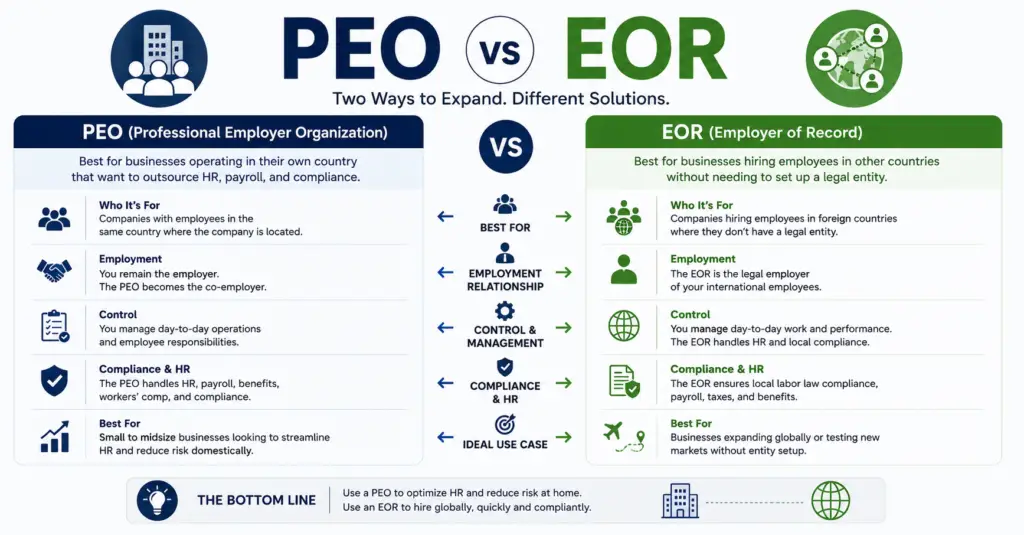
A PEO (Professional Employer Organization) is the right choice if you’re hiring employees inside the United States. An EOR (Employer of Record) is the right choice if you’re hiring workers in countries where your business has no legal entity. Both models offload HR, payroll, and compliance — but they operate under different legal structures, serve different geographic needs, and carry different price tags. Knowing which one fits your situation will save you from expensive compliance mistakes and contract regret.
What Is a PEO and How Does It Work?
A PEO enters a co-employment relationship with your business. You remain the day-to-day employer — you hire, manage, and fire. The PEO becomes the employer of record for tax and benefits purposes, running payroll under its own Employer Identification Number (EIN), sponsoring group health insurance, and filing employment taxes on your behalf. Your employees show up on the PEO’s master plan, which is how small businesses access Fortune 500-level benefits at scale.
The co-employment model is recognized and regulated in most U.S. states. The IRS even has a formal certification for it — the Certified Professional Employer Organization (CPEO) designation — which provides additional tax liability protections for clients. According to NAPEO, PEO clients grow 7–9% faster and have 10–14% lower employee turnover than companies that handle HR on their own.
In our experience matching hundreds of businesses at PEO Marketplace, PEOs are ideal when you have 5–500 U.S. employees and want to consolidate HR, benefits, payroll, and workers’ comp under one roof. They work especially well for companies in competitive hiring markets where benefits quality directly affects talent acquisition.
What a PEO covers:
- Payroll processing and tax filing (federal, state, local)
- Group health, dental, vision, and ancillary benefits
- Workers’ compensation insurance
- HR compliance support (federal and state labor law)
- Employee handbook development
- EPLI and risk management
- 401(k) plan sponsorship
Comparing PEOs is easier when you know your baseline cost. Our free calculator shows what a PEO would cost for your company in 60 seconds — no call needed.
What Is an EOR and How Does It Work?
An EOR — Employer of Record — is the legal employer of your international workers in countries where your business does not have a registered legal entity. The EOR has its own registered company in that country. They hire the worker on your behalf, handle local payroll, statutory benefits (think mandatory vacation, health contributions, severance), and ensure full compliance with local labor law. You direct the work. The EOR handles everything legal and administrative.
This matters because most countries require you to have a local legal entity before you can employ someone there. Setting up a foreign subsidiary can take 3–12 months and cost tens of thousands of dollars in legal and administrative fees. An EOR lets you hire in a new country in days — legally — without that overhead.
What an EOR covers:
- Legal employment in countries where you have no entity
- Local payroll in local currency
- Statutory benefits compliance (paid leave, social contributions, pensions)
- Locally compliant employment contracts
- Termination management under local labor law
- IP and confidentiality agreement support
Common EOR providers include Deel, Remote, Oyster HR, and Rippling Global. They typically operate in 100–180 countries and charge per employee per month.
PEO vs EOR: Key Differences Side by Side
The simplest way to think about it: PEO = domestic HR partner, EOR = international legal employer. Here’s how they compare across the factors that matter most to business owners.
| Factor | PEO | EOR |
|---|---|---|
| Geography | United States only | International (100–180+ countries) |
| Legal Structure | Co-employment (you + PEO) | EOR is sole legal employer |
| Entity Requirement | You must have a U.S. business entity | No local entity needed |
| Pricing Model | $80–$260/employee/month or 2–12% of payroll | $300–$650/employee/month (flat fee) |
| Benefits Pooling | Yes — group rates across all clients | Statutory minimums + limited extras |
| HR Support | Full-service: HR, compliance, handbooks, EPLI | Payroll + legal compliance focused |
| Control Over Employees | High — you manage day-to-day | High — but termination governed by local law |
| Speed to Hire | 1–4 weeks to onboard | 2–7 days in most countries |
| Best For | U.S. SMBs scaling domestic headcount | Companies hiring 1–10 people internationally |
When Does a PEO Make More Sense?
A PEO is the right move when your workforce is based in the United States and you want to stop managing HR, benefits, and payroll in-house. Here are the situations where PEOs clearly win:
You Want Competitive Benefits Without an HR Department
PEOs pool employees across hundreds or thousands of client companies. That buying power lets a 20-person business access the same health insurance rates as a 500-person company. According to the Bureau of Labor Statistics, employer health insurance costs continue to rise — PEOs help small businesses absorb that pressure by spreading risk across a large group plan.
You’re Managing Multi-State Compliance
If your team spans multiple states, you’re dealing with different payroll tax rules, unemployment insurance rates, leave laws, and workers’ comp requirements. A PEO handles all of it. This is one of the most underrated benefits — multi-state compliance is where small businesses get burned. You can explore how different PEOs handle this on our Find Your PEO page.
You Have 10–300 Employees and Want to Scale
This is the PEO sweet spot. Below 10 employees, the cost-benefit math can be harder to justify. Above 300–500 employees, many companies build internal HR infrastructure. In the middle, a PEO gives you enterprise-grade support without the enterprise-grade overhead. Use our PEO cost calculator to see what it would actually cost for your headcount.
When Does an EOR Make More Sense?
An EOR is the right move when you need to employ people in a country where you don’t have — and don’t want to build — a legal entity. Here’s when EORs are the clear answer:
You’re Hiring Your First International Employees
Hiring someone in Germany, Brazil, or the Philippines without a local entity is not just complicated — it’s often illegal. An EOR solves that in days. For companies testing a new market with one or two hires, an EOR is dramatically cheaper than setting up a subsidiary.
You’re Building a Remote-First Global Team
Many post-pandemic companies now hire the best talent wherever it lives. An EOR lets you hire a developer in Poland, a marketer in Canada, and a support rep in the Philippines — all compliantly — without registering entities in three countries. Most EOR platforms also handle currency conversion, local tax filings, and statutory leave automatically.
You’re Testing a Market Before Committing
Before spending $30,000–$80,000 setting up a foreign subsidiary, many companies run a 12–18 month pilot through an EOR. If the market validates, they establish a local entity and transition employees. If it doesn’t, they exit cleanly without the legal and financial cost of dissolving a foreign company.
Cost Comparison: PEO vs EOR
Pricing is one of the biggest practical differences between these two models. Based on our analysis of 40+ PEO providers at PEO Marketplace, here’s what you should expect to pay in 2026:
PEO Pricing
PEOs typically charge either a percentage of total payroll (2–12%) or a flat per-employee-per-month (PEPM) fee of $80–$160. The PEPM model is more predictable as salaries rise. Larger PEOs like ADP TotalSource and Insperity often come in at the higher end of the range — worth knowing before you sign. We’ve broken down the specifics in our posts on ADP TotalSource hidden fees and our Insperity cost comparison.
EOR Pricing
EORs almost always charge a flat monthly fee per employee — typically $300–$650 per employee per month, depending on the country and platform. That’s $3,600–$7,800 per employee per year. For a small team of 3–5 international employees, this is manageable. For 20+ international employees, the cost of establishing a local entity often starts to pencil out better.
The Hybrid Reality
Many growing companies use both simultaneously — a PEO for their U.S. workforce and an EOR for international hires. This is increasingly common among Series A–B startups and mid-market companies expanding globally. The two solutions are not mutually exclusive, and they often integrate with the same HRIS platforms.
Compliance: Where Each Model Protects You
Both PEOs and EORs reduce your compliance exposure — but in different legal jurisdictions and ways.
With a PEO, you get shared liability for U.S. employment tax filings, workers’ comp claims, and benefits administration. The PEO’s HR team monitors FLSA, FMLA, ADA, and state-specific leave law changes so you don’t have to. This is meaningful — the Department of Labor’s Wage and Hour Division recovers hundreds of millions in penalties from employers annually, many of them small businesses caught by rules they didn’t know existed.
With an EOR, you get protection against permanent establishment risk (accidentally creating a taxable presence in a foreign country) and misclassification risk (treating employees as contractors when local law says otherwise). EORs draft locally compliant contracts, manage statutory severance obligations, and handle terminations in ways that protect you from costly wrongful termination claims under foreign labor law.
In short: both models shift significant compliance burden off your plate. The question is which geography and risk profile you’re managing.
PEO vs EOR: Which One Do You Need?
Here’s the straightforward decision framework based on how we match businesses at PEO Marketplace:
- All U.S. employees, want to reduce HR overhead → PEO
- Hiring in a country where you have no legal entity → EOR
- U.S. team + a few international hires → PEO for domestic, EOR for international
- 20+ employees in one country and you plan to stay → Consider a local entity over time
- Not sure what you need → Talk to a specialist before you sign anything
If you’re comparing PEOs for your U.S. team, our post on Gusto vs Justworks is a good starting point for smaller teams. And if you’re ready to see all your options across our vetted network of 40+ providers, our free matching service will narrow it down fast.
Frequently Asked Questions
Can a PEO employ workers in other countries?
Most U.S.-based PEOs only operate domestically and cannot legally employ workers in foreign countries on your behalf. For international hiring without a local entity, you need an Employer of Record (EOR) that is registered and compliant in the target country. Some platforms offer both PEO and EOR services, but they are distinct legal arrangements.
Is an EOR more expensive than a PEO?
Yes, EORs are significantly more expensive on a per-employee basis — typically $300–$650 per employee per month compared to $80–$160 for a PEO. However, the EOR eliminates the cost of setting up a foreign legal entity, which can run $30,000–$80,000 or more, making it cost-effective for small international teams or market testing phases.
What happens if I misclassify an international employee as a contractor?
Misclassifying employees as contractors in foreign countries can result in significant penalties, back taxes, mandatory benefits payments, and termination liability under local labor law. Countries like France, Germany, Brazil, and Spain are particularly aggressive about enforcement. An EOR eliminates this risk by employing the worker under a fully compliant local contract.
Do I lose control of my employees with a PEO or EOR?
No — with both models, you retain full control over day-to-day work direction, performance management, and job responsibilities. The PEO or EOR handles the administrative and legal employer functions, not the managerial ones. The key difference with an EOR is that terminations must follow local labor law, which may require notice periods or severance payments you wouldn’t face in the U.S.
Can I use both a PEO and an EOR at the same time?
Yes, and many growing companies do exactly this — using a PEO for their U.S.-based workforce while using an EOR to employ workers in other countries where they lack a legal entity. The two solutions operate independently and can often integrate with the same payroll or HRIS platforms, giving you a unified view of your global workforce costs.
Not sure which model fits your business?
At PEO Marketplace, we’ve helped hundreds of businesses sort through exactly this question. Book a free 15-minute call with our team — we’ll tell you honestly whether a PEO, EOR, or combination approach makes sense for your situation and connect you with the right provider from our vetted network of 40+.
Not ready to book a call? Get a free Benefits Benchmark Report for your industry — we will email you a breakdown of what companies your size are paying for HR, benefits, and workers comp so you can compare on your own timeline.