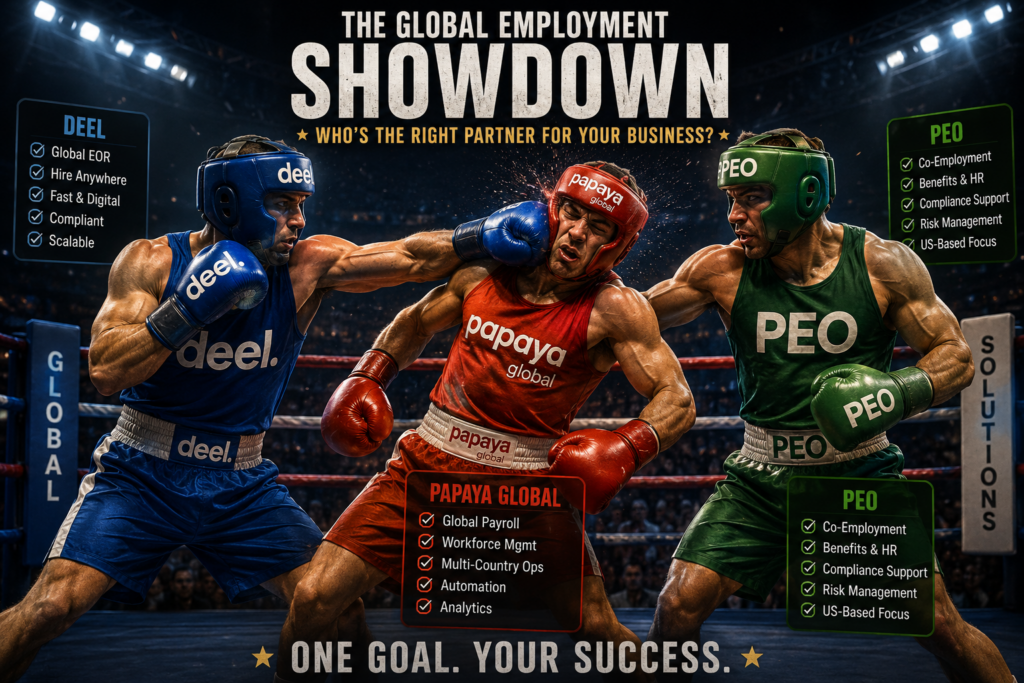
The Short Answer
If you’re hiring employees outside the United States, Papaya Global and Deel are Employer of Record (EOR) platforms built for that job. If your workforce is primarily U.S.-based, a traditional PEO almost always delivers better value, deeper HR support, and lower cost. The right choice depends almost entirely on where your people actually work.
This guide breaks down the Papaya Global vs Deel vs traditional PEO comparison so you can stop guessing and start making a confident decision.
What Is an Employer of Record (EOR) and How Does It Work?
An Employer of Record is a third-party company that legally employs workers on your behalf in a foreign country. When you use Papaya Global or Deel, they become the legal employer of your international hire — handling local payroll, taxes, statutory benefits, and compliance — while you direct the day-to-day work. You pay a monthly per-employee fee and avoid having to set up your own legal entity abroad.
EOR platforms like Deel and Papaya Global are purpose-built for cross-border employment complexity. According to the U.S. Department of Labor, employment law varies dramatically by country, covering everything from mandatory severance to required leave policies — details that can expose a U.S. company to serious legal risk if mishandled.
What Is a Traditional PEO and How Does It Differ?
A Professional Employer Organization (PEO) enters a co-employment relationship with U.S.-based businesses. The PEO becomes the employer of record for tax and benefits purposes domestically, giving your employees access to Fortune 500-level health insurance, 401(k) plans, and HR infrastructure — typically at a lower cost than you could negotiate independently.
According to NAPEO, businesses that use PEOs grow 7–9% faster and have 10–14% lower employee turnover than companies that don’t. That’s because a PEO is doing far more than payroll — it’s acting as your outsourced HR department for compliance, benefits administration, workers’ compensation, and risk management.
In our experience matching hundreds of businesses across our network of 40+ vetted PEO providers, traditional PEOs are almost always the better fit when 80% or more of a company’s workforce is U.S.-based.
Comparing PEOs is easier when you know your baseline cost. Our free calculator shows what a PEO would cost for your company in 60 seconds — no call needed.
Papaya Global vs Deel: Key Differences
Both are EOR platforms, but they target slightly different buyer profiles. Here’s how they compare head to head.
Deel
Deel launched in 2019 and became one of the fastest-growing HR tech companies by making international contractor and employee hiring feel almost as simple as domestic hiring. Deel supports 150+ countries, offers an intuitive dashboard, and has added a growing suite of domestic HR tools. It’s popular with startups and mid-market companies that need to move fast and hire globally without a dedicated international HR team.
Deel pricing for EOR services typically runs $499–$599 per employee per month, with contractor management starting lower. Additional modules like Deel HR, payroll, or equity management are priced separately.
Papaya Global
Papaya Global targets larger enterprises that need global payroll consolidation across multiple countries with deep reporting, compliance automation, and integrations with enterprise HRIS platforms like Workday and SAP. Papaya operates in 160+ countries and is particularly strong if you need a unified global payroll dashboard alongside EOR services.
Papaya Global EOR pricing typically starts at $650–$770 per employee per month and scales based on country and headcount. Papaya’s payroll-as-a-service model adds another pricing layer for companies managing mixed global/local payrolls.
Head-to-Head Comparison: Papaya Global vs Deel vs Traditional PEO
| Feature | Deel | Papaya Global | Traditional PEO |
|---|---|---|---|
| Best For | Startups hiring globally fast | Enterprises with complex global payroll | U.S.-focused SMBs (5–500 employees) |
| Countries Covered | 150+ | 160+ | United States only (most providers) |
| Typical Cost (per EE/month) | $499–$599 | $650–$770 | $100–$200 (or 2–12% of payroll) |
| Benefits Quality (U.S.) | Limited | Limited | Fortune 500-level health, 401(k), FSA |
| HR Support Depth | Moderate (tech-first) | Moderate (enterprise integrations) | High (dedicated HR team) |
| Workers’ Comp Coverage | Varies by country | Varies by country | Yes, full U.S. coverage |
| Contractor Management | Strong | Available | Rare / limited |
| ESAC/IRS Certification | N/A | N/A | Yes (top-tier PEOs) |
When to Use Deel or Papaya Global
EOR platforms make sense in specific scenarios. Here’s when an international EOR is the right call:
You’re Hiring Employees in Countries Where You Have No Legal Entity
Setting up a legal entity in Germany, Brazil, or Singapore can take months and cost tens of thousands of dollars in legal fees. If you need to hire quickly — or you’re testing a new market — Deel or Papaya Global lets you get someone on payroll within days without entity setup.
Your International Headcount Is Small (1–10 Employees Per Country)
Once you reach 15–20 employees in a single country, the math usually favors setting up your own entity and running local payroll. Below that threshold, EOR platforms are cost-effective and dramatically simpler.
You’re Managing Global Contractors Alongside Employees
Deel in particular has built a strong contractor management platform that handles payments in 150+ currencies, compliance checks, and misclassification risk. If your global team is a mix of employees and independent contractors, Deel’s unified platform is genuinely useful.
Be aware that hidden fees can accumulate on EOR platforms — the per-employee sticker price rarely tells the full story. Our post on hidden fees in HR platforms applies equally well when evaluating international EOR contracts.
When to Use a Traditional PEO Instead
A traditional PEO wins when your priorities are U.S.-based HR excellence, cost efficiency, and benefits quality — not international coverage.
Your Team Is Mostly U.S.-Based
If 80–90% of your employees work in the United States, spending $500+ per month per person on an EOR platform’s domestic HR features is overkill. A traditional PEO will give you more HR support, better benefits, and dedicated compliance guidance for $100–$200 per employee per month — or 2–12% of payroll depending on the provider.
Benefits Are a Competitive Differentiator for You
EOR platforms offer local statutory benefits abroad, but they can’t replicate the U.S. group health insurance leverage that a PEO brings. Top PEOs aggregate thousands of employees across their client base, giving small businesses access to large-group health rates they could never negotiate alone. For context, BLS data consistently shows that employer-sponsored health insurance is the top benefit that drives U.S. employee retention.
You Need Hands-On HR Support, Not Just Software
Deel and Papaya Global are fundamentally technology platforms. Traditional PEOs pair software with dedicated HR professionals who handle employee relations issues, handbook updates, ACA reporting, and state compliance changes. If your HR function is lean, that human support layer matters enormously.
If you’re comparing traditional PEO providers on cost and features, our Insperity cost comparison and our Gusto vs Justworks breakdown are good starting points before you talk to a provider.
The Hybrid Approach: PEO for U.S. + EOR for International
Based on our analysis of 40+ PEO providers, the most common real-world solution for growing companies isn’t choosing one over the other — it’s running both. A traditional PEO handles your U.S. workforce with full HR, benefits, and compliance coverage. Deel or Papaya Global handles your handful of international employees without requiring entity setup abroad.
This hybrid model is particularly effective for companies with 20–200 U.S. employees and 1–15 international hires spread across multiple countries. The U.S. PEO relationship delivers the greatest ROI domestically, while the EOR platform keeps international compliance manageable without legal entity overhead.
Use our free PEO cost calculator to get a quick baseline on what the U.S. side of that equation would cost your company before you start comparing quotes.
Cost Summary: What You’ll Actually Pay
Pricing transparency is a major pain point across all three categories. Here’s a realistic breakdown based on a company with 50 U.S. employees and 5 international employees:
| Scenario | Estimated Monthly Cost | Notes |
|---|---|---|
| Traditional PEO (50 U.S. employees) | $7,500–$10,000/mo | Includes HR, benefits admin, compliance |
| Deel EOR (5 international employees) | $2,500–$3,000/mo | Varies by country; excludes local benefits costs |
| Papaya Global EOR (5 international employees) | $3,250–$3,850/mo | Better fit if enterprise HRIS integration needed |
| Hybrid: PEO + Deel | $10,000–$13,000/mo | Best of both worlds for most growing companies |
Note: The IRS recognizes Certified PEOs (CPEOs) as having met rigorous financial and reporting standards — a designation that neither EOR platforms nor non-certified PEOs hold. If you’re considering a traditional PEO, CPEO status is a meaningful trust signal.
The Bottom Line
Papaya Global and Deel are genuinely excellent tools — for the job they’re designed to do. If you’re building a globally distributed team across multiple countries, they reduce compliance risk and eliminate entity setup headaches. If your business is primarily U.S.-based and you want better benefits, real HR support, and lower per-employee cost, a traditional PEO beats both platforms handily.
Most growing companies land somewhere in between, and a hybrid approach is usually the pragmatic answer. The key is understanding your actual workforce composition before committing to any platform or provider.
Ready to Find the Right Fit for Your Team?
PEO Marketplace has matched hundreds of U.S. businesses with the right PEO from our network of 40+ vetted providers — at no cost to you. Book a free 15-minute consultation and we’ll tell you exactly what setup makes sense for your headcount, locations, and budget.
Not ready to book a call? Get a free Benefits Benchmark Report for your industry — we will email you a breakdown of what companies your size are paying for HR, benefits, and workers comp so you can compare on your own timeline.
Frequently Asked Questions
Can a traditional PEO handle international employees?
Most traditional PEOs operate exclusively within the United States and cannot legally employ workers in foreign countries. If you have international employees, you’ll need a separate Employer of Record platform like Deel or Papaya Global, or establish your own foreign legal entity. Some larger PEOs have international partnerships, but these are typically arranged case by case and may not offer the same coverage depth as a dedicated EOR provider.
Is Deel or Papaya Global better for a small business?
Deel is generally the better fit for small businesses hiring internationally because it offers a simpler onboarding experience, competitive pricing starting around $499 per employee per month, and strong contractor management tools. Papaya Global is built more for enterprise-scale organizations that need consolidated global payroll and deep integrations with platforms like Workday or SAP. Small businesses rarely need that level of infrastructure.
What does a PEO cost compared to an EOR platform?
Traditional PEOs typically cost $100–$200 per U.S. employee per month, or 2–12% of total payroll, and include comprehensive HR services, benefits administration, and compliance support. EOR platforms like Deel ($499–$599/month) and Papaya Global ($650–$770/month) cost significantly more per employee but cover international markets that a domestic PEO cannot. For U.S.-based teams, the traditional PEO offers far better value per dollar spent.
Do I need to set up a legal entity to use Deel or Papaya Global?
No — that’s precisely the value proposition of an EOR platform. Deel and Papaya Global become the legal employer in each country on your behalf, which means you can hire internationally without establishing a foreign subsidiary or legal entity. This can save months of setup time and tens of thousands of dollars in legal costs, especially when you’re hiring fewer than 15–20 employees in a single country.
What is a Certified PEO (CPEO) and does it matter?
A Certified PEO is a Professional Employer Organization that has met IRS requirements for financial stability, background checks, and reporting practices — a designation neither EOR platforms nor uncertified PEOs carry. CPEO status matters because it shifts certain federal tax liabilities to the PEO, protecting your business from payroll tax risk. When comparing traditional PEO providers, CPEO certification is a meaningful indicator of reliability and financial health.