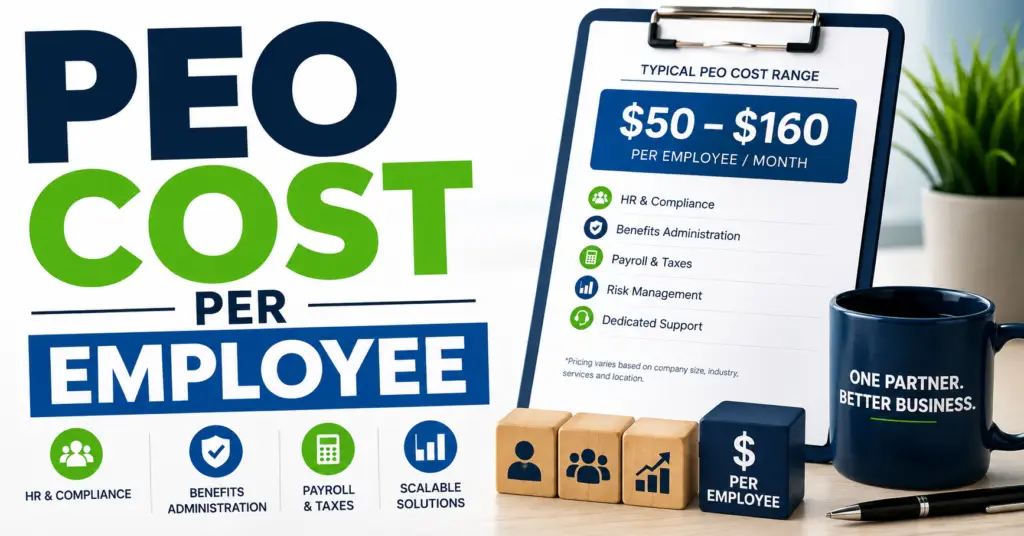
A PEO typically costs between $80 and $180 per employee per month (PEPM), or roughly 2% to 12% of your total annual payroll. The wide range exists because pricing depends on your industry, headcount, benefits selections, and which pricing model the PEO uses. Understanding PEO cost per employee before you start shopping puts you in a much stronger position to evaluate quotes and avoid paying for services you don’t need.
What Is PEO Pricing and How Does It Work?
A PEO — Professional Employer Organization — enters a co-employment arrangement with your business, handling payroll, benefits administration, HR compliance, and workers’ compensation under a shared employer structure. You pay for that service in one of two ways: a flat per-employee-per-month fee, or a percentage of your total payroll. Some providers blend both models.
According to NAPEO, businesses that use PEOs grow 7–9% faster and have 10–14% lower employee turnover than those that manage HR independently. That ROI context matters when you’re evaluating cost — you’re not just paying for administration, you’re buying access to Fortune 500-level benefits pricing, compliance infrastructure, and shared HR expertise.
In our experience matching hundreds of businesses across 40+ vetted PEO providers, most small and mid-size companies land somewhere between $100 and $150 PEPM when you account for their actual headcount and payroll structure. Here’s how the full picture breaks down.
Bundled vs. Unbundled PEO Pricing: What’s the Difference?
The two dominant pricing structures you’ll encounter are bundled (all-inclusive) and unbundled (à la carte). Choosing the wrong model for your business is one of the most common ways companies overpay for a PEO.
Bundled Pricing
Bundled pricing packages all core services — payroll processing, HR support, compliance, benefits administration, and sometimes workers’ comp — into a single PEPM or payroll percentage fee. Providers like Insperity and TriNet typically use this approach. It’s predictable and easy to budget, but you may pay for features you never use.
Unbundled Pricing
Unbundled pricing lets you select specific services and pay only for what you need. This can be more cost-effective for companies that already have robust internal HR or don’t need the full suite of benefits administration tools. The tradeoff is that add-ons can stack up quickly and make it harder to do apples-to-apples comparisons between providers.
If you’re comparing specific providers, our deep dives on Insperity’s cost structure versus other PEOs and Gusto vs. Justworks pricing give you a real side-by-side look at how these models play out in practice.
Want to see the actual numbers before talking to anyone? Our free PEO calculator gives you a realistic cost range based on your company size and payroll — no commitment, no call.
PEO Cost Per Employee: Real Numbers by Company Size
Based on our analysis of 40+ PEO providers and real quotes we’ve seen across client engagements, here’s what businesses actually pay at different headcount levels in 2026.
| Company Size | Typical PEPM Range | % of Payroll Range | Notes |
|---|---|---|---|
| 1–10 employees | $130–$180 PEPM | 8–12% | Higher per-head cost; some PEOs have minimums |
| 11–50 employees | $100–$150 PEPM | 4–8% | Sweet spot for most PEO providers |
| 51–150 employees | $80–$120 PEPM | 3–6% | Strong negotiating leverage; bundled deals improve |
| 150+ employees | $80–$100 PEPM | 2–4% | May be approaching threshold for self-insured benefits |
These ranges reflect admin fees only. They do not include the cost of the benefits themselves — health insurance, dental, vision, 401(k) — which are passed through separately based on your employee elections.
What’s Actually Included in PEO Fees?
Not every provider defines “included” the same way. Here’s what the core admin fee typically covers — and what tends to be an add-on.
Usually Included in the Base Fee
- Payroll processing and direct deposit
- Payroll tax filing (federal, state, local)
- New hire onboarding and paperwork
- HR compliance support and policy templates
- Access to benefits administration platform
- Workers’ compensation coverage (in most cases)
- Employer Practices Liability Insurance (EPLI) access
Often Billed Separately or as Add-Ons
- 401(k) plan administration fees
- Time and attendance software
- ATS or applicant tracking tools
- Performance management modules
- State unemployment insurance management
- Out-of-state employee setup fees
- Termination or offboarding processing fees
This is exactly why we wrote our guide on hidden fees to watch for with ADP TotalSource — some of the biggest national PEOs are skilled at quoting low base rates and padding the contract with line-item surprises.
The 5 Biggest Factors That Drive Your PEO Cost Per Employee
Your quote isn’t random. PEO underwriters look at specific risk and complexity signals to set your pricing. Here’s what moves the number most.
1. Industry and Workers’ Comp Risk Class
A tech company with 20 remote employees and a construction firm with 20 field workers will get dramatically different quotes. High-risk industries — construction, manufacturing, healthcare, transportation — carry elevated workers’ comp modifier rates, which directly increases your PEO cost. The Bureau of Labor Statistics injury and illness data is what actuaries use to establish those risk classes.
2. Total Payroll Volume
For percentage-based pricing, higher payroll means higher fees in absolute dollars — even if the percentage itself stays flat. For PEPM pricing, payroll volume influences negotiating power. A company paying $5M in annual wages has far more leverage than one at $500K.
3. Employee Benefits Elections
The benefits themselves — medical, dental, vision, life, disability — are separate from the admin fee, but your benefits tier selection affects how the PEO prices the overall relationship. Richer plan elections tend to attract younger, healthier workforces, which can actually reduce risk pricing over time.
4. Multi-State Operations
Every state you operate in adds compliance complexity. Multi-state employers should expect higher base fees or per-state surcharges because the PEO has to maintain compliance infrastructure across multiple jurisdictions. The Department of Labor maintains state-by-state wage and hour requirements that PEOs must track and apply correctly.
5. Contract Length and Commitment
Annual contracts almost always yield better pricing than month-to-month arrangements. If you’re confident in your provider choice, committing to a 12 or 24-month term can shave 5–10% off your PEPM rate with most providers.
PEO Cost vs. Doing It In-House: The Real Comparison
The honest question isn’t just “how much does a PEO cost?” — it’s “how much does NOT using a PEO actually cost?” Consider what you’re replacing or supplementing:
- HR manager salary: $65,000–$95,000/year fully loaded (salary + benefits + payroll taxes)
- Payroll software: $1,200–$6,000/year depending on headcount
- Benefits broker fees and administration: $500–$2,500/year
- Employment law compliance counsel: $3,000–$15,000/year on retainer
- Workers’ comp policy (standalone): Often 20–40% more than PEO group rates
NAPEO research consistently shows that PEO clients save an average of $1,775 per employee per year when total HR costs are compared side-by-side. For a 25-person company, that’s roughly $44,000 in annual savings — before accounting for the time your leadership team gets back.
Use our free PEO cost calculator to run the numbers for your specific headcount and payroll. It takes about 90 seconds and gives you a realistic range without requiring you to talk to a salesperson first.
How to Get a Fair PEO Quote (And Not Overpay)
Getting multiple quotes is the single most effective thing you can do. In our experience, businesses that only talk to one PEO overpay by 15–25% compared to those who run a competitive process. Here’s what to do:
- Request itemized pricing — don’t accept a single blended number without a breakdown of what’s included
- Ask for the workers’ comp rate separately — some providers embed it in the PEPM in a way that obscures the real cost
- Compare implementation fees — these range from $0 to $2,000+ depending on the provider
- Clarify renewal pricing — some PEOs offer a low first-year rate and increase significantly at renewal
- Check ESAC and IRS certification — certified PEOs offer stronger compliance guarantees and tax benefits under IRC §3511
If you’d rather have an expert run this process for you, our free PEO matching service compares quotes from multiple vetted providers and gives you an unbiased recommendation based on your business profile — at no cost to you.
Ready to See What PEOs Will Actually Charge Your Business?
We match you with the right PEO from our network of 40+ vetted providers — free, unbiased, and on your timeline. Book a 20-minute call and we’ll do the comparison work for you.
Not ready to book a call? Get a free Benefits Benchmark Report for your industry — we will email you a breakdown of what companies your size are paying for HR, benefits, and workers comp so you can compare on your own timeline.
Frequently Asked Questions
What is the average PEO cost per employee per month?
The average PEO cost per employee per month ranges from $80 to $180 PEPM in 2026, with most small and mid-size businesses landing between $100 and $150 PEPM depending on their industry, headcount, and selected services. This fee covers administration only — the cost of health insurance and other benefits is separate and based on employee elections.
Is PEO pricing based on per employee or percentage of payroll?
PEOs use both models, and the right choice depends on your average employee salary. If your average annual salary per employee is above $60,000, a flat PEPM rate typically works out cheaper than a percentage-of-payroll model. Lower average salaries often make percentage-based pricing more favorable.
Are there hidden fees with PEOs I should watch out for?
Yes — implementation fees, out-of-state setup charges, termination fees, and 401(k) administration costs are commonly excluded from base quotes. Always request an itemized contract and ask specifically about fees for state registrations, offboarding, and mid-year plan changes before signing.
How many employees do you need before a PEO makes financial sense?
Most PEOs have minimum headcount requirements of 3–5 employees, but the financial break-even point for most businesses is around 10–15 employees, where the cost of dedicated HR infrastructure starts to exceed PEO fees. Some providers, particularly those targeting very small businesses, offer competitive pricing starting at just one or two employees.
Do PEO fees include health insurance costs?
No — PEO admin fees and health insurance premiums are two separate line items. The PEO gives you access to its group health plan at negotiated rates, but the actual premium cost is determined by your employees’ plan elections and the carrier’s rates for your group. You pay the admin fee to the PEO and the premium cost to the carrier (often invoiced together).