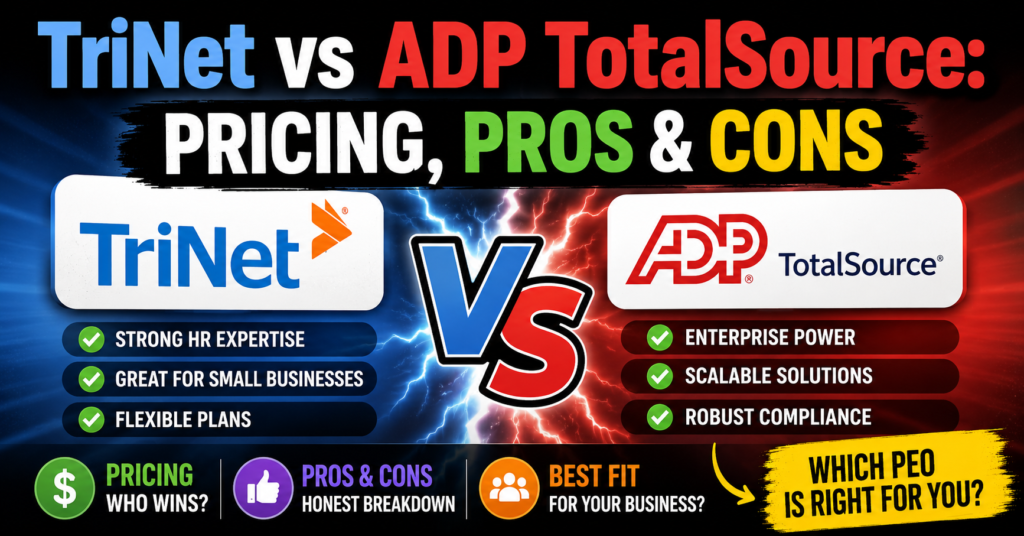
TriNet vs ADP TotalSource: Quick Answer
TriNet and ADP TotalSource are two of the largest professional employer organizations (PEOs) in the U.S., but they serve different types of businesses. TriNet is generally better for venture-backed startups and knowledge-economy businesses in tech, life sciences, and professional services. ADP TotalSource is a stronger fit for mid-market companies that want deep HR infrastructure, a household-name benefits carrier network, and the backing of the world’s largest payroll brand. Both carry IRS Certified PEO status, which matters if you want the liability protections that come with co-employment.
In our experience matching hundreds of businesses across 40+ vetted PEO providers, the right choice almost always comes down to company size, industry, and what you prioritize most — cost predictability, benefits quality, or hands-on HR support. This guide breaks it all down so you can decide without a sales pitch in your ear.
How TriNet Pricing Works in 2026
TriNet pricing is structured as a per-employee-per-month (PEPM) fee, typically bundled to include payroll, HR administration, and access to their benefits marketplace. Based on our analysis, TriNet pricing in 2026 generally lands in the following ranges:
- Base HR platform fee: $12–$18 PEPM depending on company size and tier
- Benefits administration add-on: Often embedded into a bundled quote
- Full-service PEPM (all-in): Typically $150–$350 per employee per month for smaller companies (10–50 employees), with the cost per employee dropping as headcount grows
- Minimum contract length: Usually 12 months with a renewal clause
TriNet uses industry-specific pricing verticals — so a tech startup of 20 employees will see different rates than a 20-person nonprofit. That specialization is one of their biggest selling points, but it also makes apples-to-apples comparison harder without a quote.
Comparing PEOs is easier when you know your baseline cost. Our free calculator shows what a PEO would cost for your company in 60 seconds — no call needed.
How ADP TotalSource Pricing Works in 2026
ADP TotalSource typically prices as a percentage of total payroll rather than a flat PEPM, though they do offer hybrid models for larger accounts. Here is what to expect:
- Payroll-percentage model: Typically 2%–5% of gross payroll for companies under 100 employees
- PEPM hybrid option: Available for 50+ employee companies
- Implementation fee: ADP often charges a one-time setup fee that can range from $500 to several thousand dollars depending on complexity
- Contract terms: 12-month minimum; early termination fees apply and can be significant — see our full breakdown of hidden fees with ADP TotalSource before you sign
The percentage-of-payroll model means your PEO costs rise automatically as you give raises or hire senior talent — something TriNet’s PEPM model avoids. For fast-growing companies or those with highly compensated employees, this distinction can meaningfully affect your total cost.
TriNet vs ADP TotalSource: Side-by-Side Comparison
Here is a direct comparison across the dimensions that matter most for 10–150 employee companies evaluating both platforms in 2026.
| Category | TriNet | ADP TotalSource |
|---|---|---|
| Pricing Model | PEPM (per employee/month) | % of payroll or PEPM hybrid |
| Typical Cost (10–50 EEs) | $150–$250 PEPM all-in | 2%–5% of gross payroll |
| IRS Certified PEO | ✅ Yes | ✅ Yes |
| Best For | Tech, startups, life sciences | Mid-market, multi-state ops |
| Benefits Quality | Strong — industry-tailored plans | Strong — major carrier access |
| HR Support Model | Dedicated HR team per vertical | Dedicated HR Business Partner |
| Payroll Technology | TriNet platform (modern UX) | ADP Workforce Now (enterprise) |
| Contract Flexibility | 12-month; moderate exit terms | 12-month; stricter exit penalties |
| Workers’ Comp Included | ✅ Yes | ✅ Yes |
| Risk & Compliance Support | Strong, vertical-specific | Strong, broad compliance tools |
TriNet Pros and Cons
TriNet Strengths
- Industry verticalization: TriNet builds HR and benefits packages tailored to specific industries — their tech and life sciences offerings are particularly competitive. If your employees expect Google-caliber benefits, TriNet can deliver.
- Predictable PEPM pricing: Flat per-employee fees make budgeting easier, especially if your payroll includes high earners who would inflate a percentage-based model.
- Strong benefits for small headcount: TriNet gives 10-person companies access to the same Fortune 500-level health plans that larger companies use — a major competitive advantage for hiring.
- Modern platform experience: The TriNet HR platform is cleaner and more employee-friendly than many legacy enterprise tools.
TriNet Weaknesses
- Cost at scale: PEPM pricing can become expensive as you grow past 100 employees. The per-employee fee doesn’t drop as dramatically as competitors when you hit mid-market scale.
- Support inconsistency: Some clients report variability in the quality of their dedicated HR team depending on the vertical and region. Response times during peak periods (open enrollment, tax season) can lag.
- Limited customization below the surface: TriNet’s industry-packaged approach means less flexibility for businesses that don’t fit neatly into one of their verticals.
ADP TotalSource Pros and Cons
ADP TotalSource Strengths
- Enterprise-grade infrastructure: ADP Workforce Now is one of the most feature-rich HRIS platforms on the market. If you need deep reporting, multi-state payroll, and compliance documentation, the system delivers.
- Brand trust with carriers: ADP’s scale gives them negotiating power with major insurance carriers. Benefits pricing for 50–150 employee companies can be genuinely competitive.
- Dedicated HR Business Partner: TotalSource assigns a dedicated HRBP who serves as your outsourced HR director — a meaningful advantage if your internal HR is thin.
- Proven compliance depth: For companies operating across multiple states, ADP’s compliance engine is difficult to beat. They track regulatory changes at the federal, state, and local level. According to the Department of Labor, wage and hour compliance violations are among the most common and costly for small businesses — this is where ADP earns its fee.
ADP TotalSource Weaknesses
- Percentage-of-payroll pricing gets expensive: As salaries rise, your PEO bill rises with them — even if the HR workload doesn’t. This is a real cost trap for companies with high average salaries. Before signing, read our post on hidden fees with ADP TotalSource.
- Bureaucratic sales process: ADP is a massive company. Getting a clear quote, negotiating terms, and reaching the right decision-maker can take longer than with a more agile PEO.
- Exit penalties: ADP TotalSource contracts include termination clauses that can cost you significantly if you need to switch providers mid-year. Read every line before signing.
- Platform complexity: ADP Workforce Now is powerful but has a steep learning curve. Small HR teams can feel overwhelmed without dedicated training support.
Which PEO Is Right for Your Company Size?
10–30 Employees
At this size, TriNet typically wins. Their PEPM pricing is more predictable, their benefits quality is strong for a small headcount, and their tech-focused verticals serve startups and founder-led businesses well. ADP TotalSource can feel oversized and bureaucratic for companies under 30 employees. If you’re in this range and trying to compete for talent, TriNet’s benefits marketplace is a genuine hiring asset.
30–75 Employees
This is the competitive middle ground where both providers make sense — and where pricing comparison matters most. Use our free PEO cost calculator to see what each would actually cost you based on your payroll. ADP begins to show its value here with compliance depth and carrier relationships. TriNet still wins on platform experience and industry specialization. The right answer depends heavily on your industry and internal HR capacity.
75–150 Employees
At this size, ADP TotalSource’s enterprise infrastructure and negotiated benefits rates start to outperform. You’ll also benefit more from the dedicated HRBP model as HR complexity grows. That said, if you’re in tech or life sciences, TriNet’s vertical specialization continues to command a premium for good reason. Also worth comparing at this stage: how Insperity stacks up as a third option in this size band.
What About Alternatives to Both?
TriNet and ADP TotalSource are excellent PEOs, but they’re not the right fit for every business. According to NAPEO, businesses that use PEOs grow 7–9% faster and have 10–14% lower employee turnover than those that don’t — but only when the PEO is the right match. If you’re evaluating other options, our comparison of Gusto vs Justworks covers two leaner platforms better suited for companies under 25 employees with simpler HR needs.
In our analysis of 40+ PEO providers, we consistently find that businesses get better outcomes — both on pricing and service quality — when they match to a PEO that aligns with their specific industry, headcount, and benefit priorities rather than defaulting to the biggest brand name.
How to Get the Best Deal on Either Platform
- Always negotiate: Both TriNet and ADP TotalSource have room in their pricing, especially on implementation fees and admin markups. Never accept the first quote.
- Get multiple proposals simultaneously: Using a PEO broker like PEO Marketplace means providers compete for your business, which drives pricing down.
- Watch the contract exit terms: Ask specifically what happens if you need to cancel before the contract ends and get that answer in writing.
- Ask about rate increases: Both platforms can raise rates at renewal. Ask about historical rate increase percentages before you commit.
Ready to see personalized quotes from TriNet, ADP TotalSource, and other top-tier PEOs side by side? Our team at PEO Marketplace does this every day — at no cost to you. Book a free 30-minute consultation below and we’ll handle the comparison work so you don’t have to.
Get a Free Side-by-Side PEO Comparison
Our licensed advisors compare TriNet, ADP TotalSource, and 100+ other providers for your specific company — free, unbiased, no pressure.
Not ready to book a call? Get a free Benefits Benchmark Report for your industry — we will email you a breakdown of what companies your size are paying for HR, benefits, and workers comp so you can compare on your own timeline.
Frequently Asked Questions
Is TriNet or ADP TotalSource cheaper for a 25-person company?
For most 25-person companies, TriNet’s PEPM pricing comes out to a predictable monthly cost, while ADP TotalSource’s percentage-of-payroll model can vary significantly based on your average salaries. If your team earns above-average wages, TriNet will typically be less expensive at this headcount. Use our free PEO cost calculator to run your specific numbers before requesting quotes.
Do both TriNet and ADP TotalSource offer health insurance?
Yes, both PEOs offer comprehensive health insurance as part of their co-employment model, giving small businesses access to large-group health plans they couldn’t access on their own. TriNet’s plans are often more tailored by industry vertical, while ADP TotalSource leverages its scale to negotiate competitive rates with major national carriers. Both include dental, vision, and ancillary benefit options.
Can I switch from TriNet to ADP TotalSource mid-year?
Technically yes, but it’s rarely advisable due to the disruption it causes to payroll, benefits, and employee records. Both providers have contract terms with early termination clauses, so switching mid-year can trigger financial penalties. If you’re considering a switch, plan it for the start of a new calendar year or a contract renewal window and work with a PEO advisor to manage the transition.
Are TriNet and ADP TotalSource IRS Certified PEOs?
Yes, both TriNet and ADP TotalSource hold IRS Certified PEO (CPEO) status, which means the IRS has verified their financial integrity, tax compliance history, and operational standards. CPEO status matters because it shifts federal employment tax liability to the PEO, protecting your business from payroll tax exposure. You can verify CPEO status directly on the IRS website.
What’s the minimum employee count for TriNet and ADP TotalSource?
TriNet will generally work with companies as small as 5 employees, though their sweet spot is 10–200 employees. ADP TotalSource typically prefers clients with at least 10 employees and becomes more cost-competitive as you approach 50 and beyond. If you’re under 10 employees, lighter-weight platforms like Gusto or Justworks may be a better starting point before you graduate to a full-service PEO.