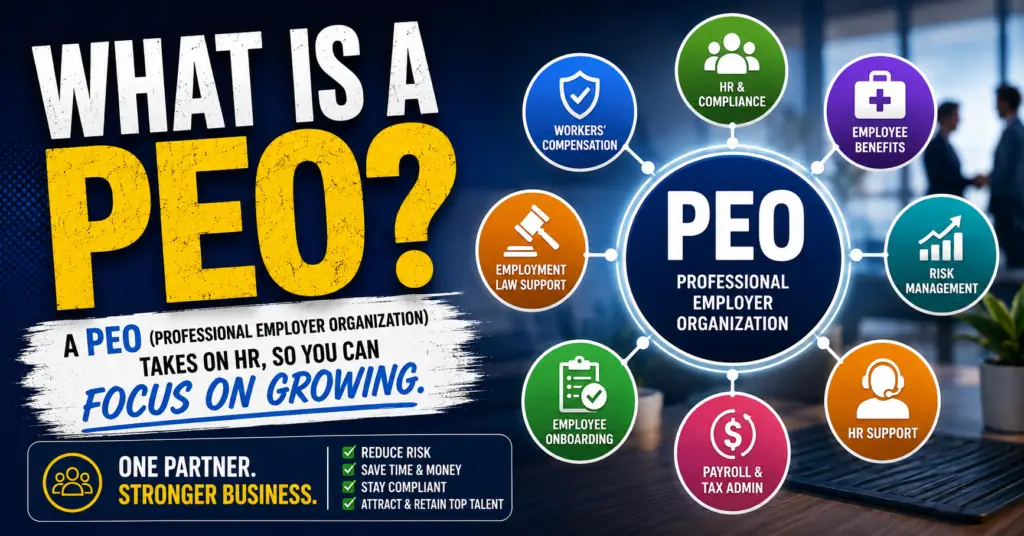
A Professional Employer Organization (PEO) is a company that handles payroll, benefits, HR compliance, and workers’ compensation on behalf of small and mid-size businesses through an arrangement called co-employment. In plain terms: you keep owning & running your business and managing your people day-to-day, while the PEO takes on the administrative and employer related responsibilities that slow you down. According to NAPEO, businesses that use a PEO grow 7–9% faster and have 10–14% lower employee turnover than those that don’t.
What Is a PEO and How Does It Work?
A PEO acts as a co-employer of your workforce. That means your employees are technically employed by both your company and the PEO at the same time — you control the work, the culture, the hiring, and the firing, while the PEO holds the employer-of-record status for payroll taxes, benefits, and compliance purposes.
Here’s the basic flow:
- You sign a Client Service Agreement (CSA) with the PEO.
- Your employees become co-employees of the PEO and your company.
- You run payroll through the PEO’s platform — they file taxes under their Federal Employer Identification Number (FEIN).
- Your employees gain access to Fortune 500-level benefits pooled across the PEO’s entire client base.
- The PEO handles compliance, workers’ comp claims, and HR administration.
The IRS formally recognizes Certified Professional Employer Organizations (CPEOs) — a designation that carries strict financial and reporting requirements. You can verify a CPEO’s status directly on the IRS website. Working with a CPEO gives you additional federal tax protections that a non-certified PEO does not.
Not sure if a PEO makes sense for your business? Our free calculator shows you the real cost in 60 seconds — no call, no email, no commitment.
What Does a PEO Actually Do for Your Business?
Most PEOs cover the same core categories, though the depth of service varies significantly by provider. Based on our analysis of 40+ PEO providers at PEO Marketplace, here’s what you can typically expect:
Payroll and Tax Administration
The PEO processes payroll, withholds federal and state taxes, files W-2s, and handles all payroll tax deposits under their FEIN. This removes one of the most time-consuming and error-prone tasks from your plate. According to the IRS, payroll tax errors are among the most common compliance issues small businesses face.
Employee Benefits
This is often the biggest financial win. Because PEOs pool thousands of employees across hundreds of clients, they negotiate group rates on health insurance, dental, vision, life insurance, disability, and 401(k) plans that a 15-person company could never access on its own. Small businesses using a PEO can often offer benefits that rival enterprise-level packages — a major recruiting advantage in a tight labor market.
HR Compliance and Risk Management
Employment law is a moving target. PEOs help you stay compliant with federal, state, and local regulations — think FMLA, ADA, FLSA, I-9 verification, and anti-discrimination laws. Many providers also offer an employee handbook builder, HR consulting hotlines, and dedicated compliance alerts when new legislation passes.
Workers’ Compensation
PEOs typically provide workers’ comp coverage through their master policy, which often means lower rates than you’d find on your own — especially in high-risk industries. They also handle claims management, which can reduce your experience modification rate over time.
Onboarding and HR Technology
Most modern PEOs include an HRIS (Human Resources Information System) platform that handles onboarding, time tracking, PTO management, performance reviews, and employee self-service — all in one place.
Co-Employment: What You Control vs. What the PEO Controls
Co-employment is the legal foundation of the PEO model, and it’s the concept that confuses most first-time buyers. Here’s the clear breakdown:
| You Control | The PEO Controls |
|---|---|
| Who you hire and fire | Payroll tax filings and FEIN |
| Day-to-day work assignments | Benefits plan administration |
| Compensation decisions | Workers’ comp master policy |
| Company culture and values | Employer-of-record for tax purposes |
| Business strategy and direction | HR compliance infrastructure |
| Client relationships | Employment practices liability (in some plans) |
The bottom line: co-employment does not mean the PEO runs your company. Your employees still report to you. The PEO simply takes on the administrative and legal employer responsibilities that exist in the background.
What Does a PEO Cost in 2026?
PEO pricing comes in two main structures, and understanding the difference can save you thousands of dollars a year. In our experience matching hundreds of businesses to PEOs, most small companies are surprised by how much pricing varies — and how much hidden fees can inflate the real cost.
Per-Employee Per-Month (PEPM)
A flat monthly fee per employee, typically ranging from $80–$200 PEPM depending on the provider, your industry, and the services included. This model is easier to budget because costs scale predictably as you hire.
Percentage of Payroll
A percentage of your total gross payroll — usually between 2% and 12%. This model is common among larger PEOs like ADP TotalSource and Insperity. The upside: costs feel proportional. The downside: as salaries rise, so does your PEO bill. If your team earns above-average wages, PEPM is often the better deal.
For a full breakdown of what you’d actually pay, use our free PEO cost calculator — it factors in your headcount, industry, and state to give you a real number in under a minute.
Also worth reading: our deep dives on hidden fees with ADP TotalSource and the Insperity cost comparison — two of the most commonly evaluated enterprise PEOs.
Who Should Use a PEO?
PEOs work best for businesses that are growing faster than their HR infrastructure, operating in heavily regulated industries, or struggling to compete on benefits. Based on our analysis, the sweet spot is 5 to 500 employees — though we’ve matched companies as small as 2 and as large as 2,000.
You’re likely a strong PEO candidate if:
- You’re spending more than 5 hours a week on payroll and HR admin
- You’ve received a compliance notice or employment-related lawsuit
- Your health insurance renewal came back with a double-digit rate increase
- You’re hiring in multiple states and struggling with varying labor laws
- You’re losing candidates to competitors offering better benefits
According to the Bureau of Labor Statistics, employee benefits account for roughly 30% of total compensation costs for private-sector employers — meaning your ability to compete on benefits directly affects your ability to hire and retain talent.
What Are the Risks of Using a PEO?
PEOs aren’t perfect for every business. Here are the legitimate risks to weigh before signing a contract:
Loss of Benefits Customization
When you join a PEO’s master health plan, you’re joining a group — which means you may not be able to design a fully custom benefits package. Some PEOs offer more flexibility than others, so this matters more at larger headcounts.
Contract Lock-In
Most PEOs require a 12-month minimum contract with early termination fees. Switching mid-year — especially around open enrollment — can be complicated and costly. Always read the exit clause before you sign.
Vendor Dependency
If your PEO has financial trouble or gets acquired, it can disrupt your payroll and benefits. Sticking with a NAPEO member or IRS-certified CPEO significantly reduces this risk.
Not All PEOs Are Equal
The quality of HR support, technology, and account management varies enormously across providers. A PEO that’s great for a 200-person tech company may be a terrible fit for a 10-person construction firm. That’s exactly why working with an independent matching service like PEO Marketplace — rather than going direct — saves most businesses time and money. See how popular options compare in our Gusto vs. Justworks comparison.
How to Choose the Right PEO in 2026
Here’s the fast-track checklist our team uses when matching businesses to providers:
- CPEO certification: Is the PEO IRS-certified? If not, why not?
- NAPEO membership: Are they a member of the industry’s trade association?
- Industry experience: Have they worked with businesses in your sector?
- State coverage: Do they operate in all states where you have employees?
- Pricing transparency: Can they give you an all-in quote, not just a teaser rate?
- Technology: Does their HR platform match your needs and team’s tech comfort level?
- Dedicated support: Will you have a named account manager or call a generic help desk?
Our team has vetted 100+ PEOs across all of these dimensions. If you want a shortlist built around your specific business, start here — it takes about 3 minutes.
Frequently Asked Questions
What is a PEO in simple terms?
A PEO (Professional Employer Organization) is a company that shares employer responsibilities with you — handling payroll, benefits, taxes, and HR compliance while you keep full control over your team’s day-to-day work. It’s essentially outsourcing the administrative side of employment without giving up authority over your people or your business.
Does using a PEO mean I lose control of my employees?
No. Co-employment means the PEO becomes a legal employer for administrative purposes only — you still hire, manage, direct, and terminate employees as you see fit. The PEO handles the paperwork and compliance infrastructure in the background, not your company’s operations or culture.
How much does a PEO cost for a small business?
Most small businesses pay between $80 and $200 per employee per month, or 2%–12% of gross payroll depending on the pricing model. The actual cost depends on your headcount, industry risk level, state, and the services included — use our free PEO calculator to get a personalized estimate based on your specific situation.
What is the difference between a PEO and a staffing agency?
A staffing agency recruits and places temporary or contract workers, who are employees of the agency while they work at your business. A PEO co-employs your existing workforce for administrative purposes — your permanent employees stay with you, and the PEO simply takes on the employer-of-record responsibilities for payroll and compliance.
Is a PEO worth it for a small business with fewer than 10 employees?
Yes, in many cases — especially if you’re in a regulated industry, hiring in multiple states, or struggling to offer competitive health benefits. The benefits savings alone can offset the PEO fee for businesses as small as 2–3 employees, particularly when accessing group health rates that would otherwise be unavailable at that headcount.
Ready to Find the Right PEO for Your Business?
Our team has matched hundreds of businesses to the right PEO from our vetted network of 40+ providers. The consultation is free, unbiased, and takes about 20 minutes.
Not ready to book a call? Get a free Benefits Benchmark Report for your industry — we will email you a breakdown of what companies your size are paying for HR, benefits, and workers comp so you can compare on your own timeline.