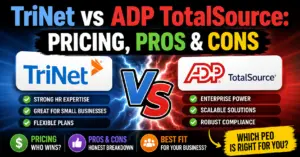
TriNet, Insperity, and ADP TotalSource are the three largest PEOs in the U.S., each serving thousands of businesses — but they are built for very different types of companies. TriNet targets venture-backed startups and professional services firms. Insperity leans toward established small and mid-size businesses that want white-glove HR service. ADP TotalSource is the enterprise-adjacent option with deep payroll infrastructure and broad integrations. Choosing the wrong one can cost you tens of thousands of dollars and months of frustration. This guide breaks all three down across every dimension that matters so you can go from three options to one confident choice.
What Is a PEO and Why Does the Provider Choice Matter So Much?
A Professional Employer Organization (PEO) enters a co-employment arrangement with your business, taking on employer-of-record responsibilities for payroll, benefits, workers’ compensation, and HR compliance. According to NAPEO, businesses that use a PEO grow 7–9% faster and have 10–14% lower employee turnover than those that go it alone. The right PEO amplifies those results. The wrong one creates service gaps, surprise fees, and an HR team that’s constantly calling a support line with no answer.
In our experience matching hundreds of businesses across 100+ vetted PEO providers, the single biggest mistake we see is choosing a PEO based on brand recognition alone. All three of these providers have strong brands. That doesn’t mean all three are right for your headcount, industry, or budget.
Comparing PEOs is easier when you know your baseline cost. Our free calculator shows what a PEO would cost for your company in 60 seconds — no call needed.
TriNet vs Insperity vs ADP: Side-by-Side Comparison
Before diving into the detail, here’s a quick reference table covering the metrics that decision-makers ask us about most often.
| Category | TriNet | Insperity | ADP TotalSource |
|---|---|---|---|
| Best For | Startups, VC-backed, tech | Established SMBs wanting premium HR | Mid-market, payroll-first companies |
| Typical Company Size | 5–500 employees | 5–5,000 employees | 10–1,000+ employees |
| Pricing Model | PEPM or % of payroll | % of payroll (custom) | PEPM or % of payroll |
| Estimated Monthly Cost | $100–$200 PEPM | 2–5% of gross payroll | $100–$175 PEPM |
| Dedicated HR Rep | Shared team model | Yes, dedicated | Shared team model |
| IRS CPEO Certified | Yes | Yes | Yes |
| Benefits Quality | Excellent (Fortune 500-level) | Excellent (comprehensive) | Good (broad but less curated) |
| Payroll Technology | Good (proprietary platform) | Good (proprietary platform) | Excellent (industry-leading) |
| Contract Flexibility | Annual contracts | Annual contracts | Annual contracts |
| Hidden Fee Risk | Medium | Low-Medium | Higher (see notes below) |
TriNet: Best for Startups and High-Growth Companies
What TriNet Does Well
TriNet has carved out a specific lane: fast-growing, often venture-backed companies in tech, professional services, financial services, and life sciences. Their benefits packages are genuinely competitive at Fortune 500 levels, which matters enormously when you’re trying to recruit engineers or senior talent. TriNet also offers industry-specific HR expertise, meaning your HR team actually understands the compliance nuances of your vertical — not just generic employment law.
Their technology platform is clean and functional. Onboarding, benefits enrollment, and payroll visibility are all reasonably intuitive for employees and administrators. For companies that need to move fast and look credible to new hires, TriNet delivers.
Where TriNet Falls Short
TriNet operates on a shared HR service model. You won’t get a dedicated HR rep who knows your company inside and out — you get a team. For some businesses, that’s fine. For others, especially those dealing with complex employee relations issues or multi-state compliance, that lack of continuity is a real friction point. TriNet’s pricing is also on the higher end of the PEPM spectrum, and cost can escalate quickly as headcount grows. If you’re a stable, headcount-steady business, TriNet may be overbuilt and overpriced for your needs.
Insperity: Best for Established SMBs That Want Premium HR Service
What Insperity Does Well
Insperity is widely regarded as the gold standard for service quality among large PEOs. Based on our analysis of 100+ PEO providers, Insperity consistently earns the highest satisfaction scores for dedicated HR support. Every client gets a dedicated HR specialist — a real person who learns your business, your culture, and your employee roster. That relationship-based model is rare at this scale and it genuinely shows in day-to-day experience.
Insperity’s benefits offerings are also top-tier. They offer access to comprehensive health, dental, vision, life, and disability plans through major carriers, plus strong 401(k) options. Their risk management and workers’ comp programs are mature and well-managed. For companies in industries with meaningful liability exposure — construction-adjacent services, healthcare, manufacturing — Insperity’s risk expertise adds real value. You can read more about how Insperity’s cost stacks up against other PEOs in our dedicated breakdown.
Where Insperity Falls Short
Insperity’s pricing is typically percentage-of-payroll based, and at 2–5% of gross wages, it can get expensive — particularly for companies with higher average salaries. A 50-person tech company paying $120K average salaries could find Insperity significantly more expensive than a per-employee-per-month alternative. Their technology platform is functional but not as sleek as some newer competitors. And like the others, they require annual contracts, so you’re committed once you sign.
ADP TotalSource: Best for Payroll-First, Mid-Market Businesses
What ADP TotalSource Does Well
ADP is the most recognized name in payroll, and ADP TotalSource — their PEO offering — inherits that infrastructure. If your business already runs on ADP payroll, the migration path to TotalSource is relatively smooth. Their compliance technology is robust, their tax filing accuracy is industry-leading, and their integrations with accounting platforms, time-tracking tools, and benefits providers are extensive. According to the Bureau of Labor Statistics, payroll compliance errors cost U.S. businesses billions annually — ADP’s strength here is real and measurable.
For mid-market companies with 50–500+ employees who prioritize payroll accuracy, ADP compliance depth, and broad integrations over boutique HR service, TotalSource is a serious contender.
Where ADP TotalSource Falls Short
ADP’s reputation for hidden fees is well-documented — and it’s one of the most common complaints we hear from businesses that come to us after a bad PEO experience. Implementation fees, W-2 fees, year-end processing charges, and module add-ons can stack up in ways that weren’t obvious during the sales process. We’ve covered this in detail in our post on ADP TotalSource hidden fees — it’s worth a read before you sign anything. ADP also operates on a shared service model, so the personal HR relationship that Insperity offers is generally not available here.
ADP TotalSource’s size can also work against smaller clients. If you’re a 15-person company, you’re not a priority account. Service responsiveness tends to correlate with revenue size at ADP, and smaller businesses often feel that gap.
Pricing Deep Dive: What Will You Actually Pay?
Pricing is where most business owners get tripped up because all three providers quote differently and negotiate differently. Here’s what to expect in practice:
- TriNet typically quotes $100–$200 per employee per month depending on your industry, headcount, and benefits selections. Startups in tech often land at the higher end due to richer benefit packages.
- Insperity quotes as a percentage of gross payroll, typically 2–5%. A company with $3M annual payroll could pay $60,000–$150,000 per year. The spread is wide and heavily negotiated.
- ADP TotalSource offers both PEPM and percentage-of-payroll structures. Quoted rates often look competitive, but the all-in cost including add-ons and fees frequently lands higher than initial estimates.
All three are negotiable, especially if you’re bringing 50+ employees. Don’t accept first-round pricing on any of them. And always ask for a line-item breakdown of every fee — not just the headline rate. The IRS CPEO certification that all three hold does guarantee certain tax liability protections, which is a meaningful financial safeguard worth factoring into your total cost analysis.
If you’re comparing PEOs and want to understand what a fair price looks like for your specific situation, our free PEO cost calculator gives you a realistic baseline in under a minute.
Which PEO Should You Choose?
Choose TriNet If:
- You’re a startup or high-growth company needing to attract top talent with competitive benefits
- You’re in tech, professional services, life sciences, or financial services
- You want strong industry-specific HR expertise without paying for a dedicated rep
- Your headcount will grow significantly over the next 12–24 months
Choose Insperity If:
- You want a dedicated HR partner who genuinely knows your business
- You’re an established company with 20–500 employees and stable payroll
- HR service quality matters more than bottom-line pricing
- You have complex compliance needs or meaningful employee relations risk
Choose ADP TotalSource If:
- You’re already in the ADP ecosystem and want to upgrade to full PEO services
- Payroll accuracy and compliance infrastructure are your top priorities
- You have 50+ employees and need robust integrations with accounting and ERP systems
- You have dedicated internal HR staff who need a strong technology backbone — not hand-holding
Consider Alternatives If:
If none of these profiles fit your business perfectly, that’s actually the most common outcome we see. The PEO market has 100+ credible providers, and many of the best fits for small businesses are regional or mid-tier PEOs that offer better pricing, more flexibility, and more attentive service than the big three. Before you commit, it’s worth seeing a full comparison. Our post on Gusto vs Justworks covers two strong alternatives for smaller companies, and our PEO matching service can surface the right fit for your specific situation at no cost.
The Bottom Line on TriNet vs Insperity vs ADP
All three are legitimate, CPEO-certified PEOs with real track records. The question is never “which is best overall” — it’s which is best for your company’s size, industry, budget, and HR philosophy. TriNet wins on startup agility and benefits depth. Insperity wins on service quality and HR relationship. ADP TotalSource wins on payroll infrastructure and integrations. Miss the match and you’ll spend the first year frustrated before shopping again.
In our experience working with hundreds of businesses across these providers, the companies that are happiest are the ones that matched on all three dimensions: size fit, service model fit, and price fit. Getting all three right at once is exactly what our matching process is designed to do.
Ready to Narrow From Three to One?
Our team has evaluated TriNet, Insperity, ADP TotalSource, and 100+ other PEOs. Tell us about your business and we’ll match you to the right provider — with pricing benchmarks and an honest assessment of where each one falls short for your situation. Free, unbiased, and no pressure.
Not ready to book a call? Get a free Benefits Benchmark Report for your industry — we will email you a breakdown of what companies your size are paying for HR, benefits, and workers comp so you can compare on your own timeline.
Frequently Asked Questions
Is TriNet more expensive than Insperity?
It depends on your payroll size and employee count. TriNet typically charges $100–$200 per employee per month, while Insperity charges a percentage of gross payroll (2–5%). For companies with higher average salaries, Insperity’s percentage model can end up costing more than TriNet’s flat PEPM structure — so it’s essential to model both approaches against your actual payroll numbers before comparing quotes.
Does ADP TotalSource have hidden fees?
ADP TotalSource has a documented pattern of add-on charges that aren’t always clear in initial pricing conversations, including implementation fees, W-2 processing fees, and year-end charges. Always request a complete written fee schedule before signing any contract with ADP TotalSource, and compare the all-in annual cost — not just the quoted rate — against other providers.
Which of these PEOs is best for a company under 20 employees?
For companies under 20 employees, all three major PEOs can feel like overkill in terms of cost and complexity. TriNet is probably the most accessible of the three at smaller headcounts due to its startup-friendly model, but smaller PEOs like Justworks or regional providers often deliver better pricing and more attentive service for sub-20 teams. Our matching service can identify the best fit at no cost.
Are TriNet, Insperity, and ADP TotalSource all CPEO certified?
Yes, all three hold IRS Certified PEO (CPEO) status, which means they meet strict financial, background, and reporting standards set by the IRS. CPEO certification provides important tax liability protections for client businesses — specifically, it protects clients from being held responsible for payroll tax liabilities if the PEO fails to remit taxes properly. This certification is a meaningful baseline that all three providers clear.
Can I switch PEOs if I choose the wrong one?
Yes, but it involves real administrative work — transitioning benefits, re-onboarding employees, and timing the switch around open enrollment or payroll cycles. Most PEOs require 30–60 days notice, and switching mid-year can create benefits gaps if not managed carefully. Choosing the right PEO from the start is significantly less painful than switching later, which is why a proper matching process upfront saves most businesses time, money, and frustration.