The best PEO for multi-state businesses is one that handles state-specific payroll tax registration, offers portable benefits that follow employees across state lines, and maintains workers’ compensation coverage in every jurisdiction where you operate — without making you manage it yourself. In 2026, multi-state hiring is one of the fastest-growing compliance challenges for small and mid-size businesses, and the right PEO can eliminate most of that risk overnight.
Why Multi-State Hiring Is a Compliance Minefield
Operating in more than one state means you’re not just dealing with federal employment law — you’re stacking state income tax withholding, unemployment insurance (SUI), state workers’ compensation requirements, paid leave mandates, and local wage laws on top of each other. Miss one registration or misclassify a remote worker’s home state, and you’re looking at penalties, back taxes, and potential audits.
According to the Bureau of Labor Statistics, remote and hybrid work arrangements have normalized across industries since 2020, meaning even a 10-person company might have employees in five or six different states. Each new state hire creates a new nexus — a legal and tax obligation that doesn’t go away just because you didn’t know about it.
A Professional Employer Organization (PEO) handles these registrations, filings, and compliance obligations under a co-employment model. But not all PEOs are built for multi-state complexity. Based on our analysis of 40+ PEO providers at PEO Marketplace, a handful consistently outperform the rest when it comes to businesses with geographically distributed teams.
What Makes a PEO Good for Multi-State Operations?
A strong multi-state PEO must excel in four specific areas: payroll tax compliance in all 50 states, benefits portability across state lines, workers’ compensation administration per state, and local/municipal law tracking. Here’s what each of those actually means in practice.
State Payroll Tax Registration and Filing
Every state has its own employer tax ID requirements, SUI rate structures, and deposit schedules. When you hire someone in a new state, your PEO should handle the registration automatically — not put it back on your plate. The best multi-state PEOs have dedicated compliance teams that monitor legislative changes in every state and update withholding tables, minimum wage thresholds, and paid leave requirements proactively. The IRS and state agencies do not grade on a curve for late filings, so this is non-negotiable.
Benefits Portability Across State Lines
If your health insurance carrier only operates in certain states, a remote employee in a different state could end up with no in-network providers — or no coverage at all. Top multi-state PEOs offer large-group benefits through national carriers like Aetna, UnitedHealthcare, or Blue Cross Blue Shield’s national networks, ensuring your employees in Texas, New York, and Oregon all have access to meaningful coverage. This is one of the most overlooked advantages of a well-matched PEO — you can use our PEO cost calculator to see how much you could save on multi-state benefits compared to managing them individually.
Workers’ Compensation Per State
Workers’ comp is regulated at the state level. Rates, classification codes, and carrier requirements vary dramatically — construction workers in California are rated entirely differently than office employees in Tennessee. A good multi-state PEO either maintains its own workers’ comp policy with national coverage or has carrier relationships in every state. They also handle certificates of insurance and year-end audits, which can be a significant administrative burden when you’re operating in multiple jurisdictions.
Local and Municipal Law Tracking
Cities like New York City, Chicago, Seattle, and Los Angeles have their own employment laws — predictive scheduling, earned sick time, pay transparency, and more. A truly capable multi-state PEO tracks these at the local level, not just the state level. According to NAPEO, businesses that use a PEO are 50% less likely to go out of business and grow 7-9% faster than non-PEO businesses — much of that advantage comes from reduced compliance risk exposure.
Best PEOs for Multi-State Businesses in 2026
After evaluating dozens of providers across pricing, multi-state infrastructure, benefits breadth, and client service quality, here are the PEOs that consistently perform best for businesses operating in more than one state.
| PEO Provider | Best For | Multi-State Tax | National Benefits | Workers’ Comp Coverage | Pricing Model |
|---|---|---|---|---|---|
| Rippling | Tech-forward teams, fast hiring | All 50 states + DC | National carriers | All 50 states | Per employee/month |
| Insperity | Mid-size businesses, robust HR | All 50 states | National carriers | All 50 states | % of payroll |
| TriNet | Industry-specific benefits | All 50 states | Industry-tailored plans | All 50 states | Per employee/month |
| Paychex PEO | Payroll-heavy operations | All 50 states | National carriers | All 50 states | % of payroll |
| ADP TotalSource | Large SMBs, enterprise feel | All 50 states | National carriers | All 50 states | % of payroll |
| Justworks | Startups, transparent pricing | All 50 states | National carriers | All 50 states | Per employee/month |
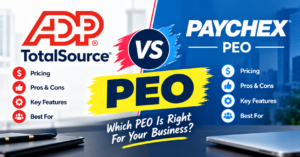
It’s worth noting that pricing and service quality vary significantly even among these top-tier providers. For example, if you’re considering Insperity, check out our Insperity cost comparison before signing anything. And if you’re weighing ADP TotalSource, our guide on hidden fees with ADP TotalSource is required reading.
How to Choose the Right Multi-State PEO for Your Business
Choosing the best PEO for multi-state businesses isn’t just about who covers the most states — it’s about fit. Here’s how to narrow it down based on your specific situation.
Step 1: Map Your Current and Planned State Footprint
Know exactly which states you’re hiring in today and where you plan to expand in the next 12-24 months. Some PEOs handle certain states better than others — particularly for high-complexity states like California, New York, Massachusetts, and Washington, which have some of the most layered employment laws in the country.
Step 2: Evaluate Benefits Networks by Employee Location
Ask each PEO for a sample of carrier networks in the states where most of your employees live. A national plan sounds great until you realize the HMO options in your employees’ zip codes are thin. This is especially important if you have a concentration of employees in smaller metros or rural areas.
Step 3: Understand How Workers’ Comp Is Structured
Some PEOs use a master workers’ comp policy that covers all states under one umbrella. Others work with state-specific carriers. Both approaches can work well, but you need to understand how claims are handled and what your experience modification rate (EMR) looks like over time. Ask specifically about states with monopolistic workers’ comp funds — Ohio, Washington, Wyoming, and North Dakota require state fund coverage, and your PEO must accommodate that.
Step 4: Ask About HR Support Model by State
Does the PEO assign you a dedicated HR business partner who understands California law if you’re hiring there? Or do you get a generalist call center? In our experience matching hundreds of businesses at PEO Marketplace, multi-state employers consistently rate dedicated, state-aware HR support as one of their top satisfaction drivers. Our comparison of Gusto and Justworks digs into how service model differences play out in practice.
Step 5: Compare Total Cost of Ownership
Multi-state compliance has a real dollar cost when you’re managing it in-house — HR staff time, compliance software, legal counsel, late filing penalties, and benefits administration overhead. A PEO consolidates most of those costs into a single contract. Use our PEO matching service to get a side-by-side comparison of providers calibrated to your actual headcount and state mix.
Red Flags to Watch for in Multi-State PEO Contracts
Not every PEO is upfront about its multi-state limitations. Watch for these warning signs before you sign:
- State surcharges: Some PEOs charge extra fees per state, which can add up quickly if you’re in five or more states.
- California exclusions: A small number of PEOs quietly exclude or limit service in California due to the complexity of CA employment law. Always confirm CA coverage explicitly.
- Benefits gaps: Review the actual carrier network in each of your key states — don’t just take the sales rep’s word that coverage is “national.”
- Delayed new-state onboarding: Some PEOs take 30-60 days to get you registered in a new state. If you’re hiring quickly, that lag creates exposure.
- Limited workers’ comp claim support: Ask who handles claims management and whether they have dedicated resources for high-volume or high-risk states.
The Bottom Line on Multi-State PEO Selection
The best PEO for multi-state businesses in 2026 is the one that matches your specific state footprint, employee demographics, and growth trajectory — not necessarily the biggest brand name or lowest advertised price. Multi-state complexity is exactly the scenario where PEO Marketplace’s unbiased matching process delivers the most value. We’ve vetted 40+ providers specifically on multi-state capability, and we can narrow the field to two or three serious contenders for your situation in a single conversation.
Frequently Asked Questions
Does a PEO handle payroll taxes in every state automatically?
Most full-service PEOs handle payroll tax registration, withholding, and filing in all 50 states as part of their co-employment model. When you hire a new employee in a new state, the PEO registers your business as an employer in that state and takes responsibility for ongoing tax compliance — but you should always confirm this is included in your specific contract and not billed as a state surcharge.
Can employees keep their health benefits if they move to a different state?
In most cases, yes — PEOs that offer benefits through national carriers allow employees to maintain coverage when they relocate, though their specific plan options may change based on what’s available in the new state’s network. This portability is one of the key advantages of a PEO over a small-group employer plan, which often restricts coverage to a single geographic region.
How does workers’ compensation work for remote employees in different states?
Workers’ compensation is governed by the state where the employee physically works, so a remote employee working from their home in Colorado is covered under Colorado’s workers’ comp rules regardless of where your company is headquartered. A multi-state PEO maintains workers’ comp coverage in every state where your employees are located and handles classification, certificates, and annual audits on your behalf.
What states are most complex for multi-state PEO compliance?
California, New York, Massachusetts, Washington, and Illinois are consistently the most complex states for employment compliance due to layered state and local laws covering paid leave, pay transparency, predictive scheduling, and discrimination protections. When evaluating a PEO for multi-state use, always ask specifically how they handle these five states before assuming full coverage.
How much does a multi-state PEO cost compared to managing compliance in-house?
PEO pricing typically ranges from $80 to $200 per employee per month or 2-12% of total payroll, but the true cost comparison must include what you’re currently spending on HR staff, compliance software, legal fees, benefits administration, and any penalties from missed filings. According to NAPEO, employers save an average of 27% on HR administration costs when using a PEO — a figure that tends to be higher for multi-state businesses given the added complexity they’re offloading.
Ready to find the best PEO for your multi-state business? PEO Marketplace has matched hundreds of businesses with the right provider based on their exact state footprint, headcount, and industry. Our matching process is free, unbiased, and takes less than 30 minutes. Book your free consultation today and get a shortlist of multi-state-ready PEOs built around your specific needs.