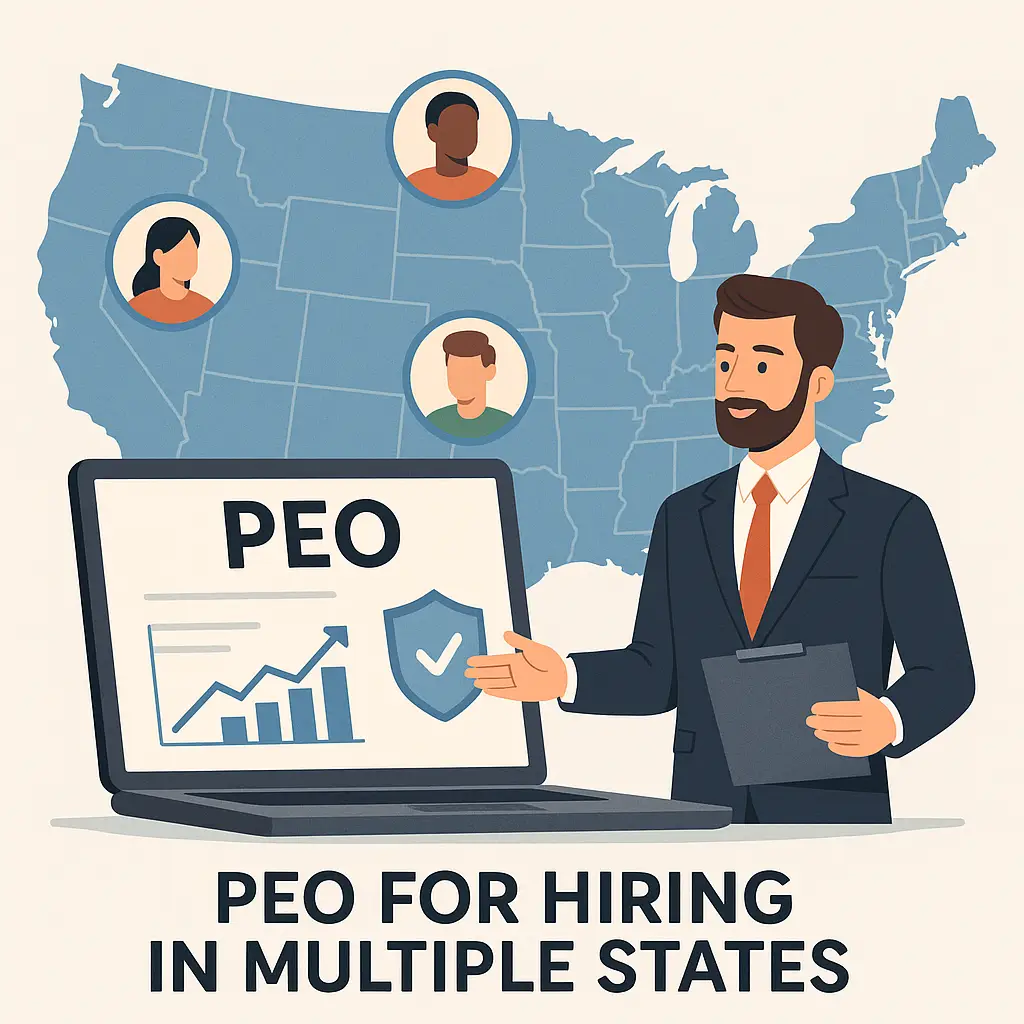
If you’re exploring options like a PEO for hiring in multiple states, comparing PEO vs buying health insurance on the open market, or learning how to use a PEO for benefits administration, it helps to start with a clear understanding of what a PEO (Professional Employer Organization) actually is.
A PEO is a third‑party organization that enters into a co‑employment arrangement with your business. Under that structure, the PEO takes on certain administrative, payroll tax, benefits, compliance and HR tasks. The business retains control over operational decisions, hiring/firing, strategy and company culture.
This model enables businesses—especially small and medium sized—to access services and benefits typically reserved for much larger companies: such as group health insurance at more competitive rates, risk management support, multi‑state payroll filings, compliance with employment laws, and more.
When these core services are understood, the next step is to see how they apply to key scenarios: multi‑state hiring, benefit administration, and the health insurance decision.
PEO for Hiring in Multiple States
Hiring employees in more than one state introduces layers of complexity: state payroll taxes, unemployment insurance, workers’ compensation mandates, local labor laws, benefit variations, and more. This is where using a PEO for hiring in multiple states becomes especially advantageous.
When a PEO operates across state lines, they handle many of the administrative burdens:
Filing payroll taxes in each state where the employee resides
Registering and managing unemployment insurance (SUTA) in each state
Ensuring workers’ compensation coverage meets local requirements
Keeping up‑to‑date with each state’s labor laws and wage‑and‑hour regulations
Coordinating benefits eligibility and carriers across state jurisdictions
By leveraging a PEO, your business can scale with less risk and fewer surprises.
One practical example: your company hires a sales associate in Florida, a developer in Texas, and a remote manager in New York. Rather than your internal HR team researching each state’s requirements and setting up separate systems, a PEO that spans all three states means you have one partner managing the regulatory burden, allowing you to focus on talent, growth and performance rather than paperwork.
Why Multi‑State Hiring Is So Challenging
Multi‑state hiring isn’t just “more work”—the risks and costs escalate quickly:
Each state has its own tax thresholds, unemployment insurance rules, payroll reporting deadlines and forms. Mis‑filing can result in audits and penalties.
Workers’ compensation requirements varies by state in coverage, premium calculations and claims processes.
Labor laws—such as minimum wage, overtime, meal break rules, rest break rules—differ across states. Failing to comply opens you up to wage‑and‑hour claims.
Benefits eligibility and mandatory offerings may vary; for example, some states have additional leave laws or insurance mandates.
Scaling operations so you have consistent policies and processes across states becomes difficult without centralized infrastructure.
Because of these variables, many growing companies find that handling multi‑state hiring on their own becomes an administrative drain and risk exposure. That’s precisely when a multi‑state capable PEO becomes a strategic asset.
How a PEO Makes Multi‑State Hiring Easier
A well‑chosen PEO with multi‑state capabilities will:
- Provide a unified payroll and HR platform for all employees, regardless of state.
Handle state registrations, unemployment and workers’ comp filings on your behalf.
Offer compliance guidance specific to each state.
Enable consistent onboarding processes across states.
Provide access to benefits plans that cover employees in multiple states, reducing fragmentation.
Scale with your business without needing separate vendors in every state.
By selecting a PEO that already operates and is accredited in multiple states, the hassle of building your own local HR operations significantly diminishes. It basically gives you one HR “hub” rather than multiple disconnected spokes.
What to Look For in a Multi‑State PEO Partner
When choosing a PEO for multi‑state hiring, pay attention to:
State footprint: Are they licensed or registered in all states where you operate or intend to operate?
Payroll and tax filing capacity: Do they file federal, state and local payroll taxes for remote employees?
Benefits coverage: Do they offer benefits plans that span multiple states (or carrier networks that work nationwide)?
Compliance support: Do they monitor and support each state’s unique regulations (leave laws, wage laws, etc)?
Transitions and scalability: Can they support your growth into additional states without new vendor onboarding each time?
Technology & platform: Is there a unified HRIS/portal for your employees in different states?
References & accreditation: Are they accredited by industry bodies (like ESAC or IRS‑certified) and do they have client references for multi‑state support?
If a PEO meets these criteria, you’ll be better positioned for smooth multi‑state employment operations.
PEO vs Buying Health Insurance on the Open Market
One of the most significant decisions you’ll face is whether to work with a PEO (and gain access via the PEO’s group purchasing power) versus buying health insurance directly from the open market (via brokers or carrier direct). Let’s compare.
PEO‑Based Health Insurance
When you partner with a PEO, you often gain access to group health plans that the PEO negotiates for its pooled clients. These plans may provide better rates, broader carrier access, and administrative support. According to industry sources:
PEOs give small and medium businesses access to “Fortune‑500‑level benefits at affordable cost.”
They can simplify benefit administration and compliance, reducing HR burden.
Because the PEO handles payroll, benefits enrollment, COBRA, reporting and more, you get a more integrated solution.
Open‑Market Health Insurance
If you buy health insurance on the open market:
You are essentially negotiating or buying as your own entity; you may have less bargaining leverage if you’re a small business.
You may still need to handle administration, payroll deductions, ACA reporting, COBRA, etc.
You might get a specific plan tailored to your business, but the administrative burden, compliance risk and cost could be higher.
Which is better?
If you’re a smaller business looking for efficiency, risk reduction and better benefits, the PEO route often wins. However, in some cases (e.g., you have a very large employee count, highly specialized benefits needs, or you want full control) open‑market insurance may be appropriate.
One firm put it simply: “Partnering with a PEO to provide employee healthcare benefits might offer significant advantages to small and medium‑sized businesses over the traditional open market.”
The Benefit of PEO‑Sourced Health Insurance
When you choose the PEO route for benefits, you typically gain:
Access to stronger carrier networks and better plan design options (due to pooled purchasing).
An integrated HR/benefits platform (enrollment, payroll deduction, COBRA, electronic records).
Less administrative burden: the PEO handles many back‑office tasks.
Better compliance support: ACA tracking, state benefit mandates, reporting.
Potential cost savings: in some cases the aggregated purchasing power helps drive lower premiums or better package options.
This integrated and streamlined approach helps you focus less on benefits logistics and more on attracting and retaining talent.
Key Considerations When Buying Insurance on the Open Market
If you’re leaning open market, keep in mind:
You’ll bear the administrative burden: you may have separate vendors for payroll, benefits enrollment, COBRA, compliance.
You may lack the bargaining leverage that a PEO pool offers.
You might face higher premiums or less favorable plan design because you’re negotiating as a smaller group.
You must ensure your HR systems support enrollment, deductions, reporting, compliance.
If you operate in multiple states, the complexity multiplies (state mandates, tax credit eligibility, etc).
Therefore, while open market has its place, many companies choose PEOs for the simplification and value they bring.
How to Use a PEO for Benefits Administration
Now, let’s zoom in on exactly how to use a PEO for benefits administration—a critical piece of the overall HR‑services puzzle.
Step 1: Select the PEO With Strong Benefits Capabilities
Start by ensuring the PEO offers robust benefits administration services: carriers, plan types, tech platform, employee portal, open enrollment support.
Step 2: Define Your Benefits Strategy
Work with the PEO to define your plan offerings, cost‑sharing structure, eligibility criteria, and enrollment schedule. The PEO’s team can help benchmark and design competitive offerings.
Step 3: Data & System Setup
Provide employee data (names, dependents, addresses, hire dates) to the PEO’s system. The PEO will integrate with payroll, deductions, carrier enrollment, and user access.
Step 4: Enrollment Launch
The PEO administers enrollment windows, sends employee communications, supports self‑service portals, and handles carrier feeds. They often take care of open enrollment process entirely.
Step 5: Ongoing Administration
After enrollment, the PEO processes monthly deductions, new hires, terminations, qualifying events, dependents, COBRA, and carrier reconciliation.
Step 6: Compliance & Reporting
The PEO tracks ACA reporting, state benefit mandates, audit readiness, plan changes, and supports you with documentation and notices.
Step 7: Performance Review & Renewal
Each renewal period, the PEO assists with carrier negotiation, benchmarking, and plan redesign if needed. They help present options to you and your employees.
By following these steps under a PEO partnership, you achieve streamlined, professional benefits administration without adding major internal burden.
Advantages of Benefits Administration Through a PEO
Using a PEO for benefits administration brings you:
Lower administrative overhead (fewer vendors, fewer systems)
Better employee experience (self‑service portal, consistent interface)
Enhanced compliance support (ACA, COBRA, state mandates)
Access to stronger benefits (due to pooled buying power)
Scalability as you grow across states or add employees
Integrated payroll, HR, benefits ecosystems—fewer errors and less duplication
Common Mistakes in Benefits Administration and How a PEO Helps
Typical mistakes include:
Using disparate systems for payroll and benefits, leading to errors in deductions or eligibility
Choosing benefits without benchmarking or understanding true employee needs
Missing critical deadlines (enrollment windows, carrier filings, ACA reporting)
Underestimating the complexity of qualifying event handling and terminations
Failing to manage multi‑state benefit mandates or variations
A capable PEO mitigates these risks by offering unified systems, compliance oversight, dedicated benefits administration teams, and multi‑state experience.
Integrating Multi‑State Hiring and Benefits Administration with a PEO
When you’re using a PEO for hiring in multiple states and leveraging benefits administration via the same PEO, the integration benefits become exponential:
One vendor manages onboarding, payroll taxes, state filings and benefits plan eligibility across states.
You enjoy standardized processes regardless of employee location.
Data flows seamlessly between payroll, HR and benefits systems—reducing manual reconciliation.
Employee experience is consistent no matter where they work.
Compliance burden is centralized, not fragmented state by state.
This unified approach is particularly powerful for companies scaling into new states or supporting remote teams across jurisdictions.
How Platforms Like PEO Marketplace Streamline the Process
Selecting the right PEO is itself a critical step. This is where platforms such as PEO Marketplace come into play. We help you compare multiple PEO providers side by side, simplifying metrics like services offered, multi‑state capabilities, benefits administration strength, pricing and accreditation. We enable businesses to “compare multiple providers side by side … avoiding being locked into just one choice.”
By using such a platform you can:
Submit your business profile once and receive quotes from multiple PEOs
Compare apples‑to‑apples: cost, service, benefits, multi‑state support
Filter providers by state presence, accreditation, technology, benefits strength
Speed up decision‑making and avoid the time‑sink of contacting each vendor individually
In short, when you’re evaluating PEO for hiring in multiple states, and focusing on how to use a PEO for benefits administration, leveraging a comparison marketplace platform helps you get clarity and confidence.
Cost and Value: Evaluating PEO Fees vs DIY HR + Insurance
When making decisions, you’ll want to understand both cost and value:
PEOs typically charge a fee—often a flat per‑employee per‑month rate or a percentage of payroll.
While there’s a cost, the value arises from savings in time, risk, benefits bargaining, multi‑state compliance, and elimination of multiple vendors.
Buying health insurance on the open market may appear cheaper but often accumulates cost via admin burden, less favorable rates, and risk exposure.
The best approach is calculating your internal HR time, vendor fees, risk‑exposure cost, benefits costs, and comparing that to what a PEO offers.
This evaluation ensures you’re choosing not just based on cost but overall value.
Ensuring Compliance Across States and Benefit Laws
Across multiple states and benefits administration, compliance risks linger:
State wage laws, leave laws, workers’ compensation, unemployment insurance—each state varies.
Benefit mandates, carrier requirements, ACA rules, COBRA—all need monitoring.
Harsh penalties exist for mis‑filings, non‑compliance, benefit errors.
A PEO with multi‑state capacity helps centralize these compliance functions so you’re less exposed. And when you use a marketplace platform to vet PEOs, you can easily filter for compliance‑capable providers.
Technology, Data, and Reporting in a PEO Relationship
Modern PEOs offer strong technology platforms: HRIS, employee portals, benefits dashboards, reporting tools, analytics. When you’re managing hiring across states and benefits admin, this tech matters. Look for:
Unified dashboards for all employees regardless of state
Self‑service for employees (benefits enrollment, pay stubs, attendance)
Integrated payroll/benefits/HR data to reduce duplication
Multi‑state tax and compliance reporting modules
Analytics dashboards for turnover, cost per employee, benefits participation, etc.
This feature set ensures you get not just service but insight.
Onboarding New Employees Across States via a PEO
Efficient onboarding is critical when you have multi‑state hiring. With a PEO:
You get one onboarding process that works regardless of state.
The PEO handles state‑specific paperwork (tax forms, SUTA registration, workers’ comp coverage).
Benefits eligibility and enrollment are streamlined via the portal.
Payroll deductions, eligibility, and launch happen without juggling separate vendors.
That means you hire faster and onboard smoother.
Open Enrollment Made Simple with a PEO
Every year, open enrollment for benefits can be an administrative headache. But when you’re using a PEO:
The PEO manages communications, self‑service portals, carrier feeds, deductions changes, and compliance documentation.
Because benefits are already integrated with payroll and HR, the process is smoother.
Even for multi‑state employees, the PEO ensures consistent experience and appropriate eligibility across jurisdictions.
When You Might Choose Open‑Market Insurance Instead of a PEO
While PEOs offer many advantages, there are cases where an open‑market insurance path may be appropriate:
You have a large, established HR team and negotiate benefits directly at scale.
You want full control over benefit design and select carriers individually.
Your business is highly specialized with unique benefit needs open‑market carriers must tailor.
Your employee base is localized in one state and complexities of multi‑state hiring or benefits are minimal.
In those cases, open‑market insurance might make sense—but you still likely benefit from comparing quotes via a PEO or PEO‑Marketplace style approach.
Scaling Up: Using a PEO During Growth or Acquisition
If your business is expanding into new states, acquiring another company, or rapidly growing headcount, a PEO becomes a strategic partner:
You can onboard new states quickly.
You can integrate acquired employees without building localized HR teams.
Your benefits admin scales seamlessly.
You get consistent policies and vendor oversight across units.
Evaluating PEOs now and using a marketplace to select the right one ensures you’re ready for future growth.
Exit Strategy: Transitioning Out of a PEO or Changing Benefit Models
Every business should plan for what happens if you change model:
What happens when you leave the PEO? How will your payroll, benefits, and compliance transition?
Are there termination fees? What about benefit carrier changes and COBRA?
If you shift from PEO‑sourced insurance to open‑market, how do you maintain employee continuity?
A good PEO vendor will provide exit support and a transition plan.
Real‑World Example of a Business Using a PEO for Multi‑State Hiring and Benefits
Consider a technology firm headquartered in Florida that expanded to hire remote developers in Texas, sales staff in California and operations in New York. They used a PEO that had presence in all four states.
The PEO managed all state tax filings, workers’ compensation, unemployment registrations and benefits eligibility uniformly.
The PEO’s benefits plan offered network access across all these states and bundled health insurance at better rates than the company could negotiate alone.
When comparing insurance open market vs PEO‑based plan, the PEO route resulted in lower per‑employee insurance cost and far less administrative time.
During open enrollment, the PEO’s portal handled deductions, eligibility, self‑service and carrier feeds seamlessly.
The company also used a PEO Marketplace‑style platform to evaluate three PEO providers, comparing multi‑state capability, benefits administration strength and cost before selecting the vendor.
This illustrates how integrating hiring in multiple states plus benefits administration under one PEO can yield significant operational and financial benefits.
Questions to Ask Potential PEOs
When evaluating PEOs (especially for multi‑state hiring and benefits administration), ask:
In how many states are you licensed/registered?
Do you handle payroll tax filings, SUTA, workers’ comp in each state?
Is your benefits plan national or multi‑state? Do employees in remote states receive the same carrier networks?
How do you handle open enrollment, benefits admin, deductible changes, qualifying events?
What technology platform do you provide? Is there self‑service for employees?
What is your fee model and how does it scale as we grow in states or employees?
What happens if we exit? How is transition managed?
Are you accredited (ESAC, IRS certified) and can you provide references with multi‑state clients?
How do you compare vs open‑market insurance? What value do you bring?
How do you help us hire and onboard employees in new states quickly?
These questions will help you discern whether the PEO is fit for your multi‑state and benefits needs.
Summary and Next Steps
To recap: using a PEO for hiring in multiple states, evaluating PEO vs buying health insurance on the open market, and learning how to use a PEO for benefits administration are three inter‑linked strategies that can transform how your business manages HR, growth, compliance and talent.
If you’re expanding into new states, a PEO centralizes your hiring infrastructure. If you’re evaluating benefits, a PEO often offers higher quality at better cost than the open market. And if you want simplified, integrated benefits administration, the PEO model gives you one vendor, one platform, one unified system.
Don’t navigate this alone. Use a comparison platform like PEO Marketplace to gather multiple quotes, compare side by side, and select a partner aligned with your strategic needs. Then define your hiring blueprint, benefits strategy, technology stack and success metrics together with your chosen PEO.
The path ahead is clear: choose wisely, scale confidently, and let the right PEO support your growth, compliance and workforce success.