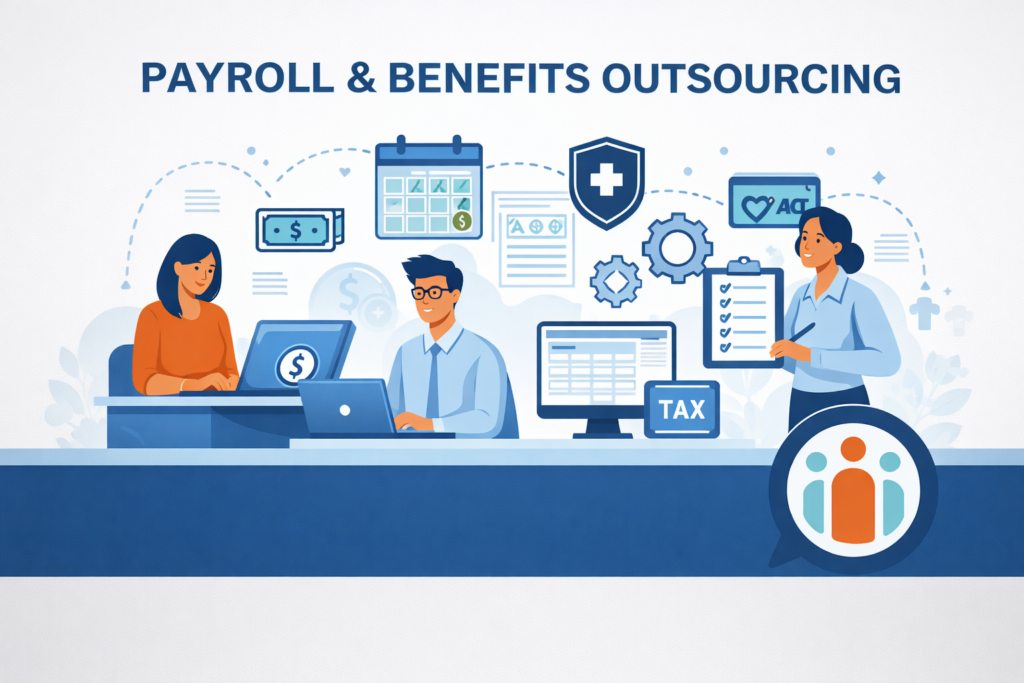
Managing payroll and employee benefits is one of the most time-consuming and high-risk responsibilities for any business. Errors in payroll processing, missed tax filings, or poorly managed benefits can quickly lead to compliance issues, employee dissatisfaction, and unnecessary costs. That’s why more organizations are turning to payroll and benefits outsourcing as a strategic solution.
By outsourcing these critical HR functions, businesses can reduce administrative burden, improve accuracy, and free up internal teams to focus on growth. In this blog, we’ll break down what payroll and benefits outsourcing is, how it works, its advantages, and how to decide if it’s the right move for your company.
What Is Payroll and Benefits Outsourcing?
Payroll and benefits outsourcing involves partnering with a third-party provider to manage payroll processing, tax filings, and employee benefits administration on your behalf. Instead of handling everything internally, businesses delegate these complex tasks to specialists who have the systems, expertise, and compliance knowledge to manage them efficiently.
Outsourcing can cover:
Payroll calculations, direct deposits, and tax withholdings
Payroll tax filing and reporting
Benefits enrollment and administration
Health, retirement, and voluntary benefit management
Ongoing compliance support
This approach is commonly used by small and mid-sized businesses but is also increasingly adopted by growing and multi-state organizations.
Why Businesses Choose Payroll and Benefits Outsourcing
Many companies initially manage payroll and benefits in-house. Over time, complexity grows—more employees, more regulations, and more benefit options. Outsourcing becomes appealing for several reasons.
First, it significantly reduces administrative workload. Payroll and benefits require recurring attention every pay period, month, and year. Outsourcing shifts that responsibility to a dedicated team.
Second, it helps improve compliance and accuracy. Payroll errors and benefit mismanagement can be costly. Outsourcing providers use standardized processes and compliance expertise to reduce risk.
Third, outsourcing often improves employee experience. Employees benefit from timely pay, clearer benefits communication, and self-service access to payroll and benefits information.
Key Benefits of Payroll and Benefits Outsourcing
Payroll and benefits outsourcing delivers both operational and strategic advantages.
Time savings: Internal teams spend less time on repetitive administrative tasks.
Cost efficiency: Outsourcing can be more affordable than maintaining in-house payroll staff and systems.
Compliance support: Providers stay current on changing tax laws and benefit regulations.
Scalability: Outsourced solutions grow with your business without requiring additional hires.
Better benefits access: Some outsourcing models allow access to broader or more competitive benefit options.
Together, these benefits allow business leaders to focus on strategy, customers, and revenue instead of HR paperwork.
Payroll and Benefits Outsourcing vs. In-House Management
Choosing between outsourcing and in-house management depends on your business size, complexity, and goals.
With in-house payroll and benefits, businesses retain full control but must invest in staff, software, training, and compliance monitoring. As regulations evolve, the risk and workload increase.
With payroll and benefits outsourcing, businesses trade some direct control for efficiency, expertise, and reduced risk. For many growing companies, the consistency and support gained from outsourcing outweigh the loss of hands-on management.
Who Should Consider Payroll and Benefits Outsourcing?
Payroll and benefits outsourcing is especially valuable for:
Small businesses without dedicated HR teams
Growing companies adding employees or locations
Businesses operating in multiple states
Organizations struggling with payroll errors or compliance concerns
Employers looking to improve benefits administration without adding overhead
If payroll and benefits tasks are pulling leadership away from core operations, outsourcing is often a strong next step.
How to Choose the Right Payroll and Benefits Outsourcing Partner
Not all providers offer the same level of service. When evaluating options, consider the following:
Service scope: Ensure payroll, tax filing, and benefits administration are fully covered.
Technology: Look for user-friendly systems with employee self-service access.
Compliance support: Confirm how the provider manages tax and benefits regulations.
Transparency: Understand pricing, contract terms, and exit options.
Scalability: Make sure the solution can grow with your business.
Taking the time to evaluate these factors helps ensure a long-term, successful outsourcing partnership.
Is Payroll and Benefits Outsourcing Worth It?
For many businesses, the answer is yes. Payroll and benefits outsourcing offers a practical way to reduce risk, save time, and improve efficiency without sacrificing quality. While it may not be the right fit for every organization, companies experiencing growth or administrative strain often see immediate value.
The key is choosing a partner that aligns with your business needs and provides clear, reliable support.
Conclusion
Payroll and benefits outsourcing is more than a cost-saving tactic—it’s a strategic decision that can improve compliance, employee satisfaction, and operational efficiency. By delegating these complex responsibilities to experts, businesses can focus on what matters most: growth, innovation, and serving their customers.