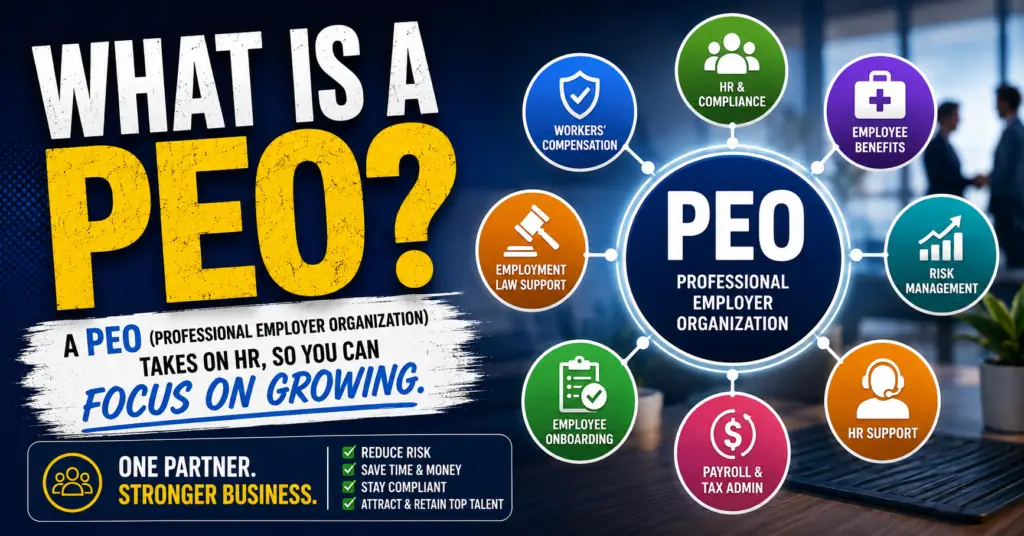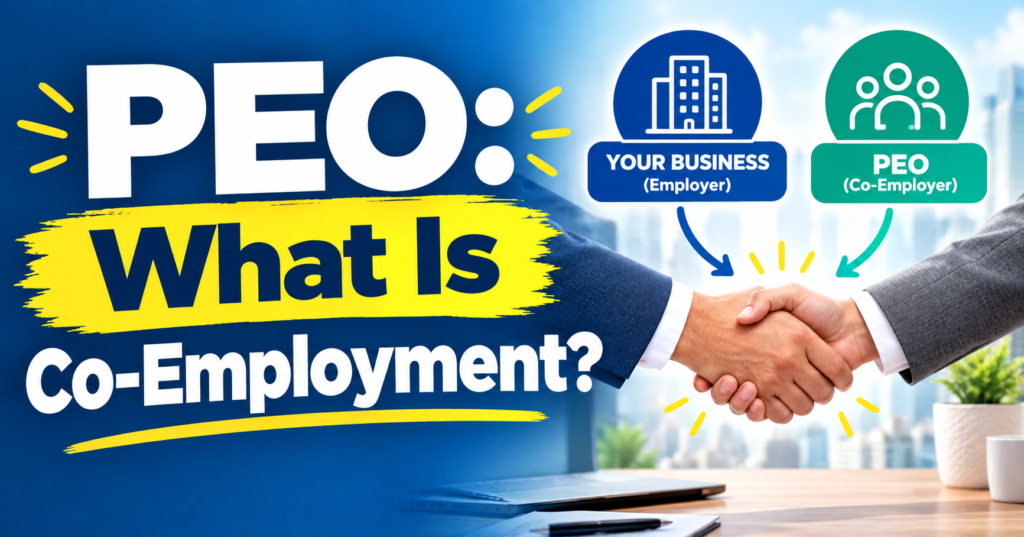
Co-employment is a shared legal arrangement between your business and a PEO (Professional Employer Organization) where both parties take on specific employer responsibilities — you keep full control of your day-to-day operations, hiring, and firing, while the PEO handles payroll, taxes, benefits administration, and HR compliance. Despite what the name implies, you do not give up your business. You do not share ownership. You stay in charge of who works for you and what they do every single day.
If you’ve heard the term co-employment and felt a wave of anxiety, you’re not alone. It’s one of the most misunderstood concepts in the PEO world — and in our experience matching hundreds of businesses with PEO providers, it’s also the number one reason owners hesitate to explore a relationship that could save them serious money and legal headaches. Let’s clear the air.
What Is Co-Employment and How Does It Actually Work?
Co-employment means two employers share legal responsibility for the same workforce. In a PEO arrangement, your employees are employed by both your company and the PEO simultaneously — but for very different purposes.
The PEO becomes the employer of record for tax and administrative purposes. That means it files payroll taxes under its own Employer Identification Number (EIN), sponsors benefit plans, manages workers’ compensation policies, and takes on certain compliance obligations. You remain the worksite employer — the one who directs the work, sets schedules, makes hiring and termination decisions, and runs the business.
Think of it this way: the PEO handles the back-office employment relationship with the government. You handle the actual employment relationship with your team.
The Legal Foundation Behind Co-Employment
The co-employment model is well-established and legally recognized across all 50 states. According to NAPEO (National Association of Professional Employer Organizations), there are more than 500 PEOs operating in the United States, collectively employing approximately 4 million workers. This isn’t a gray-area workaround — it’s a mature industry with its own regulatory framework.
The IRS formally recognized PEOs through the Tax Increase Prevention Act of 2014, which created a voluntary certification program for Certified Professional Employer Organizations (CPEOs). A CPEO carries additional financial assurances and bonding requirements, which further protects your business. You can verify CPEO status directly on the IRS website.
What the PEO Controls vs. What You Control
Here’s the breakdown that business owners actually need to see:
| Responsibility | You (Worksite Employer) | PEO (Employer of Record) |
|---|---|---|
| Hiring & Firing | ✅ Full control | ❌ No involvement |
| Day-to-Day Work Direction | ✅ Full control | ❌ No involvement |
| Salaries & Compensation | ✅ You set the rates | Processes the payments |
| Payroll Tax Filing | ❌ Offloaded | ✅ PEO files under its EIN |
| Benefits Sponsorship | ❌ Offloaded | ✅ PEO sponsors group plans |
| Workers’ Comp Policy | ❌ Offloaded | ✅ PEO manages the policy + claims |
| HR Compliance | Shared | ✅ PEO provides guidance & monitoring |
| Business Ownership/ Strategy & Clients | ✅ Full control | ❌ No involvement |
Not sure if a PEO makes sense for your business? Our free calculator shows you the real cost in 60 seconds — no call, no email, no commitment.
The Real Risks of Co-Employment — And What They Actually Mean for You
Let’s be honest: co-employment does come with shared liability, and you deserve a straight answer about what that looks like in practice.
Employment Practices Liability Is Shared
Because both you and the PEO are considered employers under the law, both parties can potentially be named in an employment-related lawsuit — a discrimination claim, a wrongful termination suit, a wage-and-hour dispute. This sounds alarming, but here’s the flip side: most reputable PEOs carry Employment Practices Liability Insurance (EPLI) and provide HR guidance specifically designed to help you avoid these situations in the first place.
According to the U.S. Department of Labor, employment law violations are far more common at companies without dedicated HR infrastructure — which is exactly what most small businesses lack before partnering with a PEO. In other words, the shared liability risk is real, but going it alone carries significantly greater compliance exposure.
The PEO Can’t Override Your Business Decisions
One fear we hear constantly: “What if the PEO decides to fire my employees or change my benefits without asking me?” This doesn’t happen. The PEO agreement — formally called a Client Service Agreement (CSA) — spells out exactly what each party controls. Your employees still report to you. The PEO cannot hire, fire, reassign, or discipline anyone on your team without your direction. If a PEO ever implied otherwise, that would be a red flag worth investigating before signing anything.
What Happens If You Leave the PEO?
This is a legitimate concern. When you exit a PEO relationship, payroll and benefits administration return to you (or a new provider). Employees don’t lose their jobs — they simply transition off the PEO’s benefit plans and onto whatever coverage you arrange next. The key is to plan the transition carefully, ideally with 30–90 days of lead time. Our team at PEO Marketplace walks clients through this scenario before they ever sign a contract so there are no surprises.
Why Co-Employment Is Actually a Business Advantage
Here’s the part that gets lost in the fear conversation: co-employment is the mechanism that lets small businesses access Fortune 500-level benefits, because the PEO pools hundreds or thousands of employees across its client base to negotiate group rates that no individual small business could get on its own.
According to NAPEO research, businesses in a PEO arrangement grow 7–9% faster and have 10–14% lower employee turnover than comparable companies not using a PEO. Those numbers don’t happen by accident — they’re the direct result of better benefits, better HR infrastructure, and better compliance support that co-employment makes possible.
You can use our PEO cost calculator to see exactly what those savings could look like for your headcount and industry. Most business owners are surprised by how quickly the math tips in favor of a PEO.
Co-Employment vs. Staffing Agencies: Not the Same Thing
A common misconception is that PEO co-employment works like a staffing agency, where workers are the agency’s employees and can be pulled or reassigned. That’s completely different. With a staffing agency, the agency recruits and places workers — they’re the primary employer. With a PEO, you recruit and hire your own team. The PEO just takes on the administrative employer role. Your employees are your employees, full stop.
How to Protect Yourself in a Co-Employment Arrangement
Co-employment risk is manageable when you choose the right PEO and read the contract carefully. Based on our analysis of 40+ PEO providers, here are the non-negotiables:
Look for ESAC Accreditation or CPEO Certification
The Employer Services Assurance Corporation (ESAC) accredits PEOs that meet strict financial, ethical, and operational standards. CPEO certification from the IRS adds another layer. Both signal that the PEO has the financial backing and operational discipline to honor its employer-of-record responsibilities without putting your business at risk.
Read the Client Service Agreement Carefully
The CSA defines the entire co-employment relationship. Make sure it clearly states who controls hiring and termination, how the PEO handles employment claims, what happens to benefits if you leave, and how liability is allocated. If a PEO can’t or won’t explain every clause clearly, walk away.
Compare Multiple PEOs Before You Commit
Not all PEOs structure co-employment the same way, and the contract terms vary significantly. We’ve seen providers like ADP TotalSource, Insperity, Gusto, and Justworks each take different approaches to co-employment liability and benefits sponsorship — and the differences matter. Before you sign anything, read our breakdowns on ADP TotalSource’s fee structure, Gusto vs. Justworks, and Insperity’s cost comparison to see how these providers stack up.
Or skip the research rabbit hole and let us do it for you. Our free PEO matching service cross-references your business size, industry, state, and risk profile against our vetted network of 40+ providers to find the right fit — without the sales pressure.
The Bottom Line on Co-Employment
Co-employment is not a trap. It’s a legal structure that allows small and mid-size businesses to operate with the HR infrastructure of a much larger company — while keeping complete control over their workforce, culture, and business direction. The shared liability is real, but it’s manageable, and in most cases the compliance protection a PEO provides far outweighs the theoretical downside of shared employer status.
The businesses that get burned by co-employment are usually the ones who signed with the wrong PEO, didn’t read the contract, or didn’t ask the right questions upfront. That’s exactly what we help you avoid.
Ready to Find the Right PEO for Your Business?
Book a free 15-minute consultation with a PEO Marketplace advisor. We’ll explain exactly how co-employment applies to your situation and match you with providers that fit your size, industry, and risk profile — at no cost to you.
Not ready to book a call? Get a free Benefits Benchmark Report for your industry — we will email you a breakdown of what companies your size are paying for HR, benefits, and workers comp so you can compare on your own timeline.
Frequently Asked Questions About Co-Employment
Does co-employment mean the PEO owns my employees?
No. Co-employment means the PEO shares certain legal employer responsibilities — primarily for tax filing, benefits administration, and compliance — but your employees report to you and you make all decisions about their work, pay, and employment status. The PEO does not own, control, or have the ability to reassign your workforce.
Can I still fire an employee if I’m in a co-employment arrangement?
Yes, absolutely. Termination decisions remain entirely with you as the worksite employer. Most PEOs will offer HR guidance on how to handle terminations compliantly to reduce your legal exposure, but the final decision is always yours. They can advise; they cannot override you.
What happens to my employees’ benefits if I leave the PEO?
When you exit a PEO, employees transition off the PEO’s group benefit plans and onto whatever new coverage you arrange — typically through a standalone broker or a new PEO. Employees do not lose coverage immediately; most agreements include a transition period. Planning the exit 60–90 days in advance prevents any gaps in coverage.
Is co-employment legal in all 50 states?
Yes. Co-employment through a PEO is legally recognized in all 50 states, though some states have specific PEO licensing or registration requirements. The IRS’s CPEO certification program, established in 2014, provides a federal framework that further legitimizes the arrangement. Always verify that your PEO is licensed to operate in your state.
How is a PEO different from a staffing agency in terms of co-employment?
With a staffing agency, the agency recruits, employs, and places workers — meaning those workers are primarily the agency’s employees, not yours. With a PEO, you hire your own employees and the PEO simply takes on the administrative employer role for tax and benefits purposes. Your employees are your team; the PEO just handles the back-office employment relationship.