
Blog

Welcome to the PEO Marketplace Blog

At PEO Marketplace, we’re dedicated to helping businesses find & compare the perfect Professional Employer Organization (PEO) to streamline HR, payroll, benefits, compliance, and more. Our blog is your go-to resource for expert insights, industry trends, and practical advice on managing your workforce more efficiently.

What You’ll Find Here

Why Follow Our Blog?

Choosing the right PEO can be a game-changer for your business, and our blog is here to guide you every step of the way. Whether you’re a startup, a growing business, or an established company, our insights will help you make informed decisions to optimize your HR processes.

Stay tuned for expert content, actionable tips, and in-depth resources to help your business thrive.

Justworks is a Professional Employer Organization (PEO) that enters a co-employment relationship with your business. Gusto is payroll and HR software that keeps you as the sole employer. Both handle payroll, but they operate on fundamentally different models — and choosing the wrong one at the wrong stage of your business can cost you time, money, and talent. Here’s how to tell which one actually fits where you are right now.

What Is the Core Difference Between Justworks and Gusto?

The short answer: Justworks is infrastructure. Gusto is software. That distinction sounds simple, but it changes everything from your liability exposure to the quality of benefits you can offer employees.

When you join Justworks, you enter a co-employment arrangement. Justworks becomes the employer of record for tax and benefits purposes, pools your employees with thousands of other small businesses, and uses that collective size to negotiate Fortune 500-level health insurance, 401(k) plans, and workers’ comp coverage. You still run your business and manage your team day-to-day — but Justworks shoulders significant compliance and administrative risk alongside you.

Gusto works differently. You remain the sole employer. Gusto automates payroll runs, files payroll taxes, and offers a self-service HR portal. It’s genuinely excellent software — but it’s a tool you use, not a partner that shares employer responsibility with you. According to NAPEO, PEO clients grow 7–9% faster and have 10–14% lower employee turnover than businesses that go it alone. That data reflects the full co-employment model — not software.

Comparing PEOs is easier when you know your baseline cost. Our free calculator shows what a PEO would cost for your company in 60 seconds — no call needed.

Try the Free Calculator →

Justworks vs Gusto: Feature-by-Feature Comparison

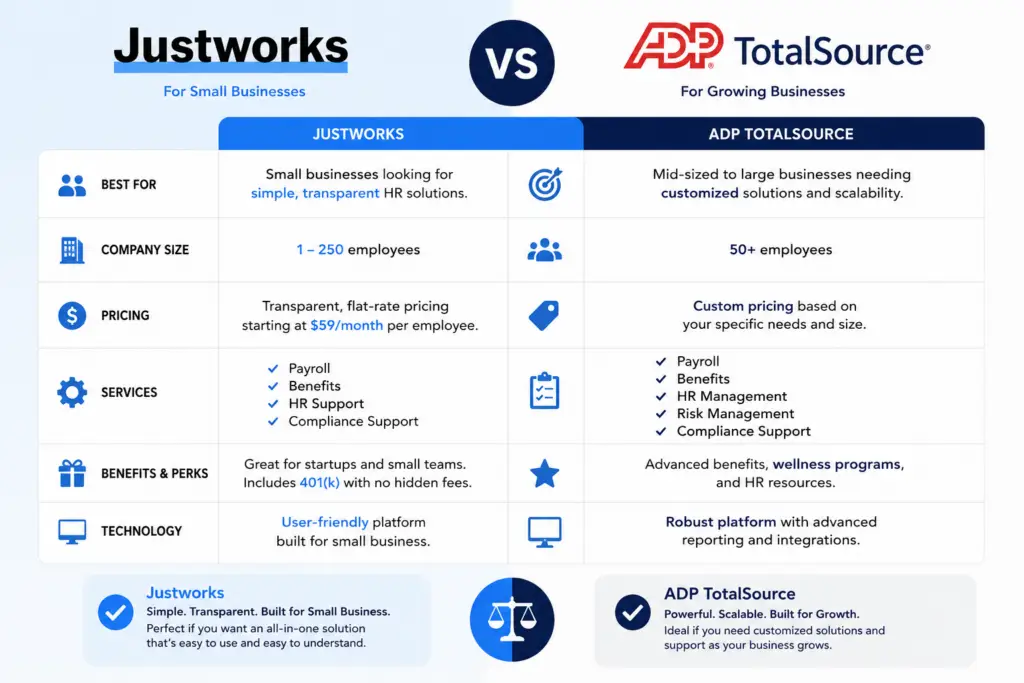
Before we dig into which platform suits which business, here’s a side-by-side look at how they stack up on the features that matter most to small and mid-size employers.

FeatureJustworks (PEO)Gusto (Payroll Software)
ModelCo-employment (PEO)SaaS payroll software
Payroll Processing✅ Full service✅ Full service
Payroll Tax Filing✅ Included✅ Included
Health Insurance Access✅ Group rates via PEO pool⚠️ Open market (small business rates)
401(k)✅ Pooled plan, lower fees✅ Available, standard rates
Workers’ Comp✅ Included in PEO pool⚠️ Partner integration only
HR Compliance Support✅ Shared liability, HR team⚠️ Guidance only, no shared liability
EPLI / Employment Practices Liability✅ Included❌ Not included
Dedicated HR Support✅ Named HR specialists⚠️ Chat/email support only
IRS Certified✅ CPEO certified❌ Not a PEO
Pricing ModelPer employee/month ($59–$99+)Base + per employee ($40–$80+/mo)
Best For5–200 employees, growth stage1–50 employees, early stage

How Does Justworks Work as a PEO?

Justworks is an IRS-certified Certified PEO (CPEO), which matters for tax purposes. As a CPEO, Justworks takes on federal employment tax liability — something standard payroll software can’t do. When you join, your employees technically become co-employed by both your company and Justworks.

In practice, that means Justworks can offer your 15-person startup access to the same Aetna or United Healthcare group rates as a 5,000-person corporation. A 15-person company shopping for health insurance on its own gets priced as a 15-person company. Through Justworks’ PEO pool, you get priced as part of a much larger group. That difference in premium alone can offset a significant portion of Justworks’ monthly fee.

Justworks also provides employment practices liability insurance (EPLI), which protects against wrongful termination claims, harassment claims, and discrimination lawsuits — a coverage most small businesses skip because it’s expensive to buy standalone. When your HR decisions are shared with a co-employer, the legal exposure is also shared.

If you want a deeper look at how Justworks stacks up against other full-service PEOs, see our breakdown in Comparing PEO, Gusto, and Justworks: Which Is Best?

How Does Gusto Work as Payroll Software?

Gusto is genuinely good at what it does. The interface is clean, onboarding new hires is fast, and it automates federal, state, and local payroll tax filings in all 50 states. For a founder running a 5-person team who needs payroll handled without complexity, Gusto is often the right call.

The key limitation is that Gusto’s compliance tools are advisory, not protective. Gusto will remind you about labor law changes and flag potential issues — but if you get hit with a misclassification audit from the Department of Labor or a discrimination claim from a former employee, that’s entirely your liability. Gusto doesn’t share it.

Gusto’s health insurance marketplace connects you to carriers, but your premium is based on your own employee pool. For a small team with any older or health-challenged employees, those rates can be brutal. You’re not benefiting from anyone else’s risk pool the way you would inside a PEO.

Which Business Stage Fits Each Platform?

Choose Gusto If…

  • You have fewer than 10 employees and your primary need is clean, automated payroll
  • Your team is healthy and relatively young, so individual health insurance rates are manageable
  • You’re pre-revenue or in very early stages and every dollar of overhead is scrutinized
  • You have no full-time HR person and just need basic self-service tools
  • You’re comfortable taking on employment compliance risk yourself or have outside counsel

Choose Justworks (or Another PEO) If…

  • You have 5–200 employees and are actively competing for talent with larger companies
  • You want to offer competitive health benefits without paying large-group premiums out of pocket
  • You’re scaling fast and don’t have time to build an HR infrastructure from scratch
  • You operate across multiple states and need multi-state compliance coverage
  • You’ve had — or are worried about — an employment claim or compliance issue

Based on our analysis of 40+ PEO providers, the most common switch we see is businesses moving from Gusto to a PEO around the 15–25 employee mark, when benefits costs and compliance risk start to outweigh the simplicity of pure software.

What Does Each Platform Actually Cost?

Justworks charges per employee per month. Their base PEO plan starts around $59/employee/month for smaller teams, with pricing scaling based on headcount and benefits selections. That fee covers payroll, HR support, EPLI, and access to the pooled benefits — so the sticker price isn’t the whole story. Use our free PEO cost calculator to model what a PEO would actually cost versus your current setup.

Gusto’s pricing starts with a base fee (around $40/month) plus a per-employee charge (around $6–$12/month per person depending on the plan tier). Their Plus and Premium tiers add HR tools and dedicated support, pushing costs higher. What Gusto doesn’t include: the cost of your health insurance premiums, workers’ comp policy, or any HR consulting you’d need to buy separately.

The honest comparison isn’t Justworks’ fee vs. Gusto’s fee. It’s Justworks’ total cost vs. Gusto’s fee plus your standalone benefits, workers’ comp, and any compliance costs. For many businesses in the 15–50 employee range, that math favors the PEO. It’s also worth reviewing how Insperity’s costs compare if you’re weighing multiple PEO options.

Justworks vs Gusto: The Honest Verdict

These aren’t really competing products — they’re different tools for different moments in a company’s life. Gusto wins on simplicity and price for very early-stage businesses. Justworks wins on benefits access, compliance protection, and HR infrastructure for growing businesses that need more than software.

The mistake we see most often is businesses staying on Gusto (or a similar payroll tool) three or four years longer than they should because switching feels complicated. Meanwhile, they’re paying individual-market health insurance rates, carrying unprotected compliance risk, and losing candidates to competitors who can offer better benefits through a PEO. If that sounds familiar, it’s probably time for an honest evaluation.

And if you want to see exactly where you stand, our free PEO matching service narrows down the right providers for your industry, headcount, and budget — no sales pressure, just a clear comparison.

Not Sure If You’re Ready for a PEO?

Talk to a PEO specialist at PEO Marketplace. We’ll tell you honestly whether a PEO makes sense for your business right now — or whether staying on payroll software is the smarter move. Free, unbiased, no commitment.

Book a Free Consultation →

Not ready to book a call? Get a free Benefits Benchmark Report for your industry — we will email you a breakdown of what companies your size are paying for HR, benefits, and workers comp so you can compare on your own timeline.

Get My Free Benchmark Report →

Frequently Asked Questions

Is Justworks actually a PEO or just payroll software?

Justworks is a certified PEO (Professional Employer Organization) and holds IRS CPEO certification, which means it takes on federal employment tax liability as a co-employer alongside your business. This is fundamentally different from payroll software like Gusto, which automates payroll processing but does not share employer legal responsibility with you.

Can I get better health insurance through Justworks than through Gusto?

Yes — in most cases, significantly better. Justworks pools your employees with thousands of other small businesses to negotiate group health insurance rates that individual small companies can’t access on their own. Gusto connects you to a broker marketplace, but your premiums are based solely on your own employee population, which typically means higher rates for smaller teams.

Is Gusto enough for a business with 20 employees?

Gusto can technically handle payroll for a 20-person team, but at that size most businesses start feeling the limitations — particularly around benefits costs, compliance exposure, and lack of dedicated HR support. In our experience matching hundreds of businesses to the right platform, 15–25 employees is the typical inflection point where a PEO starts delivering measurable ROI over standalone payroll software.

What happens to my employees if I switch from Gusto to a PEO like Justworks?

Your employees will go through a re-enrollment process and technically become co-employed by the PEO for tax and benefits purposes. From their day-to-day perspective, they’ll see a new employer of record on their paystubs and gain access to better benefits — most employees view this positively. You remain in full control of hiring, managing, and directing your team.

Are there better PEO options than Justworks for larger or more complex businesses?

Justworks is well-suited for businesses in the 5–150 employee range, particularly in professional services and tech. For businesses with more complex needs, higher headcounts, or specific industry requirements, other PEOs like Insperity, TriNet, or providers in our vetted network may be a stronger fit. PEO Marketplace works with 40+ vetted providers and matches you based on your specific situation at no cost.

TriNet, Insperity, and ADP TotalSource are the three largest PEOs in the U.S., each serving thousands of businesses — but they are built for very different types of companies. TriNet targets venture-backed startups and professional services firms. Insperity leans toward established small and mid-size businesses that want white-glove HR service. ADP TotalSource is the enterprise-adjacent option with deep payroll infrastructure and broad integrations. Choosing the wrong one can cost you tens of thousands of dollars and months of frustration. This guide breaks all three down across every dimension that matters so you can go from three options to one confident choice.


What Is a PEO and Why Does the Provider Choice Matter So Much?


A Professional Employer Organization (PEO) enters a co-employment arrangement with your business, taking on employer-of-record responsibilities for payroll, benefits, workers’ compensation, and HR compliance. According to NAPEO, businesses that use a PEO grow 7–9% faster and have 10–14% lower employee turnover than those that go it alone. The right PEO amplifies those results. The wrong one creates service gaps, surprise fees, and an HR team that’s constantly calling a support line with no answer.


In our experience matching hundreds of businesses across 100+ vetted PEO providers, the single biggest mistake we see is choosing a PEO based on brand recognition alone. All three of these providers have strong brands. That doesn’t mean all three are right for your headcount, industry, or budget.


Comparing PEOs is easier when you know your baseline cost. Our free calculator shows what a PEO would cost for your company in 60 seconds — no call needed.

Try the Free Calculator →


TriNet vs Insperity vs ADP: Side-by-Side Comparison


Before diving into the detail, here’s a quick reference table covering the metrics that decision-makers ask us about most often.

CategoryTriNetInsperityADP TotalSource
Best ForStartups, VC-backed, techEstablished SMBs wanting premium HRMid-market, payroll-first companies
Typical Company Size5–500 employees5–5,000 employees10–1,000+ employees
Pricing ModelPEPM or % of payroll% of payroll (custom)PEPM or % of payroll
Estimated Monthly Cost$100–$200 PEPM2–5% of gross payroll$100–$175 PEPM
Dedicated HR RepShared team modelYes, dedicatedShared team model
IRS CPEO CertifiedYesYesYes
Benefits QualityExcellent (Fortune 500-level)Excellent (comprehensive)Good (broad but less curated)
Payroll TechnologyGood (proprietary platform)Good (proprietary platform)Excellent (industry-leading)
Contract FlexibilityAnnual contractsAnnual contractsAnnual contracts
Hidden Fee RiskMediumLow-MediumHigher (see notes below)


TriNet: Best for Startups and High-Growth Companies


What TriNet Does Well


TriNet has carved out a specific lane: fast-growing, often venture-backed companies in tech, professional services, financial services, and life sciences. Their benefits packages are genuinely competitive at Fortune 500 levels, which matters enormously when you’re trying to recruit engineers or senior talent. TriNet also offers industry-specific HR expertise, meaning your HR team actually understands the compliance nuances of your vertical — not just generic employment law.


Their technology platform is clean and functional. Onboarding, benefits enrollment, and payroll visibility are all reasonably intuitive for employees and administrators. For companies that need to move fast and look credible to new hires, TriNet delivers.


Where TriNet Falls Short


TriNet operates on a shared HR service model. You won’t get a dedicated HR rep who knows your company inside and out — you get a team. For some businesses, that’s fine. For others, especially those dealing with complex employee relations issues or multi-state compliance, that lack of continuity is a real friction point. TriNet’s pricing is also on the higher end of the PEPM spectrum, and cost can escalate quickly as headcount grows. If you’re a stable, headcount-steady business, TriNet may be overbuilt and overpriced for your needs.


Insperity: Best for Established SMBs That Want Premium HR Service


What Insperity Does Well


Insperity is widely regarded as the gold standard for service quality among large PEOs. Based on our analysis of 100+ PEO providers, Insperity consistently earns the highest satisfaction scores for dedicated HR support. Every client gets a dedicated HR specialist — a real person who learns your business, your culture, and your employee roster. That relationship-based model is rare at this scale and it genuinely shows in day-to-day experience.


Insperity’s benefits offerings are also top-tier. They offer access to comprehensive health, dental, vision, life, and disability plans through major carriers, plus strong 401(k) options. Their risk management and workers’ comp programs are mature and well-managed. For companies in industries with meaningful liability exposure — construction-adjacent services, healthcare, manufacturing — Insperity’s risk expertise adds real value. You can read more about how Insperity’s cost stacks up against other PEOs in our dedicated breakdown.


Where Insperity Falls Short


Insperity’s pricing is typically percentage-of-payroll based, and at 2–5% of gross wages, it can get expensive — particularly for companies with higher average salaries. A 50-person tech company paying $120K average salaries could find Insperity significantly more expensive than a per-employee-per-month alternative. Their technology platform is functional but not as sleek as some newer competitors. And like the others, they require annual contracts, so you’re committed once you sign.


ADP TotalSource: Best for Payroll-First, Mid-Market Businesses


What ADP TotalSource Does Well


ADP is the most recognized name in payroll, and ADP TotalSource — their PEO offering — inherits that infrastructure. If your business already runs on ADP payroll, the migration path to TotalSource is relatively smooth. Their compliance technology is robust, their tax filing accuracy is industry-leading, and their integrations with accounting platforms, time-tracking tools, and benefits providers are extensive. According to the Bureau of Labor Statistics, payroll compliance errors cost U.S. businesses billions annually — ADP’s strength here is real and measurable.


For mid-market companies with 50–500+ employees who prioritize payroll accuracy, ADP compliance depth, and broad integrations over boutique HR service, TotalSource is a serious contender.


Where ADP TotalSource Falls Short


ADP’s reputation for hidden fees is well-documented — and it’s one of the most common complaints we hear from businesses that come to us after a bad PEO experience. Implementation fees, W-2 fees, year-end processing charges, and module add-ons can stack up in ways that weren’t obvious during the sales process. We’ve covered this in detail in our post on ADP TotalSource hidden fees — it’s worth a read before you sign anything. ADP also operates on a shared service model, so the personal HR relationship that Insperity offers is generally not available here.


ADP TotalSource’s size can also work against smaller clients. If you’re a 15-person company, you’re not a priority account. Service responsiveness tends to correlate with revenue size at ADP, and smaller businesses often feel that gap.


Pricing Deep Dive: What Will You Actually Pay?


Pricing is where most business owners get tripped up because all three providers quote differently and negotiate differently. Here’s what to expect in practice:

    • TriNet typically quotes $100–$200 per employee per month depending on your industry, headcount, and benefits selections. Startups in tech often land at the higher end due to richer benefit packages.
    • Insperity quotes as a percentage of gross payroll, typically 2–5%. A company with $3M annual payroll could pay $60,000–$150,000 per year. The spread is wide and heavily negotiated.
    • ADP TotalSource offers both PEPM and percentage-of-payroll structures. Quoted rates often look competitive, but the all-in cost including add-ons and fees frequently lands higher than initial estimates.

All three are negotiable, especially if you’re bringing 50+ employees. Don’t accept first-round pricing on any of them. And always ask for a line-item breakdown of every fee — not just the headline rate. The IRS CPEO certification that all three hold does guarantee certain tax liability protections, which is a meaningful financial safeguard worth factoring into your total cost analysis.

If you’re comparing PEOs and want to understand what a fair price looks like for your specific situation, our free PEO cost calculator gives you a realistic baseline in under a minute.


Which PEO Should You Choose?


Choose TriNet If:


  • You’re a startup or high-growth company needing to attract top talent with competitive benefits
  • You’re in tech, professional services, life sciences, or financial services
  • You want strong industry-specific HR expertise without paying for a dedicated rep
  • Your headcount will grow significantly over the next 12–24 months

Choose Insperity If:


    • You want a dedicated HR partner who genuinely knows your business
    • You’re an established company with 20–500 employees and stable payroll
    • HR service quality matters more than bottom-line pricing
    • You have complex compliance needs or meaningful employee relations risk

Choose ADP TotalSource If:


    • You’re already in the ADP ecosystem and want to upgrade to full PEO services
    • Payroll accuracy and compliance infrastructure are your top priorities
    • You have 50+ employees and need robust integrations with accounting and ERP systems
    • You have dedicated internal HR staff who need a strong technology backbone — not hand-holding

Consider Alternatives If:


If none of these profiles fit your business perfectly, that’s actually the most common outcome we see. The PEO market has 100+ credible providers, and many of the best fits for small businesses are regional or mid-tier PEOs that offer better pricing, more flexibility, and more attentive service than the big three. Before you commit, it’s worth seeing a full comparison. Our post on Gusto vs Justworks covers two strong alternatives for smaller companies, and our PEO matching service can surface the right fit for your specific situation at no cost.


The Bottom Line on TriNet vs Insperity vs ADP


All three are legitimate, CPEO-certified PEOs with real track records. The question is never “which is best overall” — it’s which is best for your company’s size, industry, budget, and HR philosophy. TriNet wins on startup agility and benefits depth. Insperity wins on service quality and HR relationship. ADP TotalSource wins on payroll infrastructure and integrations. Miss the match and you’ll spend the first year frustrated before shopping again.


In our experience working with hundreds of businesses across these providers, the companies that are happiest are the ones that matched on all three dimensions: size fit, service model fit, and price fit. Getting all three right at once is exactly what our matching process is designed to do.


Ready to Narrow From Three to One?


Our team has evaluated TriNet, Insperity, ADP TotalSource, and 100+ other PEOs. Tell us about your business and we’ll match you to the right provider — with pricing benchmarks and an honest assessment of where each one falls short for your situation. Free, unbiased, and no pressure.

Schedule Your Free PEO Matching Call →

Not ready to book a call? Get a free Benefits Benchmark Report for your industry — we will email you a breakdown of what companies your size are paying for HR, benefits, and workers comp so you can compare on your own timeline.

Get My Free Benchmark Report →


Frequently Asked Questions


Is TriNet more expensive than Insperity?


It depends on your payroll size and employee count. TriNet typically charges $100–$200 per employee per month, while Insperity charges a percentage of gross payroll (2–5%). For companies with higher average salaries, Insperity’s percentage model can end up costing more than TriNet’s flat PEPM structure — so it’s essential to model both approaches against your actual payroll numbers before comparing quotes.


Does ADP TotalSource have hidden fees?


ADP TotalSource has a documented pattern of add-on charges that aren’t always clear in initial pricing conversations, including implementation fees, W-2 processing fees, and year-end charges. Always request a complete written fee schedule before signing any contract with ADP TotalSource, and compare the all-in annual cost — not just the quoted rate — against other providers.


Which of these PEOs is best for a company under 20 employees?


For companies under 20 employees, all three major PEOs can feel like overkill in terms of cost and complexity. TriNet is probably the most accessible of the three at smaller headcounts due to its startup-friendly model, but smaller PEOs like Justworks or regional providers often deliver better pricing and more attentive service for sub-20 teams. Our matching service can identify the best fit at no cost.


Are TriNet, Insperity, and ADP TotalSource all CPEO certified?


Yes, all three hold IRS Certified PEO (CPEO) status, which means they meet strict financial, background, and reporting standards set by the IRS. CPEO certification provides important tax liability protections for client businesses — specifically, it protects clients from being held responsible for payroll tax liabilities if the PEO fails to remit taxes properly. This certification is a meaningful baseline that all three providers clear.


Can I switch PEOs if I choose the wrong one?


Yes, but it involves real administrative work — transitioning benefits, re-onboarding employees, and timing the switch around open enrollment or payroll cycles. Most PEOs require 30–60 days notice, and switching mid-year can create benefits gaps if not managed carefully. Choosing the right PEO from the start is significantly less painful than switching later, which is why a proper matching process upfront saves most businesses time, money, and frustration.

Oasis PEO no longer exists as a standalone company — it was acquired by Paychex in 2018 and fully absorbed into Paychex PEO. If you were an Oasis client, you are now on Paychex infrastructure whether you know it or not. This matters because the pricing model, technology platform, and service structure have all changed. Here is what you need to know to decide if Paychex PEO is still the right fit — or if it is time to explore alternatives.

What Was Oasis PEO and What Happened to It?

Oasis Outsourcing was one of the largest independent PEOs in the United States before Paychex acquired it in December 2018 for approximately $1.2 billion. At the time of acquisition, Oasis served more than 8,500 clients and roughly 215,000 worksite employees — making it a major player in the small-to-mid-size business HR outsourcing space.

Oasis was known for a few things that made it popular with small businesses: dedicated HR service teams, competitive benefits through major carriers like Aetna and UnitedHealthcare, and a straightforward pricing structure. Clients often stayed with Oasis for years because of strong local relationships with their HR reps.

After the Paychex acquisition, the Oasis brand was phased out. Clients were migrated to the Paychex platform — Paychex Flex — and their service teams were reorganized under the broader Paychex structure. Some legacy Oasis reps stayed on through the transition. Many did not.

What Changed for Legacy Oasis Clients

The migration brought a fundamentally different experience. Here is what long-time Oasis clients noticed most:

  • Technology platform: Moved from the Oasis portal to Paychex Flex, a more feature-rich but significantly more complex system.
  • Service model: Oasis used dedicated HR generalists. Paychex PEO uses a tiered support model where you may interact with multiple specialists rather than one go-to person.
  • Pricing: Oasis pricing was typically a flat per-employee-per-month (PEPM) fee. Paychex PEO uses a percentage-of-payroll model with admin fees layered on top, which costs more as wages rise.
  • Benefits access: Paychex PEO offers access to Fortune 500-level benefits, but the plan selection and carrier mix changed from what Oasis clients had.
  • Contract terms: Paychex PEO contracts tend to be more structured, with renewal terms and termination clauses that require careful review.

Comparing PEOs is easier when you know your baseline cost. Our free calculator shows what a PEO would cost for your company in 60 seconds — no call needed.

Try the Free Calculator →

Paychex PEO in 2026: What Does It Actually Offer?

Paychex PEO is now one of the largest PEOs in the country, co-employing hundreds of thousands of worksite employees nationwide. It is IRS-certified as a CPEO, which is an important compliance designation that protects clients from certain payroll tax liabilities. Here is an honest breakdown of what the platform delivers today.

Technology: Paychex Flex

Paychex Flex is a comprehensive HR platform covering payroll, time tracking, benefits administration, recruiting, onboarding, and compliance. It is genuinely powerful — but it has a learning curve. Smaller businesses with limited HR staff often find it overwhelming compared to more intuitive platforms like Gusto or Justworks. If you have a dedicated HR person who wants robust reporting and customization, Flex delivers. If you want simplicity, it can feel like too much.

Benefits

Paychex PEO provides access to health, dental, vision, life, and disability plans through major national carriers. Because Paychex pools thousands of employees, smaller businesses can access large-group rates they could not get on their own. According to NAPEO, PEO clients on average save 27% on health insurance compared to companies that source coverage independently. Paychex is competitive here, though the specific plan selection varies by region.

HR Support

This is where the Oasis-to-Paychex transition created the most friction. Legacy Oasis clients were used to a single dedicated HR rep who knew their business. Paychex PEO routes support through specialists — a payroll specialist, an HR specialist, a benefits specialist — depending on the issue. For complex situations, this means more handoffs. For routine questions, it works fine. Based on our experience matching hundreds of businesses, companies with 20 or fewer employees often find this model impersonal compared to boutique PEOs.

Compliance and Risk Management

Paychex PEO handles federal and state payroll tax filing, workers’ compensation administration, unemployment insurance, and ACA compliance. As a CPEO, it assumes joint liability for payroll tax obligations — a meaningful protection for clients. The Department of Labor compliance support is solid, particularly for multi-state employers navigating varying wage and hour laws.

Oasis vs Paychex PEO: Side-by-Side Comparison

FeatureLegacy Oasis PEOPaychex PEO (2026)
Pricing modelFlat PEPM fee% of payroll + admin fees
Typical cost range$40–$80 PEPM2%–4% of gross payroll
HR service modelDedicated HR generalistTiered specialist model
Technology platformOasis portal (legacy)Paychex Flex (robust)
IRS CPEO certifiedNoYes
Best forSmall businesses wanting simplicityMid-size businesses, multi-state
Contract flexibilityModerateMore structured; review terms carefully
Benefits accessMajor carriers, regional plansFortune 500-level, national carriers

Who Should Still Use Paychex PEO?

Paychex PEO is a strong option for the right type of business. Based on our analysis of 40+ PEO providers, here is where Paychex PEO tends to win:

  • Companies with 50–500 employees that need robust payroll, multi-state compliance, and strong benefits packages
  • Businesses already using Paychex payroll that want to step up to co-employment without a full platform migration
  • Industries with complex workers’ comp needs — Paychex has competitive rates in construction, manufacturing, and similar sectors
  • Multi-state employers who need consistent HR infrastructure across multiple jurisdictions

If you are comparing Paychex PEO against Insperity, it is worth reading our Insperity cost comparison to understand where each one wins on price and service. And if you have had concerns about hidden fees from large PEOs generally, our breakdown of ADP TotalSource hidden fees gives useful context for what to watch for with any enterprise PEO.

Who Should Look Elsewhere?

Paychex PEO is not the right answer for every business — especially former Oasis clients who valued simplicity and relationship-based service. Consider alternatives if:

  • You have fewer than 10 employees and want a simple, affordable platform — look at Gusto or Justworks instead
  • You want a single dedicated HR contact who knows your business by name
  • Your payroll is growing fast and a percentage-of-payroll fee structure will scale costs uncomfortably
  • You want more transparent, itemized pricing without surprises at renewal
  • You are in a niche industry where Paychex’s generalist approach does not fit

The honest reality: some former Oasis clients are thriving on Paychex PEO. Others have left for smaller regional PEOs or competitors with more personalized service. The right answer depends on your headcount, growth trajectory, and what you actually value in an HR partner.

How to Evaluate Your Current Paychex PEO Contract

If you are a current Paychex PEO client — whether you came from Oasis or joined directly — here are the three things you should audit right now:

1. Understand Your True All-In Cost

Paychex PEO’s percentage-of-payroll model means your admin costs rise automatically as you give raises or hire higher-paid employees. Use our free PEO cost calculator to see what you are actually paying as a percentage of total payroll, and compare that to the market rate of 2%–4%.

2. Review Your Service Agreement

Check your contract for auto-renewal clauses, termination windows, and what fees apply if you leave mid-year. Paychex PEO contracts can include provisions that penalize early termination — know your exit window before you need it.

3. Benchmark Your Benefits

Are the health plans you are offering competitive for your industry and geography? Benefits are often why clients stay with a PEO even when they are unhappy with service. If the benefits are not compelling your employees, the main reason to stay disappears.

The Bottom Line: Oasis PEO vs Paychex PEO

Oasis PEO no longer exists — you are on Paychex now, or you have already moved on. Paychex PEO is a legitimate, well-resourced platform with strong compliance infrastructure and decent benefits access. But it is a large company with a scalable service model, and that means some of what made Oasis feel personal has been diluted.

According to NAPEO, businesses that use a PEO grow 7–9% faster and have 10–14% lower employee turnover than companies that manage HR on their own. The key is being in the right PEO for your size and situation — not just any PEO. If Paychex PEO is working for you, great. If something feels off since the Oasis transition, it is worth a second look at the market.

At PEO Marketplace, we have matched hundreds of businesses with PEOs across all size ranges, industries, and budgets. We work with 40+ vetted providers — including alternatives to Paychex that may be a better fit depending on your headcount and what you value most. Our matching process is free, unbiased, and takes about 15 minutes. Start your PEO search here or book a call below.

Not Sure If Paychex PEO Is Still the Right Fit?

Book a free 15-minute call with a PEO Marketplace advisor. We will compare Paychex PEO against alternatives that match your size, industry, and budget — at no cost to you.

Book My Free PEO Consultation →

Not ready to book a call? Get a free Benefits Benchmark Report for your industry — we will email you a breakdown of what companies your size are paying for HR, benefits, and workers comp so you can compare on your own timeline.

Get My Free Benchmark Report →

Frequently Asked Questions

Is Oasis PEO still in business?

No, Oasis PEO is no longer an independent company. Paychex acquired Oasis Outsourcing in December 2018, and the brand was fully absorbed into Paychex PEO. Former Oasis clients were migrated to the Paychex Flex platform and the Paychex service structure.

How does Paychex PEO pricing compare to what Oasis charged?

Legacy Oasis PEO typically charged a flat per-employee-per-month fee ranging from roughly $40–$80 PEPM. Paychex PEO uses a percentage-of-payroll model, generally 2%–4% of gross payroll, which can cost more as your average salaries increase. Use a cost calculator to compare the two models based on your actual payroll numbers.

What is a CPEO and does it matter for my business?

A Certified Professional Employer Organization (CPEO) is a designation from the IRS that means the PEO has met strict financial and compliance standards. As a CPEO, Paychex PEO assumes liability for payroll taxes, which protects clients from certain IRS penalties. This designation matters most for businesses with complex multi-state payrolls or higher wage bills.

Can I switch from Paychex PEO to a different PEO?

Yes, switching PEOs is possible and more common than most business owners realize. The key is understanding your contract’s termination window — typically 30–90 days notice — and timing your transition around benefits renewal periods to avoid gaps in coverage. A PEO broker like PEO Marketplace can help manage the transition process at no cost to you.

How do I know if Paychex PEO is overpriced for my company?

The best way to tell is to benchmark your current all-in cost against what comparable PEOs charge for businesses your size and in your industry. Based on our analysis of 40+ PEO providers, many Paychex PEO clients — especially those with higher average salaries — are paying 15–30% more than they would with a flat-fee PEO alternative. Our free calculator gives you a baseline in under 60 seconds.

The best PEO for real estate brokerages is one that handles commission-based payroll, supports mixed 1099 and W-2 classifications, and offers competitive benefits without requiring a traditional salaried headcount. Most general-purpose PEOs are built for standard office environments — real estate teams need something more flexible. In this guide, we break down exactly what to look for and which providers rise to the top in 2026.

Why Real Estate Brokerages Have Unique HR Challenges

Running HR for a real estate brokerage is genuinely different from running HR for a law firm or a tech company. Your workforce is fluid. Agents come and go. Some work full-time, others pick up a few transactions a year. Your payroll isn’t a flat biweekly run — it’s commission-driven, irregular, and sometimes involves draws against future earnings.

Add in the need for Errors and Omissions (E&O) insurance, state-by-state licensing compliance, and the ongoing debate over whether your agents should be classified as 1099 independent contractors or W-2 employees, and you’ve got a genuinely complex HR environment.

According to NAPEO, businesses that use a PEO grow 7–9% faster and have 10–14% lower employee turnover than those that don’t. For brokerages trying to retain top-producing agents, that retention edge matters.

1099 vs. W-2 Agents: What Your PEO Needs to Understand

The 1099 vs. W-2 classification question is the single biggest HR issue facing real estate brokerages today — and most PEOs don’t handle it well.

How the Classification Difference Affects PEO Eligibility

PEOs co-employ W-2 workers. They cannot co-employ true independent contractors. That means if your brokerage runs entirely on 1099 agents, a traditional PEO won’t cover those workers for benefits, payroll, or workers’ comp purposes. However, most brokerages have a hybrid model — a handful of W-2 staff (office managers, transaction coordinators, marketing staff) alongside a larger pool of 1099 agents. A good PEO for real estate handles the W-2 side cleanly while offering tools that help you manage your 1099 relationships separately.

The Misclassification Risk Is Real

The IRS uses a behavioral, financial, and relationship test to determine whether a worker is truly an independent contractor. Real estate agents have a carve-out under the tax code (Section 3508), but that protection is narrow. If your agents have office hours, use brokerage equipment, or are supervised closely, you may have misclassification exposure. Some PEOs offer classification audits as part of their HR consulting services — that’s worth asking about.

Commission-Based Payroll: What to Ask Every PEO

Commission payroll is where most PEOs stumble with real estate clients. Here’s what you need to confirm before signing any agreement.

Can They Handle Variable Pay Cycles?

Most PEOs are built around predictable, fixed payroll cycles. Commission-based pay — especially in real estate where a closing might happen on a Thursday — doesn’t fit neatly into biweekly processing. Ask specifically: Can I run off-cycle payroll for commission disbursements? Is there an extra fee for it? The answer tells you a lot about whether the PEO actually serves your industry or is just claiming it does.

Draw Against Commission Support

Some brokerages offer agents a monthly draw — essentially an advance against anticipated commissions. This creates a revolving accounts receivable situation on the payroll side. Not every PEO platform supports this natively. Rippling, for example, has strong custom payroll capabilities. Paychex PEO offers flexibility for irregular pay structures. In our analysis of 40+ PEO providers, fewer than half handle draw-against-commission payroll without customization workarounds.

Multi-State Payroll for Agents Licensed in Multiple States

If your agents are licensed in more than one state — common in DC/Maryland/Virginia markets, or along state borders — your PEO needs to handle multi-state tax withholding and filing seamlessly. Confirm that multi-state payroll is included in the base fee, not billed as an add-on. You can use our PEO cost calculator to estimate what a multi-state setup might cost your brokerage.

E&O Insurance and PEO Benefits: What Real Estate Brokerages Actually Need

Errors and Omissions insurance is non-negotiable in real estate. But it sits outside the traditional PEO benefits stack — and that’s where brokerages get confused.

PEOs Don’t Typically Provide E&O Insurance

Let’s be direct: PEOs offer group health, dental, vision, life, disability, and workers’ comp through their co-employment relationship. They do not provide professional liability or E&O coverage. You’ll need to source that separately through a real-estate-specific insurer or through your state association. What a PEO can do is reduce your overall insurance costs on the benefits side, freeing up budget for E&O premiums.

Workers’ Comp for Real Estate Staff

Your W-2 staff — the office coordinator, the marketing manager, the receptionist — need workers’ comp coverage. Through a PEO, you access group workers’ comp rates that are almost always lower than what a small brokerage can get independently. The Bureau of Labor Statistics data shows real estate and rental sector injury rates are relatively low, which means your workers’ comp costs through a PEO should be quite manageable.

Benefits That Help You Recruit and Retain Agents

Here’s where a PEO genuinely moves the needle for brokerages. If you convert some agents from 1099 to W-2 — or you want to offer benefits as a competitive recruiting tool — a PEO gives you access to Fortune 500-level health plans that a 10-person brokerage could never negotiate on its own. That’s a real competitive advantage when you’re trying to pull a top producer away from a larger franchise.

PEO Comparison: Best Options for Real Estate Brokerages in 2026

Based on our experience matching hundreds of businesses with PEO providers, here are the top options for real estate brokerages and how they stack up on the issues that matter most to your industry.

PEO ProviderCommission Payroll FlexibilityMulti-State SupportHR Consulting DepthBest For
RipplingExcellent — highly customizableExcellentModerate (tech-forward)Tech-savvy brokerages, rapid scaling
InsperityGoodExcellentExcellent — dedicated HR teamMid-size brokerages wanting white-glove service
Paychex PEOGood — supports variable payExcellentGoodBrokerages already using Paychex payroll
JustworksModerate — best for fixed payGoodModerateSmall brokerages with mostly W-2 admin staff
ADP TotalSourceGoodExcellentGoodLarger brokerages needing enterprise integration

For a deeper look at cost differences between these providers, see our breakdowns on Insperity’s pricing vs. competitors and Gusto vs. Justworks for smaller teams. If you’re evaluating ADP, read our guide on hidden fees to watch for with ADP TotalSource before you commit.

Part-Time and Seasonal Agents: How PEOs Handle Headcount Fluctuation

Many brokerages have agents who are active for six months and then go quiet. Or agents who close two deals a year but are technically still on the roster. This headcount volatility creates real problems with most PEOs, which price by per-employee-per-month (PEPM) fees.

Minimum Headcount Requirements

Most PEOs require a minimum of 3–5 W-2 employees to onboard a client. If your brokerage only has two full-time staff members and a roster of 1099 agents, you may not qualify — or you may be in a higher price tier. Always clarify the minimum headcount policy and how the PEO handles employees who are added and removed frequently.

On-Demand Onboarding and Offboarding

The best PEOs for real estate offer digital onboarding that takes minutes, not days. When a new agent joins your team as a W-2 employee, you need to get them into benefits and payroll fast. Rippling and Justworks lead the industry here with same-day digital onboarding. Insperity offers strong dedicated support but slightly more process-heavy onboarding by comparison.

Questions to Ask a PEO Before Signing as a Real Estate Brokerage

Not every PEO sales rep will understand your business. These questions cut through the pitch and reveal whether a PEO can actually serve a brokerage.

  • Do you have other real estate brokerage clients? Can I speak to one?
  • How does your platform handle commission-only or draw-against-commission payroll?
  • What happens to my account when I add or remove agents mid-month?
  • Do you offer worker classification audits as part of your HR consulting?
  • Is multi-state payroll included in the base fee or billed separately?
  • What is your minimum W-2 headcount requirement?

If a PEO can’t answer questions three through six clearly and confidently, they probably don’t have deep experience with brokerages. Our team at PEO Marketplace pre-screens providers on exactly these criteria — start your match here and we’ll only send you providers who know your industry.

Frequently Asked Questions

Can a PEO work with a real estate brokerage that uses only 1099 agents?

A traditional PEO co-employs W-2 workers only and cannot cover 1099 independent contractors directly. If your brokerage is entirely 1099-based, a PEO may still serve your W-2 administrative staff, but your agents won’t be covered under the co-employment arrangement. Some PEOs offer contractor management tools as an add-on service for 1099 oversight.

Does a PEO provide Errors and Omissions insurance for real estate agents?

No — PEOs do not provide E&O or professional liability insurance as part of their standard benefits package. E&O coverage must be sourced separately through a real-estate-specific insurer or your state REALTOR® association. A PEO can reduce your group health and workers’ comp costs, freeing up budget for E&O premiums.

How does a PEO handle commission-based payroll for real estate agents?

The best PEOs for real estate support variable pay cycles, off-cycle payroll runs, and draw-against-commission structures, though capabilities vary by provider. Rippling and Paychex PEO tend to offer the most flexibility for commission-based compensation. Always confirm commission payroll support in writing before signing a PEO agreement.

What is the typical cost of a PEO for a small real estate brokerage?

PEO pricing typically runs between $80 and $180 per employee per month for the W-2 employees covered under the co-employment arrangement, depending on the provider and services included. For a brokerage with five W-2 staff members, expect to budget roughly $500–$900 per month before benefits costs. Use our PEO cost calculator to get a more specific estimate for your team size.

Can a PEO help protect my brokerage from agent misclassification liability?

Yes — many PEOs include HR compliance consulting that covers worker classification risk, and some offer formal classification audits. Real estate agents have a specific IRS carve-out under Section 3508 of the tax code, but that protection has limits. A PEO with real estate industry experience can help you evaluate your exposure and document your classification decisions properly.


Ready to find the right PEO for your real estate brokerage? At PEO Marketplace, we’ve analyzed 40+ vetted providers and match brokerages with PEOs that actually understand commission payroll, mixed workforces, and the unique compliance landscape of real estate. The service is free, unbiased, and takes about 15 minutes. Book your free consultation now →

A PEO (Professional Employer Organization) is best for U.S.-based businesses that want to co-employ domestic staff, while an EOR (Employer of Record) is designed for companies hiring workers in foreign countries without setting up a local legal entity. Choosing the wrong model can create serious compliance exposure and unnecessary costs. Here’s exactly how to tell which one your business needs.

What Is a PEO and How Does It Work?

A Professional Employer Organization enters into a co-employment relationship with your business. You retain day-to-day control over your employees — their tasks, schedules, and performance — while the PEO becomes the employer of record for tax and benefits purposes. Payroll taxes are filed under the PEO’s EIN, and your employees gain access to Fortune 500-level benefits the PEO negotiates in bulk across its entire client base.

According to NAPEO, businesses that use a PEO grow 7–9% faster, have 10–14% lower employee turnover, and are 50% less likely to go out of business compared to non-PEO companies. Those aren’t marginal gains — they’re the kind of numbers that move the needle on a small business’s survival odds.

PEOs are purpose-built for domestic U.S. operations. They handle federal, state, and local payroll tax compliance, workers’ compensation, unemployment insurance, ACA compliance, and HR administration — all under one roof. Based on our analysis of 40+ PEO providers at PEO Marketplace, the right PEO dramatically reduces HR overhead and benefits costs for companies with 5 to 500 U.S. employees.

What Does a PEO Actually Handle?

  • Payroll processing and tax filings (federal, state, local)
  • Health, dental, vision, and ancillary benefits administration
  • Workers’ compensation insurance and claims management
  • HR compliance support and employee handbook development
  • Unemployment insurance management
  • 401(k) and retirement plan administration
  • Onboarding, offboarding, and HRIS technology

Want to estimate what a PEO would actually cost your business? Use our PEO cost calculator to get a ballpark figure in minutes.

What Is an EOR and How Does It Work?

An Employer of Record is a third-party company that legally employs workers on your behalf in a foreign country. When you want to hire a developer in Germany or a sales rep in Brazil, you don’t have to incorporate a local legal entity — the EOR does it for you. They handle local payroll, statutory benefits, employment contracts governed by local labor law, and tax withholding in that country.

The key distinction: with a PEO, your company is still the employer in the eyes of the IRS and most state agencies. With an EOR, the EOR company is the legal employer. You direct the work, but the EOR carries the legal employment liability in that jurisdiction.

EORs have exploded in popularity alongside the remote work boom. Companies like Deel, Remote, and Papaya Global have built multi-country EOR networks that let you hire in 100+ countries without a single foreign entity. That speed to hire is the core value proposition — instead of 6–12 months to establish a foreign subsidiary, you can onboard a worker overseas in days.

What Does an EOR Actually Handle?

  • Legal employment contracts compliant with local labor law
  • Local payroll processing and tax withholding
  • Statutory benefits (mandatory leave, social contributions, pension)
  • Work permits and visa support in some markets
  • Termination compliance (notice periods, severance calculations)
  • IP and confidentiality agreements under local law

PEO vs EOR: Side-by-Side Comparison

FeaturePEOEOR
Best forU.S.-based employeesInternational/overseas employees
Employment modelCo-employmentFull legal employer
Legal entity required?No new entity neededNo foreign entity needed
Typical cost$100–$200/employee/month or 2–12% of payroll$300–$1,000+/employee/month
Compliance coverageU.S. federal, state, and localCountry-specific labor law
Benefits accessGroup health, 401(k), ancillaryStatutory minimums + optional top-ups
Speed to hireDaysDays to weeks
IRS/DOL oversightYes — U.S. tax frameworkNo — governed by local country law
Ideal company size5–500 U.S. employees1–50 international hires

When Does a PEO Make More Sense?

A PEO is the right call when your workforce is concentrated in the United States and you need to compete on benefits, reduce HR admin burden, and stay compliant with an increasingly complex patchwork of state and local employment laws. If you’re a 20-person company trying to offer health insurance that rivals what Google offers, a PEO is how you do it.

The IRS Certified PEO program adds an extra layer of credibility — Certified PEOs (CPEOs) carry full federal tax liability for client payroll, which protects your business if anything goes wrong. Not every PEO has this certification, so it’s worth asking during your evaluation.

Common scenarios where a PEO wins:

  • You have 5–200 U.S. employees and can’t afford enterprise-level HR
  • You’re struggling to offer competitive health benefits without breaking the budget
  • You’re expanding into new states and worried about multi-state compliance
  • You’ve had workers’ comp claims spike and need better risk management
  • You want to offload payroll, onboarding, and terminations to experts

Not all PEOs are priced the same — some bundle everything while others layer on fees you won’t see coming. Read our breakdown of hidden fees with ADP TotalSource before signing anything, and compare top options like Gusto vs Justworks or Insperity’s cost structure to understand what you’re really paying.

When Does an EOR Make More Sense?

An EOR is the right tool when you need to hire someone in another country and you don’t want to spend six figures and 12 months setting up a foreign subsidiary. It’s especially valuable for companies testing a new market, hiring a single key person overseas, or building a distributed remote team across multiple countries.

The U.S. Department of Labor doesn’t govern foreign employment — once you’re hiring outside the U.S., you’re operating under that country’s Ministry of Labor equivalent. An EOR keeps you on the right side of those rules without you needing to become an expert in German works councils or Brazilian CLT labor law.

Common scenarios where an EOR wins:

  • You want to hire in a country where you have no legal entity
  • You’re running a pilot in a new market before committing to a subsidiary
  • You need to hire one or two people internationally — not worth entity setup
  • Your business is fully remote and talent is wherever it is
  • You need to move fast and can’t wait for entity incorporation

What About Cost Differences?

This is where the gap between PEO and EOR becomes most visible. PEOs typically charge between $100–$200 per employee per month, or 2–12% of gross payroll depending on the provider and services included. For a 25-person U.S. company, that might run $2,500–$5,000/month — and in most cases, the cost savings on benefits alone more than offset the fee.

EORs are significantly more expensive on a per-head basis. Most charge $300–$1,000 or more per employee per month, depending on the country and level of service. That premium reflects the complexity of managing employment law across dozens of jurisdictions. For one or two international hires, it’s absolutely worth it. For 50+ international employees in the same country, setting up a local entity often becomes the more economical long-term play.

Can You Use Both a PEO and an EOR at the Same Time?

Yes — and many growing companies do exactly that. A 50-person U.S. company might use a domestic PEO for its American workforce while simultaneously using an EOR to employ a developer in Poland and a customer success rep in the Philippines. The two solutions operate independently and address entirely separate compliance frameworks.

In our experience matching hundreds of businesses at PEO Marketplace, companies often come to us asking about EORs when what they really need is a domestic PEO — and vice versa. Getting clarity on where your employees are located and where you plan to grow is the fastest way to figure out which tool fits.

Ready to find the right domestic PEO for your U.S. team? Start your PEO search here and we’ll match you with vetted providers at no cost.

Frequently Asked Questions

What is the main difference between a PEO and an EOR?

A PEO co-employs your U.S.-based workers alongside your business, sharing employer responsibilities under a domestic legal framework, while an EOR becomes the sole legal employer of workers in foreign countries on your behalf. PEOs are built for domestic workforce management; EORs are built for international hiring without a foreign entity.

Is an EOR more expensive than a PEO?

Yes, EORs typically cost $300–$1,000+ per employee per month, compared to $100–$200 per employee per month for most PEOs. The higher EOR cost reflects the complexity of navigating employment law across multiple international jurisdictions and carrying full legal employer liability in each country.

Do I need a PEO or an EOR if I’m hiring remote workers in different U.S. states?

If all your workers are within the United States, a PEO is the right solution — they specialize in multi-state compliance and can handle payroll taxes, benefits, and HR requirements across every state where you have employees. An EOR is only necessary when you’re hiring outside of the U.S.

Can a small business use a PEO?

Absolutely — PEOs are especially valuable for small businesses with 5–50 employees that can’t afford a full in-house HR department but need enterprise-level benefits and compliance support. According to NAPEO, small businesses using PEOs are 50% less likely to go out of business, largely due to better HR infrastructure and employee retention.

How do I choose the right PEO for my business?

The right PEO depends on your industry, headcount, states of operation, and which HR functions you most need support with — there’s no single best PEO for every business. At PEO Marketplace, we match companies with vetted providers from our network of 40+ PEOs based on your specific needs, at no cost to you.

Not Sure Which Model Fits Your Business?

Whether you need a domestic PEO or guidance on international hiring strategy, our team has matched hundreds of businesses with the right solution. We work with 40+ vetted PEO providers and can give you an unbiased recommendation — completely free.

Book a Free Consultation

Before you sign a PEO contract, you need to know which terms are actually negotiable—and which ones can cost you thousands if you get them wrong. Most business owners focus on the price quote and overlook the fine print around termination fees, rate guarantees, and data ownership. This guide breaks down every clause that matters so you walk into negotiations prepared.

Why PEO Contract Terms Matter More Than the Price Tag

The monthly fee gets all the attention, but the contract structure determines whether a PEO relationship works long-term. A low rate locked behind a punishing termination clause or an auto-renewal with a rate hike can turn a good deal into an expensive trap. According to NAPEO, businesses that use PEOs see 7–9% faster growth than non-PEO clients—but that upside depends on choosing the right partner under the right terms.

Based on our analysis of 40+ PEO providers at PEO Marketplace, we consistently see the same five contract areas where businesses either win or lose before the relationship even starts: contract length, termination fees, rate guarantees, data portability, and renewal terms. Let’s go through each one.

Contract Length: How Long Should You Commit?

Most PEO contracts run 12 months, though some providers push for 24- or 36-month terms. Longer commitments can come with better pricing, but they also increase your risk if the PEO underperforms or your business needs change.

What’s Standard

A 12-month initial term is the industry standard. Anything longer should come with meaningful rate protection or added services to justify the commitment. Watch out for providers who make 24-month terms sound routine—they’re not.

What to Negotiate

  • Start with 12 months for your first contract. You need room to evaluate performance before committing further.
  • If a provider insists on 24+ months, ask for an opt-out window at the 12-month mark without penalty.
  • Push for a performance clause: if response times, compliance accuracy, or platform uptime fall below agreed benchmarks, you can exit early without fees.

Termination Fees: The Clause That Bites Hardest

Termination fees are the single most negotiated—and most overlooked—element of a PEO contract. They range from one month’s administrative fees to three to six months of full employer costs, depending on the provider.

What’s Standard

Many national PEOs charge 30 to 90 days’ notice plus a flat termination fee. Some calculate it as a percentage of annual fees. Others bury it inside an auto-renewal clause, meaning if you don’t cancel within a 30-day window, you’re locked in for another year.

What to Negotiate

  • Request a capped termination fee—no more than one month’s admin fees.
  • Ask for a 30-day written notice requirement rather than 60 or 90 days.
  • Add a for-cause exit clause: if the PEO fails to meet service levels, files errors that expose you to IRS penalties, or undergoes a change of ownership, you can exit without paying the termination fee.
  • Get specific on what triggers the fee—some providers charge it even if they terminate the relationship themselves.

If you’re comparing specific providers, our breakdown of hidden fees with ADP TotalSource shows exactly how these clauses play out in real contracts.

Rate Guarantees: Locking In Your Costs

A rate guarantee means the PEO cannot raise your administrative fees during the contract term without your consent. Without one, you’re exposed to mid-year pricing changes that weren’t in your budget.

What’s Standard

Most PEOs will hold admin fees flat for the contract year. However, workers’ compensation rates and health insurance premiums are almost always excluded because they’re driven by external factors like claims history and carrier pricing. The Bureau of Labor Statistics tracks employer cost trends, and health costs have increased an average of 5–7% annually in recent years—meaning benefit cost exposure is real.

What to Negotiate

  • Get admin fee stability in writing for the full contract term—12 months minimum.
  • For health insurance, ask for a rate cap at renewal (e.g., no more than 5% increase without 60-day notice).
  • Request transparency on workers’ comp rate factors so you understand what drives changes.
  • Ask whether pricing is tied to headcount bands—if you grow from 20 to 30 employees, does your per-employee rate change?

Data Portability: Who Owns Your Employee Records?

Data portability refers to your right to access, export, and retain all employee records—payroll history, tax filings, benefits data, and HR documents—when you leave the PEO. This is non-negotiable, and yet many businesses never ask about it until they’re trying to leave.

What’s Standard

Reputable PEOs will provide a full data export in standard formats (CSV, PDF) within 30 days of termination. Less transparent providers may charge for data retrieval, delay exports, or only provide summaries rather than raw records. The IRS requires employers to retain payroll tax records for at least four years—you need clean access to those records regardless of who processed them.

What to Negotiate

  • Require a clause stating all data is delivered within 30 days of contract end at no additional cost.
  • Specify the file formats: payroll registers, W-2s, tax filings, employee records, and benefits enrollment history.
  • Confirm that the PEO cannot withhold data pending payment disputes—your employee records are yours.
  • Ask who holds the data if the PEO is acquired or goes out of business.

Use our PEO matching service to identify providers with clean data portability track records before you commit.

Renewal Terms: The Auto-Renew Trap

Auto-renewal clauses are standard in PEO contracts, but the notice window and rate change provisions vary widely. Missing a cancellation deadline by even one day can lock you in for another full year.

What’s Standard

Most PEOs require 30 to 60 days written notice before the contract end date to prevent auto-renewal. Some require 90 days. Rate increases at renewal are common and often aren’t disclosed until the notice window has already passed.

What to Negotiate

  • Push for a 30-day notice window rather than 60 or 90 days.
  • Require that the PEO notify you of any rate changes at least 60 days before renewal, giving you time to evaluate alternatives.
  • Ask for the renewal to be opt-in rather than automatic—you confirm continuation rather than having to actively cancel.
  • Set a calendar reminder the moment you sign. Whatever the notice period is, mark 30 days before that deadline as your internal review date.

PEO Contract Terms: Quick Comparison

Contract TermWhat You’ll SeeWhat to Negotiate For
Contract Length12–36 months12 months with opt-out at month 12
Termination Fee30–180 days of feesCapped at 1 month, for-cause exit included
Rate GuaranteeAdmin fees held; benefits excludedAdmin locked in writing; benefit cap at renewal
Data PortabilityVaries widelyFull export in 30 days, no charge, all formats
Renewal TermsAuto-renew, 30–90 day notice30-day notice, advance rate disclosure, opt-in renewal

Three More Contract Clauses Worth Reviewing

Beyond the big five, keep an eye on these additional terms that can create friction later.

Liability Allocation

A good PEO contract clearly defines who is responsible for compliance errors, tax filing mistakes, and employment claims. In a co-employment model, shared liability is expected—but the contract should specify that the PEO carries responsibility for errors made in their scope of work. Review this alongside your attorney if your business operates in a heavily regulated industry.

Insurance Carrier Rights

Some PEOs lock you into their master health insurance plan with no option to bring your own carrier. If you have an existing relationship with a broker or a plan your employees value, ask upfront whether you can maintain it. Our comparison of Gusto and Justworks covers how smaller PEOs handle carrier flexibility differently than enterprise providers.

Service Level Agreements (SLAs)

Ask whether the contract includes SLAs with defined response times for payroll errors, HR inquiries, and compliance questions. Without written SLAs, you have no contractual recourse when service slips. In our experience matching hundreds of businesses with PEOs, SLA commitments are one of the clearest signals of a provider’s confidence in their own service quality.

How to Use This Before You Sign

Print this post or use it as a checklist. Before you return a signed contract to any PEO, confirm you’ve addressed every item in the table above. If a provider pushes back hard on reasonable requests—especially around data portability and termination caps—that’s a signal worth taking seriously. Use our PEO cost calculator to benchmark pricing before entering any negotiation, so you’re not flying blind on what fair rates look like. And if you want a side-by-side comparison of what specific providers offer, our Insperity cost comparison is a solid starting point for mid-market businesses.

Frequently Asked Questions

Are PEO contracts always negotiable?

Most PEO contract terms are negotiable to some degree, especially for businesses with 20 or more employees. Smaller businesses may have less leverage on pricing but can still negotiate termination fees, data portability clauses, and notice periods. Working with a PEO broker like PEO Marketplace gives you additional leverage because providers compete for the placement.

What happens to my employees if I leave a PEO mid-contract?

Your employees remain your employees—co-employment ends, and you take back full employer responsibilities including payroll processing, benefits administration, and HR compliance. You’ll need to have a new payroll system and benefits plan in place before the PEO relationship ends to avoid a coverage gap.

Can a PEO raise my rates during the contract term?

Administrative fees are typically locked for the contract year if you negotiate a rate guarantee in writing. However, health insurance premiums and workers’ compensation rates are usually subject to change based on claims experience and carrier pricing, which are outside the PEO’s direct control. Always clarify in writing exactly which fees are guaranteed and which are variable.

How much notice do I need to give to cancel a PEO contract?

Most PEO contracts require 30 to 90 days written notice before the contract end date to cancel without triggering auto-renewal. Missing this window—even by a few days—can lock you in for another full term. Always set a calendar reminder at the start of your contract so you don’t miss the cancellation window.

What does data portability mean in a PEO contract?

Data portability is your right to receive a complete export of all employee records—payroll history, tax filings, benefits enrollment, and HR documents—when you leave the PEO. A strong data portability clause specifies the file formats, delivery timeline (typically 30 days), and confirms there’s no additional charge for the export. The IRS requires employers to retain payroll tax records for at least four years, so clean access to your records is a legal necessity, not just a convenience.

Ready to Negotiate from a Position of Strength?

At PEO Marketplace, we’ve reviewed contracts from 40+ vetted PEO providers. We know which ones are flexible and which ones hide landmines in the fine print. Let us match you with providers who offer fair terms—and help you understand exactly what you’re signing.

Book a Free Consultation →

The best PEO for multi-state businesses is one that handles state-specific payroll tax registration, offers portable benefits that follow employees across state lines, and maintains workers’ compensation coverage in every jurisdiction where you operate — without making you manage it yourself. In 2026, multi-state hiring is one of the fastest-growing compliance challenges for small and mid-size businesses, and the right PEO can eliminate most of that risk overnight.

Why Multi-State Hiring Is a Compliance Minefield

Operating in more than one state means you’re not just dealing with federal employment law — you’re stacking state income tax withholding, unemployment insurance (SUI), state workers’ compensation requirements, paid leave mandates, and local wage laws on top of each other. Miss one registration or misclassify a remote worker’s home state, and you’re looking at penalties, back taxes, and potential audits.

According to the Bureau of Labor Statistics, remote and hybrid work arrangements have normalized across industries since 2020, meaning even a 10-person company might have employees in five or six different states. Each new state hire creates a new nexus — a legal and tax obligation that doesn’t go away just because you didn’t know about it.

A Professional Employer Organization (PEO) handles these registrations, filings, and compliance obligations under a co-employment model. But not all PEOs are built for multi-state complexity. Based on our analysis of 40+ PEO providers at PEO Marketplace, a handful consistently outperform the rest when it comes to businesses with geographically distributed teams.

What Makes a PEO Good for Multi-State Operations?

A strong multi-state PEO must excel in four specific areas: payroll tax compliance in all 50 states, benefits portability across state lines, workers’ compensation administration per state, and local/municipal law tracking. Here’s what each of those actually means in practice.

State Payroll Tax Registration and Filing

Every state has its own employer tax ID requirements, SUI rate structures, and deposit schedules. When you hire someone in a new state, your PEO should handle the registration automatically — not put it back on your plate. The best multi-state PEOs have dedicated compliance teams that monitor legislative changes in every state and update withholding tables, minimum wage thresholds, and paid leave requirements proactively. The IRS and state agencies do not grade on a curve for late filings, so this is non-negotiable.

Benefits Portability Across State Lines

If your health insurance carrier only operates in certain states, a remote employee in a different state could end up with no in-network providers — or no coverage at all. Top multi-state PEOs offer large-group benefits through national carriers like Aetna, UnitedHealthcare, or Blue Cross Blue Shield’s national networks, ensuring your employees in Texas, New York, and Oregon all have access to meaningful coverage. This is one of the most overlooked advantages of a well-matched PEO — you can use our PEO cost calculator to see how much you could save on multi-state benefits compared to managing them individually.

Workers’ Compensation Per State

Workers’ comp is regulated at the state level. Rates, classification codes, and carrier requirements vary dramatically — construction workers in California are rated entirely differently than office employees in Tennessee. A good multi-state PEO either maintains its own workers’ comp policy with national coverage or has carrier relationships in every state. They also handle certificates of insurance and year-end audits, which can be a significant administrative burden when you’re operating in multiple jurisdictions.

Local and Municipal Law Tracking

Cities like New York City, Chicago, Seattle, and Los Angeles have their own employment laws — predictive scheduling, earned sick time, pay transparency, and more. A truly capable multi-state PEO tracks these at the local level, not just the state level. According to NAPEO, businesses that use a PEO are 50% less likely to go out of business and grow 7-9% faster than non-PEO businesses — much of that advantage comes from reduced compliance risk exposure.

Best PEOs for Multi-State Businesses in 2026

After evaluating dozens of providers across pricing, multi-state infrastructure, benefits breadth, and client service quality, here are the PEOs that consistently perform best for businesses operating in more than one state.

PEO ProviderBest ForMulti-State TaxNational BenefitsWorkers’ Comp CoveragePricing Model
RipplingTech-forward teams, fast hiringAll 50 states + DCNational carriersAll 50 statesPer employee/month
InsperityMid-size businesses, robust HRAll 50 statesNational carriersAll 50 states% of payroll
TriNetIndustry-specific benefitsAll 50 statesIndustry-tailored plansAll 50 statesPer employee/month
Paychex PEOPayroll-heavy operationsAll 50 statesNational carriersAll 50 states% of payroll
ADP TotalSourceLarge SMBs, enterprise feelAll 50 statesNational carriersAll 50 states% of payroll
JustworksStartups, transparent pricingAll 50 statesNational carriersAll 50 statesPer employee/month

It’s worth noting that pricing and service quality vary significantly even among these top-tier providers. For example, if you’re considering Insperity, check out our Insperity cost comparison before signing anything. And if you’re weighing ADP TotalSource, our guide on hidden fees with ADP TotalSource is required reading.

How to Choose the Right Multi-State PEO for Your Business

Choosing the best PEO for multi-state businesses isn’t just about who covers the most states — it’s about fit. Here’s how to narrow it down based on your specific situation.

Step 1: Map Your Current and Planned State Footprint

Know exactly which states you’re hiring in today and where you plan to expand in the next 12-24 months. Some PEOs handle certain states better than others — particularly for high-complexity states like California, New York, Massachusetts, and Washington, which have some of the most layered employment laws in the country.

Step 2: Evaluate Benefits Networks by Employee Location

Ask each PEO for a sample of carrier networks in the states where most of your employees live. A national plan sounds great until you realize the HMO options in your employees’ zip codes are thin. This is especially important if you have a concentration of employees in smaller metros or rural areas.

Step 3: Understand How Workers’ Comp Is Structured

Some PEOs use a master workers’ comp policy that covers all states under one umbrella. Others work with state-specific carriers. Both approaches can work well, but you need to understand how claims are handled and what your experience modification rate (EMR) looks like over time. Ask specifically about states with monopolistic workers’ comp funds — Ohio, Washington, Wyoming, and North Dakota require state fund coverage, and your PEO must accommodate that.

Step 4: Ask About HR Support Model by State

Does the PEO assign you a dedicated HR business partner who understands California law if you’re hiring there? Or do you get a generalist call center? In our experience matching hundreds of businesses at PEO Marketplace, multi-state employers consistently rate dedicated, state-aware HR support as one of their top satisfaction drivers. Our comparison of Gusto and Justworks digs into how service model differences play out in practice.

Step 5: Compare Total Cost of Ownership

Multi-state compliance has a real dollar cost when you’re managing it in-house — HR staff time, compliance software, legal counsel, late filing penalties, and benefits administration overhead. A PEO consolidates most of those costs into a single contract. Use our PEO matching service to get a side-by-side comparison of providers calibrated to your actual headcount and state mix.

Red Flags to Watch for in Multi-State PEO Contracts

Not every PEO is upfront about its multi-state limitations. Watch for these warning signs before you sign:

  • State surcharges: Some PEOs charge extra fees per state, which can add up quickly if you’re in five or more states.
  • California exclusions: A small number of PEOs quietly exclude or limit service in California due to the complexity of CA employment law. Always confirm CA coverage explicitly.
  • Benefits gaps: Review the actual carrier network in each of your key states — don’t just take the sales rep’s word that coverage is “national.”
  • Delayed new-state onboarding: Some PEOs take 30-60 days to get you registered in a new state. If you’re hiring quickly, that lag creates exposure.
  • Limited workers’ comp claim support: Ask who handles claims management and whether they have dedicated resources for high-volume or high-risk states.

The Bottom Line on Multi-State PEO Selection

The best PEO for multi-state businesses in 2026 is the one that matches your specific state footprint, employee demographics, and growth trajectory — not necessarily the biggest brand name or lowest advertised price. Multi-state complexity is exactly the scenario where PEO Marketplace’s unbiased matching process delivers the most value. We’ve vetted 40+ providers specifically on multi-state capability, and we can narrow the field to two or three serious contenders for your situation in a single conversation.


Frequently Asked Questions

Does a PEO handle payroll taxes in every state automatically?

Most full-service PEOs handle payroll tax registration, withholding, and filing in all 50 states as part of their co-employment model. When you hire a new employee in a new state, the PEO registers your business as an employer in that state and takes responsibility for ongoing tax compliance — but you should always confirm this is included in your specific contract and not billed as a state surcharge.

Can employees keep their health benefits if they move to a different state?

In most cases, yes — PEOs that offer benefits through national carriers allow employees to maintain coverage when they relocate, though their specific plan options may change based on what’s available in the new state’s network. This portability is one of the key advantages of a PEO over a small-group employer plan, which often restricts coverage to a single geographic region.

How does workers’ compensation work for remote employees in different states?

Workers’ compensation is governed by the state where the employee physically works, so a remote employee working from their home in Colorado is covered under Colorado’s workers’ comp rules regardless of where your company is headquartered. A multi-state PEO maintains workers’ comp coverage in every state where your employees are located and handles classification, certificates, and annual audits on your behalf.

What states are most complex for multi-state PEO compliance?

California, New York, Massachusetts, Washington, and Illinois are consistently the most complex states for employment compliance due to layered state and local laws covering paid leave, pay transparency, predictive scheduling, and discrimination protections. When evaluating a PEO for multi-state use, always ask specifically how they handle these five states before assuming full coverage.

How much does a multi-state PEO cost compared to managing compliance in-house?

PEO pricing typically ranges from $80 to $200 per employee per month or 2-12% of total payroll, but the true cost comparison must include what you’re currently spending on HR staff, compliance software, legal fees, benefits administration, and any penalties from missed filings. According to NAPEO, employers save an average of 27% on HR administration costs when using a PEO — a figure that tends to be higher for multi-state businesses given the added complexity they’re offloading.


Ready to find the best PEO for your multi-state business? PEO Marketplace has matched hundreds of businesses with the right provider based on their exact state footprint, headcount, and industry. Our matching process is free, unbiased, and takes less than 30 minutes. Book your free consultation today and get a shortlist of multi-state-ready PEOs built around your specific needs.

A PEO (Professional Employer Organization) is a co-employment partner that takes on legal employer responsibilities alongside your business—handling payroll, benefits, compliance, and HR support under one roof. HR software like Gusto, Rippling, or BambooHR automates administrative tasks but leaves all employer liability with you. Knowing which model fits your stage of growth can save you serious money, legal headaches, and management time.

What Is the Difference Between a PEO and HR Software?

At its core, the difference comes down to who carries the risk. HR software is a tool—a very good one—that digitizes your HR workflows. A PEO is a service relationship where a third party becomes your co-employer, pooling your employees with thousands of others to negotiate Fortune 500-level benefits, absorb compliance liability, and provide hands-on HR expertise.

According to NAPEO, businesses that use PEOs grow 7–9% faster and have 10–14% lower employee turnover than those that don’t. That’s not a software feature. That’s a structural advantage built into the co-employment model.

HR software platforms like Gusto, Rippling, and BambooHR have done an excellent job making payroll and onboarding faster and less painful. But faster paperwork is not the same as managed risk—and for growing businesses, that distinction matters enormously.

What HR Software Does Well

To be fair, platforms like Gusto, Rippling, and BambooHR are genuinely useful—especially in the early days of your business. Here’s where they shine:

Payroll Automation

Gusto and Rippling both handle multi-state payroll well. They calculate taxes, file returns, and process direct deposits reliably. For businesses with simple payroll needs, this is often enough.

Onboarding and Document Management

BambooHR is particularly strong here. Digital offer letters, e-signatures, and centralized employee records make the onboarding experience smoother for HR teams and new hires alike.

Basic Benefits Administration

Most HR platforms let you administer benefits through their marketplace. Employees can enroll online, and deductions sync automatically to payroll. Convenient—yes. Competitive group rates backed by a large risk pool—no.

Integrations and Reporting

Rippling in particular is known for its deep integration ecosystem, connecting HR data to IT, finance, and operations tools. If you’re a tech-forward company that needs workflow automation, Rippling’s platform approach is genuinely impressive.

You can also explore our comparison of Gusto and Justworks vs. full-service PEOs to see how these platforms stack up on a feature-by-feature basis.

Where HR Software Falls Short

Here’s what HR software doesn’t do—and where most growing businesses eventually run into a wall.

No Employer Liability Transfer

When you use Gusto or BambooHR, you are still 100% the employer of record. Every wage-and-hour violation, misclassification claim, wrongful termination suit, or OSHA citation lands on your desk. The software processed the paycheck—but you own the consequences. According to the U.S. Department of Labor, wage and hour violations alone cost employers billions annually, and small businesses are disproportionately targeted.

No Access to Large-Group Benefits

HR software brokers benefits through carriers, but your rates are based on your headcount. A 25-person company gets 25-person pricing. A PEO pools your employees with tens of thousands of co-employed workers, unlocking large-group health insurance rates that can reduce benefits costs by 20–30%. That’s a real dollar difference that shows up in your P&L and your ability to recruit.

No Dedicated HR Expertise

Software gives you workflows. A PEO gives you certified HR professionals who know employment law in your state, can help you draft compliant handbooks, advise on terminations, and respond when an employee files a complaint. There’s no chatbot that replaces that when something goes sideways at 4pm on a Friday.

Multi-State Compliance Complexity

The moment you hire across state lines, HR software starts showing its limits. Each state has its own payroll tax registration requirements, leave laws, and employer obligations. HR platforms can process the payroll—but they won’t proactively tell you that California just changed its CFRA rules or that New York requires a specific pay frequency disclosure. A PEO handles state registrations on your behalf and monitors regulatory changes continuously.

PEO vs HR Software: Side-by-Side Comparison

FeatureHR Software (Gusto / Rippling / BambooHR)Full-Service PEO
Payroll Processing✅ Yes✅ Yes
Benefits Administration✅ Basic marketplace✅ Large-group rates + full admin
Employer Liability Transfer❌ No✅ Yes (co-employment)
Multi-State Compliance Support⚠️ Partial✅ Full
Dedicated HR Expertise❌ Limited / self-serve✅ Yes
Workers’ Comp Management⚠️ Broker only✅ Included in most plans
Employee Handbook Support❌ Templates only✅ Custom, legally reviewed
Unemployment Claims Management❌ No✅ Yes
EPLI / HR Liability Coverage❌ No✅ Often included
Pricing ModelPer employee / month (low upfront)% of payroll or PEPM (higher, more inclusive)

The Tipping Points: When to Switch From HR Software to a PEO

Based on our experience matching hundreds of businesses with the right HR solution, these are the clearest signals that it’s time to move beyond HR software.

You’ve Hit 10–15 Employees

Below 10 employees, HR software is often the right call. The cost is low, and compliance exposure is manageable. Once you cross 10–15 people, employment law obligations multiply—FMLA eligibility thresholds, ACA reporting requirements, and increased risk of EEOC complaints all kick in. This is typically when a PEO starts delivering real ROI.

You’re Hiring Across Multiple States

Remote and distributed teams are the norm now—but multi-state employment is a compliance minefield. State income tax nexus, varying leave laws, and different workers’ comp requirements can quickly overwhelm an HR admin using software alone. A PEO handles all of it.

Your Benefits Are Costing You Talent

If candidates are turning down offers because your health plan isn’t competitive, that’s a direct cost to your business. PEOs give small businesses access to the same caliber of benefits that large employers offer. Use our PEO cost calculator to see if a PEO’s benefits savings could offset its cost entirely.

You’ve Had (or Nearly Had) an HR Incident

A wrongful termination claim. A harassment complaint. An OSHA citation. If you’ve been through one—or if you’ve been winging it on terminations and disciplinary procedures—a PEO provides both the expertise to handle these situations and the liability coverage to protect you when they arise.

Your HR Admin Is Drowning

If your office manager or ops person is spending 30–40% of their week on HR tasks, that’s a misallocation of labor that’s costing you more than a PEO would. According to the Bureau of Labor Statistics, the median HR Specialist salary is over $67,000/year. A PEO often costs less and delivers more expertise.

What About Cost? Is a PEO More Expensive Than HR Software?

This is the most common objection we hear—and it’s usually based on an incomplete comparison. Yes, a PEO typically costs more per employee per month than Gusto or BambooHR. But HR software doesn’t include large-group benefits, compliance liability, workers’ comp, or HR support. When you add up what businesses pay for those items separately, a PEO frequently comes out ahead on total cost.

NAPEO research shows that businesses save an average of $1,775 per employee per year when working with a PEO—even after accounting for PEO fees. That number comes from benefits savings, reduced turnover, and avoided compliance costs.

Want a real apples-to-apples breakdown? Check out our Insperity cost comparison and our breakdown of hidden fees to watch for with ADP TotalSource—because not all PEO pricing is transparent either.

How to Transition From HR Software to a PEO

Switching is simpler than most business owners expect. Most PEOs handle the data migration from platforms like Gusto or BambooHR and can go live within 30–60 days. Here’s the general process:

  • Assessment: A PEO broker (like PEO Marketplace) reviews your headcount, states, benefits, and risk profile
  • Matching: You’re matched with 2–3 vetted PEOs based on your needs and budget—not whoever pays the highest referral fee
  • Proposal Review: Compare total cost, service levels, and contract terms side by side
  • Onboarding: The PEO migrates your payroll data, sets up benefits enrollment, and assigns your HR team
  • Go Live: Employees enroll in benefits, and payroll runs through the new system

In our analysis of 40+ PEO providers, the businesses that struggle most with the transition are those who wait too long—after an HR incident has already occurred or after key employees have left due to poor benefits.


Frequently Asked Questions

Can I use HR software and a PEO at the same time?

In most cases, no—a PEO replaces your HR software stack for core functions like payroll and benefits administration, since it becomes your employer of record for those purposes. Some businesses use supplementary tools alongside a PEO for specific functions like applicant tracking, but the PEO typically handles the full HR and payroll workflow.

Is Gusto a PEO?

Gusto is an HR software platform, not a PEO—though they do offer a PEO add-on product called Gusto Employer of Record for limited use cases. The core Gusto product does not transfer employer liability or provide co-employment, which are the defining features of a true PEO relationship.

What size company benefits most from a PEO?

PEOs are most valuable for businesses with 10–500 employees, though companies as small as 5 or as large as 1,000 can benefit depending on their complexity and risk profile. The sweet spot is typically 15–150 employees, where the cost savings on benefits and compliance support deliver the clearest ROI.

How is a PEO different from an EOR (Employer of Record)?

A PEO operates under a co-employment model where you retain significant control over your workforce and the PEO shares employer responsibilities. An EOR becomes the full legal employer of your workers—often used for international hires or contractors—and assumes more complete control. Most U.S. small businesses use a PEO rather than an EOR for their domestic workforce.

Will switching to a PEO disrupt my employees?

A well-managed PEO transition is largely invisible to employees—they may notice an improved benefits selection and a new portal for paystubs and enrollment, but day-to-day work is unaffected. In our experience matching hundreds of businesses, most employees view the switch positively once they see the upgraded benefits options available to them.


Ready to find out if a PEO is the right next step for your business? At PEO Marketplace, we’ve vetted 40+ providers and match you with the right fit for your industry, headcount, and budget—at no cost to you. Book a free 15-minute consultation and get a clear comparison within days, not weeks.

When you join a PEO, your SUTA rates — State Unemployment Tax Act taxes — don’t automatically drop. Some PEOs pool your unemployment tax exposure with thousands of other employers, potentially saving you money. Others pass your existing rate straight through, leaving your bottom line exactly where it started. Understanding how your PEO handles SUTA could mean thousands of dollars in annual savings or a costly surprise you never saw coming.

What Is SUTA Tax and Why Does It Matter for Small Businesses?

SUTA (State Unemployment Tax Act) is a state-level payroll tax that funds unemployment insurance benefits. Every employer pays SUTA on a portion of each employee’s wages — the taxable wage base varies by state, ranging from around $7,000 in some states to over $56,000 in others. Your SUTA rate is assigned by your state and is largely determined by your claims history, or “experience rating.”

New businesses typically receive a standard “new employer rate” for the first few years. After that, your rate adjusts annually based on how many of your former employees have filed unemployment claims. If you’ve had layoffs, your rate goes up. If you’ve had a clean record, it stays low. According to the U.S. Department of Labor, SUTA rates can range anywhere from 0.1% to over 10% depending on the state and your claims history — a massive swing that directly affects payroll costs.

For a small business with 25 employees averaging $50,000 in salary, even a 2% difference in SUTA rate can mean $25,000 or more per year. That’s real money — and it’s exactly why how a PEO handles SUTA should be part of every buying decision.

How Do PEOs Handle SUTA Rates? The Two Models Explained

PEOs handle SUTA in one of two fundamental ways: pass-through pricing or pooled/master SUTA rates. Both are legal and common, but they have very different implications depending on your business’s claims history and size.

Model 1: Pass-Through SUTA

With pass-through SUTA, the PEO files unemployment taxes under your Federal Employer Identification Number (FEIN). Your existing state experience rating follows you into the PEO relationship. If your rate is 1.2%, you pay 1.2%. If it’s 4.8%, you pay 4.8%.

This model is straightforward and transparent — what you have is what you pay. It works well for businesses that have a strong claims history and a low existing rate. You’re not subsidizing anyone else’s unemployment costs, and your low rate is preserved. The downside? If you’ve had layoffs, acquisitions, or a rough couple of years, your elevated rate comes with you and there’s no relief from being part of a larger pool.

Model 2: Pooled (Master) SUTA Rates

Under the co-employment model, many PEOs become the employer of record and file SUTA taxes under their own FEIN. This means your employees are technically part of the PEO’s larger workforce for unemployment tax purposes. The PEO blends the claims history across all their client companies to arrive at a single master rate — then charges clients that blended rate (often with a markup).

This is where the math can get very interesting. According to NAPEO, PEOs serve over 4 million worksite employees across the U.S. A large PEO with 100,000+ employees can absorb unemployment claims across a massive workforce, often resulting in a pooled SUTA rate significantly lower than what a small employer would qualify for on their own.

If your current SUTA rate is 3.5% and the PEO’s pooled rate is 1.8%, you’ve just found meaningful savings without changing anything about how you run your business. But if your rate is already 0.9% and the PEO charges 1.8% pooled, you’re now paying more — not less.

SUTA Pass-Through vs. Pooled: Side-by-Side Comparison

FactorPass-Through SUTAPooled (Master) SUTA
Who files underYour FEINPEO’s FEIN
Rate based onYour claims historyPEO’s blended experience
Best forLow-rate, stable employersHigh-rate or newer employers
Rate transparencyHigh — you know your rateVaries — depends on PEO disclosure
Savings potentialMinimal if rate is already lowHigh if your rate exceeds pool rate
RiskRate rises if you have claimsPool rate can rise if other clients have high claims
Rate visibility when leaving PEOYour rate preservedYou may restart experience rating as a new employer

The Hidden Catch: What Happens to Your SUTA Rate When You Leave a PEO?

This is one of the most overlooked issues in PEO contracts — and one of the most important. If you’ve been filing SUTA under a PEO’s FEIN for three or four years, your own state unemployment experience rating may have lapsed or reset. When you exit the PEO, some states treat you as a brand-new employer and assign you a new employer rate, which can actually be higher than what you were paying inside the PEO.

In our experience matching hundreds of businesses with PEO providers, this exit scenario catches employers off guard more than almost any other issue. It’s worth asking potential PEOs directly: What happens to my SUTA experience rating when I leave your platform? A reputable PEO should be able to give you a straight answer.

This is also why hidden fee structures matter. If you’re evaluating large national PEOs, make sure you understand the full cost picture — our breakdown of hidden fees with ADP TotalSource is a good starting point for knowing what questions to ask.

How to Evaluate SUTA Treatment Before Signing a PEO Contract

Based on our analysis of 100+ PEO providers at PEO Marketplace, here are the five questions every business owner should ask before signing:

1. Will my SUTA be filed under your FEIN or mine?

This single question tells you which model you’re in. No ambiguity, no jargon — just a direct yes or no. If a PEO can’t answer this clearly, that’s a red flag.

2. What is your current pooled SUTA rate by state?

If they use a master rate model, ask for the actual rate in your state. Compare it to your current rate. Do the math before you commit.

3. Is there a markup on top of the pooled rate?

Some PEOs charge their pool rate plus a small administrative markup — say, 0.3% to 3.5%. That’s not necessarily wrong, but you should know about it. It affects the real cost comparison.

4. What’s my SUTA situation if I leave the PEO?

Get this in writing if possible. Understand whether your state experience rating will be preserved, lapsed, or reset when you exit.

5. How does claims management work inside the PEO?

A good PEO actively manages unemployment claims on your behalf — contesting invalid claims, handling hearings, and reducing unnecessary payouts. According to the IRS, PEOs that are Certified PEOs (CPEOs) meet strict financial and reporting requirements, including proper handling of employment tax liabilities. Active claims management can protect your rate over time regardless of which model you’re using.

Does SUTA Treatment Vary by PEO Provider?

Significantly. Large national PEOs like Insperity, ADP TotalSource, and TriNet each handle SUTA differently and their pooled rates vary by state and industry. Smaller regional PEOs sometimes offer better pooled rates in specific states where they have deep market presence and favorable claims histories. There’s no universal “best” answer — it depends on your state, your claims history, your industry, and your headcount.

If you’re comparing specific providers, our Insperity cost comparison and our Gusto vs. Justworks breakdown both dig into how pricing structures — including tax handling — differ across platforms.

The fastest way to get an apples-to-apples comparison for your specific situation is to use our PEO cost calculator, which factors in SUTA treatment alongside benefits, admin fees, and workers’ comp costs.


Frequently Asked Questions About SUTA Rates and PEOs

Can joining a PEO lower my SUTA rate?

Yes, it can — but only if the PEO uses a pooled master SUTA model and their blended rate is lower than your current experience rate. If your SUTA rate is already low or the PEO uses pass-through pricing, joining a PEO won’t change your unemployment tax costs. Always compare your current rate to the PEO’s rate before signing.

What is a pooled SUTA rate in a PEO?

A pooled SUTA rate is a blended unemployment tax rate that a PEO calculates across all of its client companies using its own employer tax identification number. Instead of paying based on your individual claims history, you pay the PEO’s aggregate rate, which can be lower or higher than your standalone rate depending on the PEO’s overall claims experience.

Do all PEOs file SUTA under their own FEIN?

No — some PEOs use pass-through SUTA, meaning they file unemployment taxes under your own FEIN using your existing experience rating. Others file under their own FEIN using a master pooled rate. The model a PEO uses is a key differentiator that affects your cost and your rate history, so you should always ask which approach they use before signing a contract.

What happens to my SUTA experience rating when I leave a PEO?

It depends on how the PEO filed taxes and your state’s rules. If SUTA was filed under the PEO’s FEIN, your own experience rating may have lapsed, and some states will treat you as a new employer when you exit — potentially assigning a higher rate. If taxes were filed under your FEIN (pass-through), your rating is typically preserved. Ask your PEO this question directly before you sign.

Is SUTA the same as FUTA?

No — SUTA is a state-level unemployment tax that varies by state, and your rate is based on your claims history. FUTA (Federal Unemployment Tax Act) is a federal tax set at 6% on the first $7,000 of each employee’s wages, though most employers receive a 5.4% credit if they pay SUTA on time, bringing the effective FUTA rate to 0.6%. Both taxes fund unemployment insurance but operate independently of each other.


Ready to See How PEO SUTA Rates Stack Up for Your Business?

SUTA treatment is one of those details that can make or break the financial case for joining a PEO — and most business owners don’t find out until they’re already under contract. At PEO Marketplace, we match you with vetted providers who are upfront about how they handle unemployment taxes, pooled rates, and exit terms. No guesswork, no surprises.

Book a free 15-minute consultation with our team and we’ll help you compare SUTA treatment — and total cost — across the providers that are the right fit for your business size, state, and industry.

Employer Flexible is a Houston-based PEO that serves small and mid-size businesses across Texas, offering payroll, HR administration, BCBS health benefits, and workers’ compensation coverage under a co-employment model. If you’re a Texas business owner shopping for a regional PEO alternative to the national giants, Employer Flexible comes up often. This review breaks down exactly what you get, what it costs, and whether it holds up against other options — based on our analysis of 100+ PEO providers at PEO Marketplace.


What Is Employer Flexible?


Employer Flexible is a Texas-based Professional Employer Organization (PEO) headquartered in Houston, with additional offices in San Antonio and other Texas markets. Founded in 2000, the company has built its reputation serving SMBs in industries like construction, healthcare, professional services, and retail — all sectors with significant Texas footprints. As a PEO, Employer Flexible enters a co-employment relationship with your business, becoming the employer of record for tax and benefits purposes while you retain full control over day-to-day management and operations.

According to NAPEO, businesses that use PEOs grow 7–9% faster and have 10–14% lower employee turnover than non-PEO businesses. For Texas SMBs navigating a competitive labor market, that kind of edge matters.

Employer Flexible Pricing: What Does It Actually Cost?

Employer Flexible does not publish pricing publicly, which is standard practice among regional PEOs. Based on our experience matching hundreds of businesses with PEOs, here’s what Texas companies typically see from Employer Flexible:

  • Per-employee-per-month (PEPM) fee: Typically ranges from $125–$175 PEPM for administrative services, depending on headcount and industry.
  • Percentage of payroll model: Some contracts are structured as a percentage of gross payroll, usually in the 2%–5% range.
  • Minimum headcount: Employer Flexible generally works best with businesses of 5+ employees, though exceptions exist for high-risk industries.
  • Setup fees: Onboarding fees vary by contract; always ask for a fee waiver or reduction, especially if you’re committing to a multi-year agreement.

Want to estimate what a PEO will cost your business before you call anyone? Use our free PEO cost calculator to get a ballpark figure in under two minutes.

How Employer Flexible Pricing Compares to National PEOs

ProviderPricing ModelEst. Cost RangeTexas Focus
Employer FlexiblePEPM or % of payroll$125–$175 PEPMYes — Houston HQ
InsperityPEPM$150–$200 PEPMYes — Houston HQ
ADP TotalSource% of payroll3%–6% of payrollNational
JustworksPEPM$59–$109 PEPMNational (tech-focused)
GustoPEPM$40–$80 PEPMNational (Small Biz-focused)

Employer Flexible lands in a mid-range price tier — more affordable than Insperity for comparable services, and more Texas-centric than a national provider like ADP. For a deeper look at how Insperity compares, see our Insperity cost comparison guide.

Health Benefits: BCBS Coverage Through Employer Flexible

One of Employer Flexible’s strongest selling points is access to Blue Cross Blue Shield (BCBS) of Texas health plans. For small businesses that would otherwise qualify only for expensive small-group rates — or no group coverage at all — this is a significant advantage.

What’s Included in the Benefits Package

  • Medical: Multiple BCBS of Texas plan tiers (PPO and HMO options) with access to one of the largest provider networks in the state
  • Dental and Vision: Group dental and vision plans bundled or available as voluntary add-ons
  • Life and Disability: Basic employer-paid life insurance is typically included; supplemental options available
  • FSA/HSA: Flexible Spending Accounts and Health Savings Accounts compatible with qualifying HDHP plans
  • Employee Assistance Programs (EAP): Mental health and wellness resources included in most packages

Because Employer Flexible pools employees across its entire client base, smaller Texas companies get access to large-group pricing on BCBS plans. According to the Bureau of Labor Statistics, employer-sponsored health insurance is the single most valued benefit by employees — making this benefit access a genuine recruitment tool for SMBs competing for Texas talent.

BCBS vs. What You’d Get on Your Own

A Texas business with 15 employees buying small-group BCBS coverage directly could easily pay 20–35% more in premiums than the same business accessing coverage through a PEO’s master plan. The co-employment structure is what makes this work — Employer Flexible becomes the employer of record, allowing your employees to join a large-group plan. This is one of the core financial cases for using any PEO.

Workers’ Compensation Coverage

Texas is the only state where workers’ compensation insurance is not mandatory for most private employers — but that doesn’t mean going without it is smart. Employer Flexible provides workers’ comp coverage through its PEO arrangement, which delivers two key benefits for Texas SMBs:

Key WC Advantages with Employer Flexible

  • No large upfront deposit: Traditional WC policies often require a significant deposit. Through a PEO, premiums are paid as part of your regular payroll cycle.
  • Pay-as-you-go billing: WC premiums are calculated on actual payroll each period, eliminating year-end audit surprises.
  • Access to better rates: Employer Flexible’s combined workforce gives it leverage to negotiate competitive WC rates, especially in high-risk industries like construction and manufacturing.
  • Claims management support: Employer Flexible’s HR team assists with claims administration, return-to-work programs, and OSHA compliance — critical for industries with elevated workplace injury risk.

For Texas construction companies in particular, this WC structure can represent thousands of dollars in annual savings compared to purchasing a standalone policy. The U.S. Department of Labor estimates workplace injuries cost employers an average of $40,000+ per incident in direct and indirect costs — professional claims management alone can justify the PEO fee.

Service Quality: What Texas SMBs Actually Experience

Employer Flexible markets itself on personalized, relationship-driven service — a meaningful differentiator from large national PEOs where you may feel like a number in a queue. Here’s how that plays out in practice:

Dedicated HR Support

Employer Flexible assigns dedicated HR representatives to client accounts rather than routing every call to a general support line. For a 20-person Texas business, this means you have a named HR contact familiar with your workforce, your industry, and your history. In our experience matching businesses with PEOs, this dedicated model consistently scores higher in client satisfaction than call-center-based support models used by larger national providers.

Payroll and Technology Platform

Employer Flexible runs its payroll operations on established third-party platforms with an employee self-service portal for pay stubs, W-2s, PTO requests, and benefits enrollment. The platform is functional and reliable — though it doesn’t offer the same polished UX as tech-first PEOs like Justworks or Gusto. If cutting-edge software is your top priority, see our comparison of Gusto vs. Justworks for a tech-forward alternative.

Texas-Specific HR Compliance Expertise

Because Employer Flexible operates exclusively in Texas markets, their HR team has deep familiarity with Texas employment law, including the state’s unique at-will employment landscape, Texas Payday Law compliance, and industry-specific regulations. For Texas businesses, this local expertise is worth real money compared to a national PEO that treats Texas like any other state in the union.

Who Is Employer Flexible Best For?

  • Texas SMBs with 5–250 employees in industries like construction, healthcare, staffing, or professional services
  • Business owners who want dedicated HR support and a local relationship rather than a national call center
  • Companies that want BCBS health benefits at large-group rates without the administrative burden
  • Employers in high-risk industries who need competitive workers’ comp and claims management support
  • Business owners who prefer a Texas-based provider with local regulatory knowledge

Who Should Look Elsewhere

  • Businesses with employees outside of Texas — Employer Flexible’s multi-state capabilities are limited
  • Companies that prioritize software and self-service HR technology above relationship-based service
  • Very small businesses under 5 employees who may find pricing less competitive at lower headcount
  • Businesses looking for the lowest possible price point — Gusto or Justworks will undercut on cost for straightforward payroll needs

Not sure whether Employer Flexible is the right fit or whether another provider matches your profile better? Use our free PEO matching service — we compare 40+ vetted providers and make a recommendation at no cost to you.

Employer Flexible Review: The Bottom Line

Employer Flexible is a solid, regionally focused PEO that delivers real value for Texas SMBs — particularly around BCBS health benefits, workers’ comp flexibility, and dedicated HR service. It’s not the cheapest option on the market, and it’s not the most technologically sophisticated. But for a Texas business owner who wants a local partner that understands the state’s regulatory environment and can pick up the phone when something goes wrong, it deserves serious consideration. In our experience matching hundreds of businesses with PEOs, regional providers like Employer Flexible often outperform national giants on the things that matter most day-to-day: responsiveness, relationship quality, and local expertise.

Before you sign anything, make sure you compare at least two or three providers side by side. Hidden fees are common in PEO contracts — read our guide on beware of hidden fees with ADP TotalSource to understand what to watch for in any PEO agreement.


Ready to See How Employer Flexible Stacks Up for Your Business?

PEO Marketplace is a licensed insurance agency that matches Texas SMBs with the right PEO — free, unbiased, and with no pressure. We’ve evaluated 40+ providers so you don’t have to start from scratch. Book a free 15-minute consultation and we’ll tell you exactly which PEOs make sense for your headcount, industry, and budget.

Book Your Free PEO Consultation →


Frequently Asked Questions

Is Employer Flexible accredited or certified?

Employer Flexible is a member of NAPEO (National Association of Professional Employer Organizations) and holds IRS Certified PEO (CPEO) status, which means it has met rigorous federal financial and reporting standards. CPEO certification matters because it protects your business from federal tax liability during a PEO transition.

Does Employer Flexible operate outside of Texas?

Employer Flexible is primarily a Texas-focused PEO and is best suited for businesses with employees located in Texas. While they can handle occasional multi-state payroll situations, businesses with significant workforces in other states should compare providers with stronger national infrastructure before committing.

How does Employer Flexible’s BCBS coverage compare to buying insurance directly?

Because Employer Flexible pools employees across all its clients under a master plan, your employees access large-group BCBS of Texas rates regardless of your company’s size. Most small Texas businesses that purchase coverage independently pay significantly higher premiums for equivalent plan designs — in many cases, the benefits savings alone offset the PEO administrative fee.

What industries does Employer Flexible specialize in?

Employer Flexible has strong experience serving Texas businesses in construction, healthcare, staffing, professional services, and light manufacturing — industries with complex workers’ comp needs and high employee turnover. Their HR compliance expertise is particularly valuable for employers in regulated or high-risk sectors.

How long does it take to onboard with Employer Flexible?

Most businesses complete the onboarding process with Employer Flexible within two to four weeks, depending on company size and the complexity of existing payroll and benefits arrangements. Timing your start date to align with the beginning of a new payroll period or plan year typically makes the transition smoother.

The Short Answer

If you’re hiring employees outside the United States, Papaya Global and Deel are Employer of Record (EOR) platforms built for that exact job. If you’re a U.S.-based business focused on domestic workforce management — payroll, benefits, compliance, and HR — a traditional PEO almost always delivers better value and deeper service. Most US based growing businesses that want to hire abroad will eventually need both models, but understanding which solves your immediate problem saves you significant time and money in 2026.


What Is an EOR Platform vs a Traditional PEO?

These two models are frequently confused, but they serve fundamentally different purposes.

Employer of Record (EOR): Like Papaya Global and Deel

An Employer of Record is a third-party company that legally employs workers on your behalf in a foreign country where you have no legal entity. You direct the work; the EOR handles local payroll, taxes, benefits compliance, and employment contracts under that country’s labor law. Deel and Papaya Global are the two most recognized names in this space globally. According to NAPEO, international co-employment arrangements are an entirely separate category from the domestic PEO model and are regulated differently in each jurisdiction.

Traditional PEO: What It Is and How It Works

A Professional Employer Organization (PEO) enters a co-employment relationship with your U.S.-based workforce. The PEO becomes the employer of record for tax and benefits purposes domestically, giving your employees access to Fortune 500-level benefits, streamlined payroll, and HR compliance support — all under one roof. Based on our analysis of 100+ PEO providers at PEO Marketplace, traditional PEOs are purpose-built for U.S. businesses with 5 to 500 employees who want to reduce administrative burden and control costs. Use our PEO cost calculator to see what you’d actually save.

Papaya Global vs Deel: How Do They Compare?

Both Deel and Papaya Global operate as EOR platforms, but they have meaningfully different strengths, pricing structures, and ideal customer profiles.

Deel

Deel is the most widely used EOR platform in the world as of 2026, covering 150+ countries. It’s particularly strong for tech companies hiring remote contractors and full-time employees globally. Deel’s pricing for EOR services typically runs $499–$599 per employee per month internationally, with contractor management starting around $49/month per contractor. Deel also offers a U.S. domestic PEO product, though in our experience matching hundreds of businesses, standalone PEO specialists consistently outperform Deel’s domestic offering on benefits access, pricing leverage, and HR depth.

Papaya Global

Papaya Global positions itself as an enterprise-grade global workforce platform. It offers EOR, contractor management, and payroll aggregation across 160+ countries. Pricing is typically $650–$800+ per employee per month for EOR services, making it one of the more premium options in the market. Papaya’s platform is particularly well-suited for larger companies (200+ employees globally) that need consolidated reporting across multiple countries. For smaller businesses, the cost-to-value ratio can be harder to justify.

Cost Comparison: EOR Platforms vs Traditional PEO

Cost is where these models diverge most sharply. Here’s a straightforward breakdown for a 25-person company:

FeatureDeel (EOR)Papaya Global (EOR)Traditional PEO
Primary Use CaseGlobal hiring, contractorsEnterprise global payrollU.S. workforce management
Countries Covered150+160+United States only
Avg. Monthly Cost/Employee$499–$599$650–$800+$80–$200 (% of payroll)
U.S. Benefits AccessLimitedLimitedExcellent (group rates)
HR Compliance SupportAutomated/self-serveAutomated/self-serveYour Own Dedicated HR team
Workers’ Comp & LiabilityCountry-dependentCountry-dependentIncluded (U.S.)
Best Company SizeStartups to mid-marketMid-market to enterprise5–500 U.S. employees
Setup TimeDays1–2 weeks2–4 weeks

The cost difference is stark. According to Bureau of Labor Statistics data, average U.S. employer costs per employee hour worked include 30%+ in benefits and payroll taxes. A traditional PEO typically costs 2–12% of gross payroll depending on the provider — far less per head than EOR platforms charge for international staff. If your workforce is primarily domestic, paying EOR-level fees makes little financial sense.

When Does Each Model Make Sense?


Use Deel or Papaya Global When:

  • You need to hire a full-time employee in Germany, Brazil, Singapore, or another country where you have no legal entity
  • You’re managing a distributed remote team across multiple countries and need consolidated payroll
  • You want to test a new international market before investing in entity setup
  • You’re paying international contractors and need compliant contracts and payment rails
  • Speed matters — Deel can onboard an international hire in days versus months to set up a foreign entity

Use a Traditional PEO When:

  • Your core workforce is U.S.-based and you want competitive health insurance, 401(k), and HR support
  • You’re a growing business (10–200 employees) that needs to compete with larger companies on benefits to attract talent
  • You want a dedicated HR partner, not just software — someone who picks up the phone
  • You’re concerned about employment law compliance in multiple U.S. states
  • You want to control costs: according to NAPEO research, businesses using PEOs grow 7–9% faster and have 10–14% lower employee turnover than non-PEO businesses

When You Might Need Both

It’s increasingly common for mid-size companies to run a traditional PEO for their U.S. employees while using Deel or Papaya Global for international hires. These models aren’t mutually exclusive. In our experience matching hundreds of businesses, the combination of a strong domestic PEO plus a lean EOR platform for international headcount is often the most cost-effective structure once a company crosses 50 employees and starts expanding globally.

The Hidden Cost Trap: What EOR Platforms Don’t Tell You

EOR platforms like Deel and Papaya Global price their core service clearly, but the total cost of international employment includes local statutory benefits, severance obligations, mandatory bonuses (common in Latin America and parts of Europe), currency risk, and local legal fees if an employment dispute arises. These costs sit on top of the monthly EOR fee. Similarly, traditional PEOs have their own fee complexity — if you’re evaluating domestic providers, read our guide on hidden fees with ADP TotalSource before signing anything.

If you’re comparing domestic PEO options, we’ve also published detailed breakdowns of Gusto vs Justworks and an Insperity cost comparison to help you benchmark your options.

How PEO Marketplace Helps You Choose

PEO Marketplace is a licensed insurance agency with access to 40+ vetted PEO providers. We don’t push any single solution — we match your business to the right domestic PEO based on your industry, headcount, benefits needs, and budget. If you need international hiring support alongside your U.S. workforce strategy, we can help you build a combined model that doesn’t overpay on either side. Our matching service is completely free and unbiased. Start your PEO search here or book a consultation below.


Frequently Asked Questions


Is Deel a PEO or an EOR?

Deel is primarily an Employer of Record (EOR) platform for international hiring, though it does offer a separate U.S. PEO product. An EOR legally employs workers in foreign countries on your behalf, while a traditional PEO operates as a co-employer for your U.S. workforce — these are distinct legal and operational models with different cost structures and compliance frameworks.

Can I use a U.S. PEO to hire employees in other countries?

No — traditional U.S. PEOs operate exclusively within the United States and cannot serve as the employer of record in foreign jurisdictions. If you need to hire employees abroad, you’ll need an EOR platform like Deel or Papaya Global, or you’ll need to establish your own legal entity in that country, which typically takes months and significant legal expense.

How much does Papaya Global cost compared to a traditional PEO?

Papaya Global’s EOR service typically costs $650–$800+ per international employee per month, while a traditional U.S. PEO generally costs 2–12% of gross payroll — often equivalent to $100–$200 per employee per month for a domestic workforce. For U.S.-based employees, a traditional PEO almost always offers significantly better cost-per-value, plus deeper HR services and benefits access.

What’s the risk of using an EOR platform long-term?

The main risks of long-term EOR reliance include cost escalation as your international headcount grows, less control over local employment contracts, and dependency on the EOR’s legal infrastructure in each country. Many fast-scaling companies find that once they reach 15–20 employees in a single country, establishing a local legal entity and transitioning off the EOR platform becomes more economical.

When should a small business use a PEO instead of handling HR in-house?

Most small businesses benefit from a PEO once they reach 5–10 employees, when the cost of competitive health insurance, payroll errors, and HR compliance risks starts to exceed what a PEO charges. According to NAPEO, small businesses using PEOs save an average of $1,775 per employee annually in HR administration costs alone — making the decision straightforward for most growing companies.


Not sure which model fits your business? Book a free 20-minute consultation with a PEO Marketplace advisor. We’ll map out exactly what you need — domestic PEO, EOR, or both — based on where you’re hiring and what you’re spending today.

Book Your Free PEO Consultation →

A PEO vs HR manager decision comes down to one core trade-off: a dedicated HR manager costs $65,000–$95,000+ per year in salary alone, while a PEO typically runs $40–$160 per employee per month — covering payroll, benefits, compliance, and more. For most small and mid-size businesses under 150 employees, the PEO model delivers more coverage at a lower total cost. But there are situations where a full-time HR hire makes more sense — and this guide breaks both down honestly.

What Does an HR Manager Actually Cost?

An HR manager is a full-time employee responsible for recruiting, onboarding, payroll administration, compliance, benefits management, and employee relations. The sticker price is higher than most business owners expect — and the total cost is even higher when you factor in everything beyond base salary (like employee benefits).

HR Manager Salary Benchmarks for 2026

According to the U.S. Bureau of Labor Statistics, the median annual wage for HR managers is approximately $136,000 nationally — though small business HR generalists and HR coordinators typically earn in the $55,000–$95,000 range depending on experience and location. Here’s a realistic breakdown of what you’re actually paying:

Cost ComponentAnnual Estimate
Base Salary (HR Generalist)$65,000 – $95,000
Payroll Taxes (FICA, FUTA, SUTA)$6,500 – $9,500
Health Insurance Contribution$6,000 – $12,000
401(k) Match$1,500 – $3,500
PTO, Sick Days, Holidays$5,500 – $9,000
HR Software & Tools$2,400 – $6,000
Recruiting & Onboarding Costs$3,000 – $8,000
Total Annual Cost$90,000 – $143,000+

And that’s before you account for turnover risk. If your HR manager leaves, you face another round of recruiting costs plus a gap in compliance coverage. For a 30-person company, that single hire could represent 15–20% of your entire payroll budget.

What Does a PEO Cost?

A PEO (Professional Employer Organization) is a co-employment arrangement where the PEO handles payroll processing, tax filings, benefits administration, HR compliance, and risk management — for all of your employees — at a per-employee monthly fee or a percentage of payroll.

PEO Pricing Models Explained

PEOs typically price in one of two ways:

  • Per Employee Per Month (PEPM): A flat fee typically ranging from $40–$300 per employee per month, depending on the provider and services included.
  • Percentage of Payroll: Typically 2%–12% of gross payroll, which tends to scale unfavorably as salaries rise.

Based on our analysis of 100+ PEO providers at PEO Marketplace, most small businesses land in the $80–$130 PEPM range for a full-service PEO. Use our PEO cost calculator to get a personalized estimate based on your headcount and payroll.

What a PEO Covers That One HR Manager Can’t

Here’s where the value comparison shifts dramatically. A single HR manager — no matter how talented — cannot replicate what a full PEO brings to the table:

  • Fortune 500-level health, dental, and vision insurance at group rates
  • Workers’ compensation coverage and claims management
  • Multi-state payroll tax compliance and filings
  • Employment practices liability guidance
  • Dedicated HR support teams and legal compliance updates
  • 401(k) plan administration
  • OSHA safety programs and risk management
  • An entire team of advisors provided by the PEO (specialists for payroll, benefits, safety,

According to NAPEO, businesses that use a PEO grow 7–9% faster and have 10–14% lower employee turnover than those that don’t. That’s a compounding advantage that a single HR hire simply cannot deliver.

Head-to-Head Cost Comparison: PEO vs HR Manager

Let’s run the numbers at three common business sizes to see which option wins at each stage of growth.

Company SizeHR Manager Annual CostPEO Annual Cost (@ $100 PEPM)PEO Savings
12 Employees$90,000 – $110,000$12,000$78,000 – $98,000
30 Employees$95,000 – $125,000$30,000$65,000 – $95,000
60 Employees$100,000 – $143,000$60,000$40,000 – $83,000
120 Employees$130,000 – $165,000+$120,000$10,000 – $45,000
150+ Employees$150,000 – $200,000+$150,000+Comparable or HR Manager wins

The math is clear: for businesses under 100 employees, a PEO almost always wins on cost. The break-even point where hiring dedicated HR staff becomes cost-competitive typically falls around 150–200 employees — and even then, many companies use both a PEO and an internal HR coordinator working in tandem.

When a PEO Makes More Sense

A PEO is typically the better choice when your business is growing fast, doesn’t yet have an HR infrastructure, or needs access to enterprise-level benefits to compete for talent. In our experience matching hundreds of businesses with PEO providers, these situations consistently favor the PEO model:

  • You have fewer than 100 employees and can’t justify a full HR salary
  • You operate in multiple states and face multi-jurisdiction compliance complexity
  • You want to offer competitive health benefits without but traditional open market rates are unaffordable
  • You’ve had a compliance scare — an I-9 audit, a wage claim, or an OSHA issue
  • Your founder, CFO or COO is currently handling HR tasks and burning valuable time

Not sure which PEO fits your industry and size? Use our free PEO matching service to compare vetted providers side by side.

When Hiring an HR Manager Makes More Sense

There are legitimate scenarios where a dedicated HR hire outperforms a PEO. An internal HR manager brings cultural alignment, institutional knowledge, and strategic flexibility that a third-party vendor cannot fully replicate.

  • You have 150+ employees with complex internal culture and talent programs
  • Your business requires highly specialized HR expertise (healthcare, finance, government contracting)
  • You’re building a people-first brand where HR is a core strategic function
  • You need someone physically present for daily employee relations and conflict resolution
  • You’ve outgrown a PEO and want to bring HR fully in-house with your own HRIS

Even in these cases, some businesses use a PEO alongside an HR manager — letting the PEO handle administrative compliance and benefits while the HR manager focuses on culture, talent acquisition, and strategic initiatives. This hybrid model is increasingly common among 75–200 employee companies.

Hidden Costs That Tip the Scale

Before making your decision, factor in a few often-overlooked costs on both sides. On the HR manager side: if they miss a compliance deadline — say, an ACA reporting requirement from the IRS — fines can run thousands of dollars per violation. One employment lawsuit can cost $50,000–$200,000 in legal fees alone.

On the PEO side, watch for setup fees, per-employee minimums, and contract lock-in terms. Some providers advertise low base rates but stack on charges for onboarding, off-cycle payroll runs, or W-2 processing. Our guide on hidden PEO fees walks through exactly what to look for before you sign.

If you’re evaluating specific providers, our Insperity cost comparison and Gusto vs Justworks breakdown give you a real-world view of what different PEOs charge — and what they actually deliver.

The Bottom Line

For most businesses under 100 employees, a PEO delivers significantly more HR coverage at a fraction of the cost of a full-time hire. The savings range from $40,000 to nearly $100,000 per year — money that goes directly back into growth. Once you cross 150+ employees and need strategic HR leadership embedded in your culture, bringing on a dedicated hire (or hybrid model) starts to make financial and operational sense.

The best move? Get a real cost comparison for your specific headcount, payroll, and industry before making either decision. At PEO Marketplace, we match businesses with the right provider from our network of 40+ vetted PEOs — at no cost to you.

Book a free 15-minute consultation with a PEO advisor today →

Frequently Asked Questions

Is a PEO cheaper than hiring an HR manager?

For most businesses under 100 employees, yes — a PEO is significantly cheaper than a full-time HR manager when you account for total employment costs including salary, benefits, taxes, and tools. A PEO typically costs $40–$160 per employee per month, while a full-time HR hire costs $90,000–$143,000+ per year all-in.

Can a PEO replace an HR manager entirely?

A PEO can handle the administrative and compliance functions of HR — payroll, benefits, filings, and risk management — but it won’t replace the strategic, cultural, and interpersonal aspects of a great in-house HR leader. Many growing businesses use a PEO to handle compliance & transactional HR administration while an internal HR coordinator manages people strategy.

At what company size should I switch from a PEO to in-house HR?

Most businesses find that the cost-benefit of a PEO begins to level off around 150–200 employees, at which point dedicated HR staff may offer better value. However, many companies continue using a PEO well beyond 200 employees for the benefits purchasing power and multi-state compliance support alone.

What’s the risk of not having HR support at all?

Operating without proper HR support — whether a PEO or an HR manager — exposes your business to wage and hour violations, I-9 errors, ACA non-compliance fines, and employment lawsuits. The IRS and DOL actively audit small businesses, and a single violation can cost more than a full year of PEO fees.

How do I find the right PEO for my business?

The right PEO depends on your industry, headcount, state(s) of operation, and budget — there’s no one-size-fits-all answer. PEO Marketplace offers a free, unbiased matching service that compares 100+ vetted PEO providers to find the best fit for your specific situation.

The Short Answer: Best PEOs in Texas

The best PEOs in Texas for growing companies in 2026 include Insperity, ADP TotalSource, Justworks, Paychex PEO, and TriNet — each with distinct strengths depending on your industry, headcount, and budget. Texas businesses face a unique HR landscape: no state income tax simplifies payroll, but the state’s opt-out workers’ compensation system and complex multi-city compliance create real administrative risk that the right PEO can eliminate.


Why Texas Businesses Need a PEO More Than Most

Texas is one of the best states to run a business — low taxes, a massive labor pool, and a business-friendly regulatory environment. But don’t let that fool you into thinking HR compliance is simple here. Texas has some of the most nuanced employment law dynamics in the country, and getting it wrong is expensive.


The Texas Workers’ Comp Wild Card

Here’s the big one: Texas is the only state in the U.S. where private employers are not required to carry workers’ compensation insurance. Sounds like a cost-saving opportunity — and for some businesses, it is. But non-subscribers who get hit with an injury lawsuit lose most of their standard legal defenses. According to the Texas Department of Insurance, non-subscriber employers face unlimited liability in civil suits filed by injured employees.

A quality PEO operating in Texas will either bring workers’ comp coverage under their master policy or help you navigate the non-subscriber route strategically. Either way, you need expert guidance — not guesswork.

No State Income Tax, But Payroll Still Gets Complicated

Texas has no personal state income tax, which does simplify payroll withholding. But Texas employers still deal with state unemployment insurance (SUTA) rates that vary widely based on your industry and claims history, plus city-level paid sick leave ordinances in Austin, Dallas, and San Antonio that have had a tangled legal history. A PEO with deep Texas expertise stays current on all of it so you don’t have to.

Rapid Headcount Growth Creates HR Risk

Texas is one of the fastest-growing states for small businesses. That growth is great — until you hit 15, 50, or 100 employees and suddenly face FMLA, ADA accommodation requirements, and benefits administration complexity you weren’t ready for. According to NAPEO, businesses using a PEO grow 7–9% faster and have 10–14% lower employee turnover than non-PEO companies. In a competitive Texas labor market, that edge matters.

Top 5 Best PEOs in Texas for 2026

Based on our analysis of 100+ PEO providers and hundreds of Texas-based business matches, here are the standout options for 2026.

1. Insperity — Best Overall for Texas Mid-Market

Insperity was founded in Houston and still headquartered there. That’s not just a fun fact — it means their compliance teams, local HR specialists, and workers’ comp relationships are deeply Texas-rooted. They’re the go-to for companies with 20–500 employees that want white-glove HR support and a comprehensive benefits package. The tradeoff is cost: Insperity runs premium. See how their pricing compares in our Insperity cost comparison guide.

2. ADP TotalSource — Best for Established Texas Companies

ADP TotalSource brings enterprise-grade technology and nationwide compliance infrastructure to Texas businesses. Their workers’ comp program is particularly strong, and their risk management team understands the Texas opt-out landscape well. Best fit for companies with 50+ employees that already use ADP payroll and want to upgrade to full PEO co-employment. One caution: pricing transparency isn’t always their strong suit. Read our breakdown on hidden fees with ADP TotalSource before you sign or contact us if you need help figuring this out.

4. Justworks — Best for Texas Startups and Small Teams

Justworks has made serious inroads in Austin’s tech scene and is a top pick for startups with 5–75 employees. Their transparent flat-rate pricing, clean platform, and access to Fortune 500-level benefits make them a strong option for companies that value simplicity. Less robust for heavy-duty HR consulting, but excellent for lean teams that want payroll, benefits, and compliance handled cleanly. Compare them head-to-head in our Gusto vs. Justworks comparison.

4. Paychex PEO — Best for Texas Service and Trade Industries

Paychex PEO is a strong fit for Texas industries like construction, HVAC, landscaping, and some staffing — sectors where workers’ comp complexity and high employee turnover are the norm. Their nationwide footprint, robust time-tracking tools, and dedicated HR generalists make them particularly useful for businesses managing shift workers or field crews across multiple Texas locations.

5. TriNet — Best for Texas Professional Services Firms

TriNet specializes in high-skill industries: tech, financial services, consulting, and life sciences. If you’re a Dallas law firm, an Austin SaaS company, or a Houston energy consultancy trying to compete for talent against big players, TriNet’s industry-specific HR packages and premium benefits options give you a serious edge. Their pricing is higher, but so is the tailored value.

Texas PEO Comparison Table

PEOBest ForIdeal Employee CountTX Workers’ CompPricing Model
InsperityMid-market, full-service HR20–500✅ StrongPer employee/month
ADP TotalSourceEstablished, larger companies50–1,000+✅ Strong% of payroll + fees
JustworksStartups, lean teams5–75✅ IncludedFlat per employee/month
Paychex PEOTrades, service, field workers10–500✅ StrongPer employee/month
TriNetProfessional services, tech10–200✅ IncludedPer employee/month

What to Look for in a Texas PEO: 5 Non-Negotiables

Not every PEO is built for the Texas market. Here’s what separates a genuinely Texas-capable PEO from a generic national provider that just happens to operate here.

1. Texas Workers’ Comp Expertise

Ask any PEO you’re evaluating: “How do you handle Texas non-subscriber risk, and do you offer a subscriber program under your master policy?” If they fumble the answer, walk away. This is not an area for on-the-job learning.

2. SUTA Management and Experience Rating

Your Texas state unemployment tax rate can range dramatically based on your industry and claims history. A good PEO will help you manage your experience rating over time, not just process your taxes. According to the Texas Workforce Commission, new employer rates in 2026 vary by industry — make sure your PEO understands yours.

3. City-Level Compliance Coverage

If you operate in Austin, Dallas, or San Antonio, you need a PEO that monitors municipal-level HR ordinances, including any developments around paid sick leave. Local rules change — your PEO should catch it before it becomes your problem.

4. Competitive Benefits for Texas Talent Markets

Houston, Austin, and Dallas are some of the most competitive hiring markets in the country. Your PEO’s benefits package needs to include strong medical, dental, vision, and ideally 401(k) access at group rates that let you compete with larger employers for top talent.

5. Scalability as You Grow

Texas companies grow fast. Make sure the PEO you choose can handle your headcount doubling without blowing up your account structure, pricing model, or service quality. Use our PEO cost calculator to model out what costs look like at different headcount levels before you commit.

How Much Does a PEO Cost in Texas?

Most Texas PEOs charge between $100–$300 per employee per month, or 2–6% of gross payroll, depending on the provider and your company profile. For a 25-person Texas company, that typically means $2,500–$5,000/month in PEO fees. That sounds like a lot until you factor in what you’re getting: HR administration, compliance management, workers’ comp coverage, and access to Fortune 500-level benefits that would otherwise cost significantly more to assemble independently.

The real ROI calculation isn’t just cost — it’s risk mitigation. One workers’ comp claim gone wrong or one wage-and-hour violation in Texas can cost far more than a year of PEO fees. Use our PEO matching service to get a no-obligation comparison of what these providers would actually charge your business.

Frequently Asked Questions

Are PEOs required to be licensed in Texas?

Yes. Texas requires PEOs to register with the Texas Department of Licensing and Regulation (TDLR) under the Professional Employer Organization Act. Always verify that any PEO you work with holds a valid Texas PEO license before signing a contract.

Does using a PEO affect my Texas workers’ comp status?

When you co-employ with a PEO in Texas, your employees typically come under the PEO’s workers’ compensation master policy, making you a subscriber. This significantly limits your liability exposure compared to operating as a non-subscriber. Your PEO should clearly explain how coverage is structured before you sign.

Can a PEO help me compete for talent in Austin or Dallas?

Absolutely. One of the primary reasons Texas small businesses use PEOs is access to large-group benefits — medical, dental, vision, and 401(k) plans that are typically only available to companies with hundreds or thousands of employees. In competitive markets like Austin and Dallas, this levels the playing field against larger employers.

How do I know which PEO is the right fit for my Texas business?

The right PEO depends on your industry, headcount, location within Texas, and growth trajectory. In our experience matching hundreds of businesses, there is no single “best” PEO — the best one is the one that fits your specific risk profile, budget, and culture. PEO Marketplace evaluates 100+ vetted providers and matches you at no cost.

What’s the difference between a PEO and a payroll service for Texas businesses?

A payroll service processes your payroll — that’s it. A PEO enters into a co-employment relationship with your business, taking on employer-of-record responsibilities for HR compliance, benefits, workers’ comp, and risk management. For growing Texas companies, the difference in protection and value is substantial.


Ready to Find the Best PEO for Your Texas Business?

Stop guessing which PEO is right for your company. PEO Marketplace has evaluated 100+ providers and matches Texas businesses with the right fit — free, unbiased, and fast. Book a 15-minute consultation and walk away with a clear recommendation tailored to your headcount, industry, and Texas-specific needs.

Book Your Free Texas PEO Consultation →

A PEO typically delivers $1,500–$2,000 in savings per employee per year when you factor in benefits cost reductions, workers’ compensation savings, HR time recovered, and compliance risk avoided. For a 25-person company, that’s a potential $37,500–$50,000 in annual value — often 2–4x the cost of the PEO itself. This post breaks down exactly how to calculate PEO ROI so you can decide whether a PEO is worth it for your business.

What Is a PEO ROI Calculator and Why Does It Matter?

A PEO ROI calculator is a framework for measuring the total financial return you get from partnering with a Professional Employer Organization — compared to what you’re currently spending on HR, benefits, compliance, and risk management. Most business owners focus only on the sticker price of a PEO and miss the four major value drivers that determine real return on investment.

According to NAPEO research, businesses that use a PEO grow 7–9% faster than non-PEO businesses and have 10–14% lower employee turnover. When you bake in those downstream effects, the ROI conversation shifts from “can we afford a PEO?” to “can we afford not to have one?”

In our experience matching hundreds of businesses across 100+ vetted PEO providers, the companies most surprised by their ROI are small and mid-size employers who didn’t realize how much money they were leaving on the table with fragmented HR and benefits solutions. Use our PEO cost calculator alongside this guide to run your own numbers.

The 4 Real Drivers of PEO ROI

Before we get into the math, understand this: PEO value doesn’t come from one place. It stacks across four distinct categories. Miss any one of them and you’ll underestimate your true return.

1. Benefits Cost Savings

This is usually the single biggest line item in your PEO ROI calculation. When you join a PEO, your employees get pooled into a large group — sometimes tens of thousands of workers — which gives the PEO massive buying power with carriers like Aetna, UnitedHealthcare, and Blue Cross Blue Shield.

The result? Small businesses routinely access Fortune 500-level health insurance rates through a PEO that they could never negotiate independently. According to NAPEO, PEO clients save an average of $1,300 per employee per year on benefits costs alone.

Here’s how to calculate your benefits savings:

  • Get your current per-employee monthly health insurance premium
  • Request a benefits quote through the PEO (PEO Marketplace can get this for you at no cost)
  • Multiply the monthly difference by 12, then by your headcount

For a 30-person company paying $650/month per employee vs. a PEO rate of $520/month, that’s $130 x 12 x 30 = $46,800 in annual savings — before you’ve counted anything else.

2. Workers’ Compensation Savings

Workers’ comp is another area where PEOs create significant ROI, especially for businesses in higher-risk industries like construction, manufacturing, staffing, or healthcare. PEOs self-insure or carry master workers’ comp policies at group rates, and they share the risk pool across thousands of employers.

This does two things for you:

  • Lower premiums: Small businesses often pay 20–40% more for standalone WC coverage than PEO-sponsored rates
  • Experience mod protection: A single serious claim can spike your mod rating and follow you for three years — spreading that risk across a larger pool softens the blow

The Department of Labor estimates that workplace injuries cost U.S. employers over $170 billion annually. PEOs also invest heavily in safety programs, OSHA compliance support, and return-to-work protocols that reduce claim frequency — which further compounds your savings over time.

3. HR Time Saved (and What That Time Is Worth)

This is the ROI driver most business owners undercount because it doesn’t show up on an invoice. But it’s real money.

Think about how many hours per week your team spends on HR tasks: processing payroll, onboarding employees, answering benefits questions, managing PTO, handling unemployment claims, staying current on employment law changes. According to the Bureau of Labor Statistics, the average HR manager earns $75,000–$100,000 per year. If your office manager or CFO is spending 30% of their time on HR tasks, you’re paying for a part-time HR manager at full-time rates — without the expertise.

A PEO typically absorbs the following HR functions:

  • Payroll processing and tax filing
  • New hire paperwork and onboarding
  • Benefits enrollment and administration
  • Employee handbook creation and maintenance
  • Unemployment and workers’ comp claims handling
  • ACA reporting and compliance documentation

To calculate your HR time savings: estimate the fully-loaded hourly cost of whoever handles your HR tasks internally, multiply by hours spent per week, then multiply by 52. A conservative estimate for a 20-person company is 8–15 hours per week of recovered HR time — worth $15,000–$30,000 annually at a $40/hour blended rate.

4. Compliance Risk Avoided

Compliance violations are silent killers for small businesses. Employment law changes constantly — federal, state, and local — and the penalties for getting it wrong are steep.

Consider the exposure:

  • FLSA misclassification penalties: up to $1,000 per violation plus back wages
  • ACA non-compliance fines: $2,970+ per full-time employee for failing to offer minimum essential coverage (2026 adjusted rate)
  • I-9 documentation violations: $281–$2,789 per paperwork violation
  • State-level leave law violations: increasingly common as paid leave laws expand

PEOs employ dedicated compliance teams that monitor regulatory changes and update your policies proactively. They also carry employment practices liability exposure through their co-employment model, which means you have shared legal infrastructure protecting you that most small businesses simply can’t afford independently.

Quantifying this is harder than the other three categories, but a single FLSA audit or DOL investigation can cost $25,000–$100,000+ in legal fees and penalties. The risk-adjusted value of compliance protection alone often justifies the cost of a PEO for businesses with 10+ employees.

PEO ROI Calculator: Sample Comparison Table

Here’s how the numbers stack up for a hypothetical 25-person company currently spending $8,000/year per employee on HR-related costs (a reasonable benchmark based on our analysis of 100+ PEO providers):

ROI CategoryCurrent Cost / RiskWith PEOAnnual Savings
Health Insurance (25 EEs)$650/mo per EE$510/mo per EE$42,000
Workers’ Comp Premium$18,000/yr$11,000/yr$7,000
Internal HR Time (est.)12 hrs/wk @ $42/hr3 hrs/wk oversight$19,656
Compliance Risk (avoided)Estimated $15K exposureManaged by PEO$15,000 (risk-adjusted)
Total Annual Value~$83,656
Typical PEO Cost (25 EEs)$20,000–$35,000
Net ROI$48,000–$63,000+

How to Run Your Own PEO ROI Calculation

You don’t need a spreadsheet degree to do this. Here’s a simple four-step process:

  1. Pull your current benefits costs: What are you paying per employee per month for health, dental, vision, and ancillary benefits?
  2. Estimate your HR time cost: Who handles HR tasks, how many hours per week, and what’s their loaded hourly cost?
  3. Get your workers’ comp rate: What’s your current annual premium and experience mod rating?
  4. Request a PEO proposal: Get an apples-to-apples comparison with actual PEO pricing and benefits rates

The fastest way to complete step four is to use our free PEO matching service. We gather your information once and bring you 2–3 competitive proposals from vetted providers — so you’re comparing real numbers, not estimates. You can also browse our deep-dive comparisons like Insperity vs. other PEOs or Gusto vs. Justworks to understand what different pricing models look like before you start.

When Does a PEO NOT Make Financial Sense?

In our analysis, PEOs deliver the strongest ROI for businesses with 10–200 employees. Below 10 employees, the administrative fees sometimes outweigh the savings depending on your industry and current benefits setup. Above 200 employees, you may have enough leverage to negotiate group benefits rates on your own and the in-house HR infrastructure to manage compliance.

Also, if you’re already on a large group health plan through an association or industry group, your benefits savings advantage through a PEO may be smaller — though the HR time and compliance value still often holds. And watch out for bundled pricing that hides fees inside benefits markups; our guide on hidden PEO fees walks you through what to watch for.

Bottom Line: Is a PEO Worth It?

For most businesses with 10–200 employees, a PEO delivers a clear, measurable return on investment. NAPEO data shows that for every dollar spent on a PEO, businesses see an average return of $2.73 in value — a 173% ROI. Based on our experience matching hundreds of businesses with PEO providers, we see similar results consistently when all four ROI categories are properly accounted for.

The key is making sure you’re comparing the right PEO at the right price for your specific business profile. Not all PEOs price the same way, and a mismatch can eat into your savings fast.

Ready to see your actual PEO ROI? Book a free 20-minute consultation with a PEO Marketplace advisor. We’ll review your current HR costs, pull competitive proposals from 100+ vetted providers, and show you a side-by-side comparison — at no cost to you. Schedule your free consultation here →

Frequently Asked Questions

How do I calculate ROI for a PEO?

To calculate PEO ROI, add up your expected savings across four categories — benefits cost reduction, workers’ compensation savings, HR time recovered, and compliance risk avoided — then subtract the annual PEO fee. Most businesses with 10–50 employees find that savings exceed PEO costs by 2–4x when all categories are included. Use our PEO cost calculator to run your own estimate.

What is the average cost of a PEO per employee?

PEO pricing typically ranges from $800–$2,500 per employee per year, depending on the provider, company size, and services included. Some PEOs charge a percentage of payroll (typically 2–6%) rather than a flat per-employee fee. Getting multiple quotes through a matching service like PEO Marketplace ensures you’re not overpaying for your specific needs.

How much can a PEO save on health insurance?

According to NAPEO, PEO clients save an average of $1,300 per employee per year on benefits costs due to the PEO’s group buying power with major health carriers. The actual savings depend on your current plan, employee demographics, and location, but savings of 15–25% on premiums are common for small and mid-size businesses.

Is a PEO worth it for a small business with fewer than 20 employees?

A PEO can absolutely be worth it for businesses under 20 employees, especially if you’re currently paying individual market health insurance rates or spending significant owner/manager time on HR tasks. The ROI calculation shifts slightly at smaller headcounts, so it’s important to get a real quote rather than estimating — the benefits savings alone often cover the entire PEO fee.

What is the ROI of a PEO according to industry research?

According to NAPEO’s industry research, businesses that use a PEO see an average ROI of $2.73 for every dollar invested — a 173% return. PEO clients also experience 10–14% lower employee turnover and grow 7–9% faster than comparable non-PEO businesses, adding long-term financial value beyond the direct cost savings.

The best PEO for manufacturing companies is one that specializes in high-risk workers’ comp class codes, OSHA compliance support, and complex shift-based payroll — not just a generic HR platform. Manufacturing employers deal with a different level of risk and complexity than most industries, and the right PEO partner will reflect that. This guide breaks down what to look for, which providers stand out, and how to avoid costly mismatches.

Why Manufacturing Companies Are a Natural Fit for PEOs

Manufacturing is one of the largest industries served by PEOs. According to NAPEO, manufacturing accounts for roughly 13% of all PEO client companies — making it one of the top three industry segments in the entire PEO market. That’s not a coincidence. The challenges that make manufacturing HR difficult are exactly the problems PEOs are built to solve.

Here’s the core tension every manufacturing owner knows: you’re running a lean operation, your workforce is your biggest variable cost, and one bad OSHA citation or workers’ comp claim can wipe out a quarter’s margin. Add in overtime rules, shift differentials, union-adjacent compliance questions, and high employee turnover — and you’ve got an HR stack that most small business platforms simply weren’t built for.

A well-matched PEO for manufacturing doesn’t just handle payroll. It becomes your safety department, your risk management team, and your benefits broker — all under one co-employment arrangement that legally spreads liability and drives down your insurance costs.

The 4 Biggest HR Challenges for Manufacturing Companies

1. High Workers’ Comp Class Codes and Premiums

Workers’ compensation is where manufacturing companies feel the most pain. Class codes for machine operators, welders, press operators, and assemblers carry some of the highest mod rates in any industry. A standalone workers’ comp policy for a 50-person shop can run 4–8% of payroll or more, depending on your state and claims history.

PEOs operate master workers’ comp policies that pool hundreds or thousands of employers together. Because of this volume, they negotiate rates that individual manufacturers can rarely match on their own. Based on our experience matching hundreds of businesses at PEO Marketplace, manufacturing companies commonly see 15–30% reductions in workers’ comp costs after moving to a PEO — with the biggest savings going to companies that had high experience modification rates (EMRs).

2. OSHA Compliance and Workplace Safety Programs

OSHA compliance is non-negotiable in manufacturing. The Occupational Safety and Health Administration regularly targets manufacturing facilities for inspections, and penalties for serious violations now exceed $16,000 per incident. Willful violations can reach $156,259.

The best PEOs for manufacturing don’t just hand you a compliance checklist — they provide dedicated safety consultants, job site assessments, OSHA 300 log management, and employee safety training programs. Some even offer 24/7 claims reporting lines and nurse triage services that can dramatically reduce the cost and severity of workplace injuries by catching them early.

3. Shift Differentials, Overtime, and Complex Payroll

Manufacturing payroll is rarely straightforward. You’re likely running multiple shifts with different pay rates, calculating overtime under FLSA rules, tracking piece-rate or production bonuses, and managing PTO accruals for hourly workers. Many generic payroll platforms weren’t built to handle this level of complexity cleanly.

A manufacturing-focused PEO will have payroll systems that natively support shift differential rules, multiple pay rates per employee, and integration with time-and-attendance systems common on factory floors (like Kronos/UKG or Swipeclock). Getting this wrong isn’t just an administrative headache — it’s a wage-and-hour liability. The Department of Labor collected over $274 million in back wages from manufacturing employers in a recent enforcement year.

4. Recruiting, Retention, and Benefits in a Tight Labor Market

Manufacturing companies compete hard for skilled labor. Offering Fortune 500-level health benefits through a PEO is one of the fastest ways to close the gap against larger employers. According to NAPEO, businesses that use PEOs see 10–14% lower employee turnover than businesses that don’t — a statistic that hits especially hard in industries where training new operators is expensive and time-consuming.

What to Look for in a PEO for Manufacturing

Not every PEO is equipped to handle manufacturing accounts. Here’s the shortlist of must-haves when evaluating providers:

  • Experience with high-risk WC class codes: Ask specifically whether the PEO’s master workers’ comp policy accepts your class codes. Some PEOs quietly exclude the highest-risk manufacturing categories.
  • Dedicated safety services: Look for on-site safety audits, OSHA training, and return-to-work programs — not just a PDF safety manual.
  • Hourly/shift payroll capability: Confirm the platform handles multiple pay rates, shift differentials, and integrates with your timekeeping system.
  • Claims management: A PEO with an in-house or closely managed claims team will fight harder to control costs than one that farms it out.
  • Industry references: Ask for two or three references from manufacturing clients of similar size and risk profile.

Top PEOs for Manufacturing Companies: How They Compare

Based on our analysis of 40+ PEO providers at PEO Marketplace, here’s how the leading options stack up for manufacturing-specific needs:

PEO ProviderHigh-Risk WC Class CodesDedicated Safety ServicesShift/Hourly PayrollBest For
Insperity✅ Selective✅ Strong✅ RobustMid-size manufacturers (50–500 employees)
TriNet⚠️ Limited⚠️ Basic✅ GoodLight manufacturing, tech-adjacent
ADP TotalSource✅ Broad✅ Strong✅ ExcellentLarger manufacturers needing enterprise tools
Justworks❌ Very Limited❌ Minimal⚠️ BasicNot recommended for traditional manufacturing
Oasis (Paychex)✅ Broad✅ Good✅ StrongSmall to mid-size manufacturers
Regional/Specialty PEOs✅ Often excellent✅ Specialized✅ FlexibleNiche manufacturing, highest-risk class codes

If you’re evaluating Insperity specifically, our Insperity cost comparison breaks down exactly how their pricing stacks up. And if ADP TotalSource is on your radar, read our analysis of hidden fees with ADP TotalSource before signing anything.

One important note: for manufacturers with the highest-risk class codes — think metal stamping, foundry work, or chemical processing — a regional or specialty PEO often beats the national names. These smaller providers build their entire book of business around industries like yours, which means better rates, better service, and less chance of being dropped when your claims history has a bad year.

How Much Does a PEO Cost for a Manufacturing Company?

PEO pricing for manufacturing companies typically runs higher than the national average due to the workers’ comp complexity and safety service overhead. Most manufacturers can expect to pay between 3–6% of gross payroll in PEO administrative fees, though this varies significantly by provider model (percentage of payroll vs. per-employee-per-month).

Here’s the key calculation most manufacturers miss: you have to net the PEO fee against what you’re currently spending on workers’ comp, HR staff, safety consultants, and benefits administration. When you add those up, most manufacturers find the PEO is cost-neutral or cheaper — before accounting for the time savings. Use our PEO cost calculator to run the numbers for your specific headcount and payroll.

If you want to see a side-by-side breakdown of what the major providers actually charge, our guide to comparing PEO options like Gusto and Justworks is a good starting point — though as noted above, those platforms aren’t usually the right fit for traditional manufacturing environments.

How to Get the Best PEO Deal as a Manufacturer

A few tactical moves that consistently get manufacturing clients better outcomes:

  • Pull your OSHA 300 logs before shopping. Providers will ask for them, and having clean documentation signals you’re a well-run operation — which influences pricing.
  • Share your experience modification rate (EMR) upfront. An EMR under 1.0 is a selling point. If yours is above 1.0, be ready to explain what you’ve done to address it.
  • Get at least three competing proposals. Workers’ comp pricing especially varies widely across PEOs for manufacturing class codes. The first quote is rarely the best quote.
  • Ask about return-to-work programs. PEOs with strong RTW programs measurably reduce claim duration and cost — critical in manufacturing where modified duty opportunities exist.

Is a PEO Right for Every Manufacturer?

PEOs work best for manufacturers with 10–500 employees who are spending disproportionately on workers’ comp, struggling with HR compliance complexity, or unable to offer competitive benefits. If you’re a 5-person machine shop, the overhead may not pencil out yet. If you’re above 500 employees, an Administrative Services Organization (ASO) model — where you retain the employer-of-record status — may be more appropriate.

The sweet spot is a manufacturer with 25–200 employees who has felt the sting of a bad claims year, is dealing with OSHA compliance stress, and knows their benefits package is losing them good workers to larger competitors. That’s exactly who a manufacturing-focused PEO was built for.


Frequently Asked Questions: PEO for Manufacturing Companies

Can a PEO help reduce my workers’ comp costs as a manufacturer?

Yes — this is one of the primary financial benefits for manufacturing companies. PEOs pool all their client companies under a master workers’ comp policy, giving them buying power that individual manufacturers can’t replicate. Based on our experience at PEO Marketplace, manufacturing clients commonly see 15–30% reductions in workers’ comp premiums after joining a PEO, with the largest savings going to companies with higher experience modification rates.

What OSHA compliance support do PEOs provide for manufacturers?

The best PEOs for manufacturing go beyond basic compliance checklists and offer dedicated safety consultants, on-site facility assessments, OSHA 300 log management, employee safety training programs, and incident reporting support. Some providers include 24/7 nurse triage lines that help manage workplace injuries immediately, which can significantly reduce claim severity and duration.

Do PEOs handle shift differentials and complex hourly payroll?

Manufacturing-focused PEOs are built to handle multi-shift payroll with different pay rates, overtime calculations under FLSA, production bonuses, and piece-rate pay structures. It’s important to confirm that a specific PEO’s platform integrates with your existing time-and-attendance system, since not all HR platforms handle manufacturing-grade payroll complexity equally well.

Will a PEO accept my manufacturing business if I have high-risk class codes?

Not all PEOs will — some national providers quietly exclude the highest-risk manufacturing class codes from their master workers’ comp policies. Always ask a prospective PEO directly whether your specific class codes are accepted before investing time in their sales process. Regional and specialty PEOs often have broader acceptance for high-risk manufacturing categories than the major national brands.

How do I find the right PEO for my manufacturing company?

The most efficient approach is to work with a PEO broker or marketplace that pre-screens providers for manufacturing suitability — rather than cold-calling individual PEOs yourself. At PEO Marketplace, we match manufacturers with vetted providers from our network of 40+ PEOs, comparing workers’ comp coverage, safety services, and pricing at no cost to you. You can start your search here or book a free consultation below.


Ready to find the best PEO for your manufacturing company? Our team at PEO Marketplace has matched hundreds of manufacturers with the right PEO partners — and we do it for free. We’ll compare proposals from multiple vetted providers so you get the best rate and the right fit for your operation.

Book your free PEO consultation now →

Amplify PEO is a full-service professional employer organization best suited for small to mid-size businesses that want responsive, personalized HR support without the enterprise price tag. Based on our analysis of 40+ PEO providers at PEO Marketplace, Amplify stands out for its transparent pricing model and strong benefits administration — but it isn’t the right fit for every company. This Amplify PEO review breaks down exactly what you’re paying for, who it serves best, and where it falls short.

What Is Amplify PEO?

Amplify PEO is a co-employment provider that bundles payroll processing, HR administration, employee benefits, and compliance support into a single monthly fee. Like all PEOs, Amplify operates under a co-employment model — meaning it technically becomes the employer of record for your workforce, which allows it to pool your employees into larger group benefit plans and assume shared liability for HR compliance.

According to NAPEO, businesses that use a PEO grow 7–9% faster and experience 10–14% lower employee turnover than those that don’t. Amplify is designed to deliver those advantages specifically to companies in the 10–150 employee range, where dedicated in-house HR is often too expensive but HR needs are very real.

Amplify PEO Pricing Structure: What Does It Actually Cost?

Amplify PEO pricing is structured as a per-employee-per-month (PEPM) fee, which is one of the two most common PEO billing models. The alternative — a percentage of gross payroll — can become punishing as you hire more experienced (and expensive) employees, so PEPM tends to be friendlier for growth-oriented businesses.

Estimated Cost Range

Amplify’s pricing typically falls in the $100–$175 PEPM range depending on your headcount, state, industry risk profile, and the benefit plans you elect. That’s competitive when benchmarked against larger platforms. For context, Insperity’s pricing often runs higher for comparable service tiers, and enterprise-focused PEOs like ADP TotalSource can carry additional fees that aren’t always obvious upfront — something we’ve covered in detail in our ADP TotalSource hidden fees guide.

What’s Included in the Fee

  • Full-service payroll processing and tax filing (federal, state, and local)
  • HR administration and dedicated support team access
  • Workers’ compensation insurance (pay-as-you-go model)
  • Employee benefits administration including medical, dental, and vision
  • Compliance support for federal and state employment law
  • Onboarding and offboarding workflows
  • Access to an HRIS platform for employee self-service

One thing to verify during your sales conversation: whether 401(k) administration is bundled or quoted separately. Use our PEO cost calculator to estimate your total spend before entering any contract negotiation.

Amplify PEO Service Quality: What Users Actually Experience

Service quality is where Amplify differentiates itself most clearly from the big-box PEOs. Rather than routing every question through a generic call center, Amplify assigns dedicated HR representatives to each client account. In our experience matching hundreds of businesses to PEO providers, this dedicated-contact model consistently produces higher satisfaction scores — especially for HR teams (or solo HR generalists) who need a real person who knows their business.

HR Support Model

Amplify’s HR support is consultative rather than transactional. Clients report that their assigned HR contact proactively flags compliance risks, helps draft employee policies, and weighs in on HR decisions rather than simply processing requests. For a 25-person company that doesn’t have a full-time HR director, that level of engagement is meaningful.

The Department of Labor updates wage and hour rules regularly, and keeping pace with those changes is exactly the kind of compliance burden a good PEO should absorb on your behalf. Amplify’s team is generally regarded as responsive on this front.

Payroll and Technology Platform

Amplify’s HRIS and payroll platform is functional and clean but not flashy. It handles the core tasks — direct deposit, tax forms, PTO tracking, new hire onboarding — reliably. However, if your team expects the consumer-grade UX of platforms like Gusto, there may be a slight adjustment period. For a deeper look at how tech-forward PEOs compare, see our Gusto vs. Justworks comparison.

Compliance and Risk Management

Amplify carries ESAC accreditation and maintains IRS Certified PEO (CPEO) status. CPEO status matters because it protects your business from federal payroll tax liability if the PEO were ever to fail — a protection that non-certified PEOs cannot offer. You can verify CPEO status directly on the IRS CPEO registry.

Employee Benefits: How Competitive Are Amplify’s Plans?

Benefits access is often the primary driver for small businesses choosing a PEO, and Amplify delivers solid — though not market-leading — options in this area.

Health Insurance Options

Amplify pools its client companies to access group health insurance rates typically reserved for much larger employers. The carrier lineup includes major national carriers, and depending on your location and workforce demographics, the savings versus purchasing coverage on your own can be substantial. Medical, dental, vision, and supplemental life insurance are all available through the platform.

Retirement and Ancillary Benefits

Amplify offers access to a 401(k) plan through a third-party administrator. The plan design is solid for small businesses, though the investment menu and administrative fees should be compared carefully if you have employees who are already enrolled in a competitive plan elsewhere. Additional benefits like FSAs, HSAs, and employee assistance programs (EAPs) round out the package.

Amplify PEO vs. Competitors: Quick Comparison

FeatureAmplify PEOInsperityJustworksADP TotalSource
Pricing ModelPEPM% of PayrollPEPM% of Payroll
Ideal Company Size10–150 employees5–5,000+1–20050–1,000+
Dedicated HR RepYesYesNoVaries by tier
CPEO CertifiedYesYesNoYes
Technology PlatformFunctionalRobustBest-in-classRobust
Best ForPersonalized serviceMid-market scaleTech-forward SMBsEnterprise compliance

Who Is Amplify PEO Best For?

Based on our matching experience at PEO Marketplace, Amplify is the strongest fit for companies that meet most of these criteria:

  • 10–150 employees — small enough that you need high-touch service, large enough that you’re dealing with real HR complexity
  • Industries with standard risk profiles — professional services, technology, healthcare administration, and similar white-collar sectors
  • Business owners who want a partner, not just a vendor — if you want someone to pick up the phone and give you real HR counsel, Amplify fits that model well
  • Companies prioritizing compliance confidence — multi-state employers or businesses in heavily regulated industries benefit most from Amplify’s CPEO-certified compliance support

Where Amplify May Not Be the Best Fit

Amplify is not the ideal choice if your team demands enterprise-grade software with deep integrations, if you’re a very early-stage startup under 10 employees looking for the lowest possible cost, or if you’re in a high-risk industry like construction or heavy manufacturing where specialized workers’ comp expertise matters most. In those cases, our team can match you with a more specialized provider through our PEO matching service.

The Bottom Line on Amplify PEO

Amplify PEO earns high marks for personalized service, transparent pricing, and compliance credibility. It won’t win a technology beauty contest against Justworks or Rippling, but for the business owner who wants a knowledgeable HR partner — not just a software subscription — Amplify delivers consistent value. In our analysis of 40+ providers, it sits comfortably in the tier of mid-market PEOs that punch above their weight on client satisfaction.

The smartest move before signing any PEO contract is to compare two or three providers side by side with real numbers. That’s exactly what we do at PEO Marketplace — for free, with no obligation.

Schedule a free consultation with our PEO matching specialists today and get a personalized shortlist of providers that fit your size, industry, and budget — including whether Amplify is the right call for your business.

Frequently Asked Questions About Amplify PEO

Is Amplify PEO a certified PEO?

Yes, Amplify PEO holds IRS Certified PEO (CPEO) status, which means your business is protected from federal payroll tax liability even in the unlikely event of a PEO failure. CPEO certification is a meaningful trust signal that not all PEOs carry, and you can verify it directly on the IRS website.

How much does Amplify PEO cost per employee?

Amplify PEO typically charges between $100 and $175 per employee per month, depending on your headcount, state, industry, and elected benefit plans. Using a PEPM model rather than a percentage of payroll means your costs won’t automatically increase just because you give employees raises.

What size company is Amplify PEO designed for?

Amplify PEO is best suited for businesses with 10 to 150 employees that need full-service HR support but aren’t large enough to justify a dedicated in-house HR department. Companies in that range typically get the most value from Amplify’s dedicated representative model and group benefits pricing.

Does Amplify PEO offer employee benefits?

Yes, Amplify PEO provides access to medical, dental, vision, life insurance, 401(k), FSA, HSA, and employee assistance programs through its benefits administration platform. By pooling client company employees, Amplify can offer group rates that most small businesses couldn’t access independently.

How does Amplify PEO compare to larger providers like ADP or Insperity?

Amplify PEO generally offers more personalized, high-touch service than ADP TotalSource or Insperity at a more competitive price point for smaller companies. However, larger providers may have more sophisticated technology platforms and broader national infrastructure, making them a better fit for companies scaling past 200 employees or operating across many states.

A PEO renewal rate increase is one of the most common surprises business owners face at contract time — and it’s almost never explained clearly by the provider. Rate hikes typically stem from rising healthcare costs, changes in your workforce, or the PEO repricing their risk. Knowing exactly why your rate went up gives you real leverage to negotiate, or a solid reason to shop elsewhere.

Why PEO Renewal Rates Go Up: The Real Reasons

A PEO renewal rate increase doesn’t happen randomly. There are specific triggers — some within your control, some not. Understanding which category your increase falls into tells you whether to negotiate, accept, or walk.

1. Healthcare Claims Drove Up Your Group’s Cost

This is the single biggest driver of PEO renewal rate increases. Most PEOs run what’s called an “experience-rated” health plan — meaning your group’s actual claims history directly affects what you pay next year. If your employees had a high-cost year (surgeries, chronic conditions, specialist visits), your renewal reflects that.

According to the Bureau of Labor Statistics, employer health insurance costs have risen steadily year over year. When you’re in a smaller risk pool — which many small businesses are inside a PEO — a few bad claims years can hit hard and fast.

2. Your Employee Demographics Shifted

Did you hire older employees? Add more dependents to your health plan? Expand into a new state with higher workers’ comp rates? All of these changes affect your risk profile. PEOs re-underwrite your account at renewal, and a riskier demographic mix means higher rates — even if your claims were low.

3. Your Workforce Grew (or Shrank) Past a Pricing Threshold

PEO pricing is often tiered by headcount. Growing past a threshold can unlock better rates, but dropping below one — due to layoffs or attrition — can push you into a higher per-employee cost bracket. This is a counterintuitive but real factor in PEO renewal rate increases.

4. The PEO Is Repricing to Improve Their Margins

Let’s be direct: PEOs are businesses. If they underpriced your contract in year one to win your business, renewal is when they recoup that margin. According to NAPEO, PEOs serve over 4 million worksite employees across the U.S. — and in a competitive market, low introductory pricing followed by renewal bumps is a documented practice at some providers.

In our experience matching hundreds of businesses with PEOs, we see this most often with larger national providers that prioritize new customer acquisition over long-term pricing stability.

5. Workers’ Comp Claims or MOD Rate Changes

If your experience modification rate (MOD) increased due to workplace incidents, your workers’ compensation costs inside the PEO will climb. This is especially impactful in industries like construction, manufacturing, and logistics where comp rates are already elevated.


How Much of a PEO Rate Increase Is Normal?

Based on our analysis of 100+ PEO providers, a renewal rate increase of 3–8% annually is considered normal when driven by healthcare inflation and modest demographic changes. Anything above 10–12% warrants a serious conversation — and above 15% usually signals either a significant claims issue or a repricing strategy that works against you.

Rate Increase RangeLikely CauseRecommended Action
0–5%Normal healthcare inflationAccept or do a light market check
5–10%Claims or demographic changesRequest full claims breakdown, negotiate
10–15%High claims year or repricingGet competing bids before renewing
15%+Severe claims exposure or margin grabStrongly consider switching PEOs

How to Negotiate Your PEO Renewal Rate

Negotiating a PEO renewal rate increase is absolutely possible — but you need the right information and the right posture going in. Here’s how to approach it effectively.

Request a Full Cost Breakdown Before You Do Anything

Ask your PEO account manager for a line-item breakdown of your renewal pricing. You want to see: administrative fees, healthcare premiums (with claims loss ratio), workers’ comp rates, and any ancillary benefit costs. Many business owners accept renewal paperwork without ever seeing what’s actually driving the increase. Don’t be one of them.

Under the ACA’s medical loss ratio requirements, fully-insured health plans must spend at least 80–85% of premiums on actual medical care. Your PEO should be able to show you how your group performed against that benchmark.

Use Competing Quotes as Leverage

Nothing focuses a PEO account manager’s attention like a competing bid. Start the renewal conversation at least 90 days out, and use that window to get 2–3 quotes from other providers. You don’t have to intend to switch — but having real numbers on paper changes the negotiation entirely.

Our free PEO matching service can get you vetted competing quotes fast, without you having to cold-call providers or sit through a dozen sales demos.

Negotiate on Admin Fees, Not Just Benefits

Healthcare premiums are harder to move because they’re driven by actual cost data. Administrative fees — the per-employee-per-month or percentage-of-payroll fee your PEO charges for HR services — are far more negotiable. Push hard here, especially if your headcount has grown or you’ve been a loyal client for multiple years.

Ask About Plan Design Changes

Sometimes the fastest way to offset a PEO renewal rate increase is to adjust your health plan design rather than the rate itself. Moving to a higher-deductible plan, adding an HSA option, or restructuring dependent coverage can reduce total cost without switching providers. Ask your PEO to model out 2–3 alternative plan designs before you sign renewal paperwork.


When It Makes Sense to Switch PEOs Instead

Negotiating only gets you so far. Sometimes a PEO renewal rate increase is the signal you needed to move to a better-fit provider — one with stronger pricing, better technology, or a health plan structure that works for your workforce.

Signs You Should Shop for a New PEO

  • Your renewal increase is above 12% with no clear claims-driven explanation
  • Your PEO can’t provide transparent line-item pricing when you ask
  • You’ve outgrown your current PEO’s technology or HR support capabilities
  • You’re entering a new state and your current PEO has weak coverage there
  • You’ve had persistent service issues and renewal is your exit opportunity

Switching PEOs has a reputation for being painful, but the transition process has improved significantly. Most well-run PEOs have dedicated onboarding teams that handle the heavy lifting. The real cost of staying in a bad deal usually exceeds the cost of moving.

Before you make any decision, use our PEO cost calculator to estimate what you should be paying based on your headcount, industry, and location. It takes two minutes and gives you a realistic baseline for any negotiation.

How to Compare PEOs Before Switching

When you’re evaluating alternatives, don’t just compare the headline rate. Look at the full fee structure — and watch for hidden charges that inflate the real cost. We’ve written detailed breakdowns on hidden fees at ADP TotalSource, and if you’re weighing smaller options, our Gusto vs. Justworks comparison and Insperity cost breakdown are worth reading before you commit.

Based on our analysis of 100+ PEO providers, the businesses that get the best long-term value are those who treat renewal as a competitive event every 2–3 years — not a formality.


The Bottom Line on PEO Renewal Rate Increases

A PEO renewal rate increase is common, often partly justified — but rarely something you should accept without pushback. Get the data, understand what’s actually driving the increase, and bring competing quotes to the table. If your PEO can’t offer transparent answers or reasonable pricing, that’s valuable information too. According to NAPEO, businesses using PEOs grow 7–9% faster and have 14% lower employee turnover than non-PEO companies — but those benefits only materialize when you’re with the right provider at a fair price.

You deserve a PEO that earns your renewal, not one that counts on your inertia.

Ready to see if you’re overpaying? Our team has matched hundreds of businesses with the right PEO at the right price. Get a free, unbiased comparison — no sales pressure, just answers.

Book a Free PEO Strategy Call →


Frequently Asked Questions

How much notice does a PEO need to give before a renewal rate increase?

Most PEO contracts require 30–60 days’ written notice before renewal, but best-practice providers notify clients 90 days out to allow time for review and negotiation. If your PEO is giving you less than 30 days’ notice on a significant rate change, that’s a contract compliance issue worth raising directly with your account manager.

Can I negotiate my PEO renewal rate even if I’ve been with them for years?

Yes — in fact, a multi-year client relationship is leverage, not a reason to accept whatever you’re offered. Long-tenured clients represent lower onboarding cost and more predictable revenue for the PEO, and most providers would rather negotiate than lose a client they know well. Come prepared with competing quotes and a clear ask.

What’s the difference between a PEO admin fee increase and a benefits cost increase?

Admin fees are what the PEO charges for HR, payroll, and compliance services — typically expressed as a per-employee-per-month fee or a percentage of payroll. Benefits cost increases are driven by actual health insurance and workers’ comp pricing. Both can go up at renewal, but they’re negotiated differently: admin fees have more flexibility, while benefits costs are harder to move without changing plan design.

How long does it take to switch PEOs?

Most PEO transitions take 30–60 days from signed contract to first payroll run with the new provider. Timing the switch to coincide with a new plan year (typically January 1) simplifies benefits transitions significantly. Working with a PEO broker like PEO Marketplace can compress that timeline because we know each provider’s onboarding process in detail.

Are PEO renewal rate increases tax-deductible?

PEO administrative fees and employer-paid benefits costs are generally deductible as ordinary business expenses under IRS guidelines. The specific deductibility of each component depends on how your PEO structures its invoicing — consult your CPA to confirm treatment, particularly for S-corp owners with special health insurance deduction rules. The IRS guidance on S-corp health insurance is a useful starting reference.

A PEO for law firms is a professional employer organization that handles HR, payroll, benefits administration, and compliance for legal and professional services firms — where high salaries, complex partner structures, and strict regulatory exposure make getting this right non-negotiable. Law firms and professional services companies represent roughly 22% of all PEO clients, making them the single largest industry vertical in the PEO space. If you’re running a law firm, CPA practice, consulting firm, or similar professional services business, this guide will help you identify exactly what to look for — and what to avoid.

Why Law Firms and Professional Services Firms Use PEOs

Professional services firms have always operated at the intersection of high human capital costs and complex compliance obligations. Unlike a retail business or a construction company, a law firm’s entire value is its people — attorneys, paralegals, and support staff who expect competitive compensation and Fortune-500-caliber benefits. A PEO gives you access to exactly that, without the administrative overhead of an in-house HR department.

According to NAPEO, PEO clients grow 7–9% faster than comparable businesses not using a PEO, and they have 10–14% lower employee turnover. In a profession where retaining a talented associate or paralegal can save $50,000–$100,000 in replacement costs, those numbers matter enormously.

Here’s what drives law firms and professional services companies specifically toward PEOs:

  • Benefits competitiveness: Competing with BigLaw or the Big Four on benefits without a PEO is nearly impossible for mid-size firms.
  • Multi-state compliance: Firms practicing across state lines face a patchwork of wage laws, leave mandates, and tax obligations.
  • High-salary payroll complexity: Partner draws, associate bonuses, and 1099 attorney relationships require sophisticated payroll handling.
  • Employment practices liability: Law firms are not immune to EPLI claims — in fact, the high-stress, high-stakes environment can increase exposure.
  • HR bandwidth: Most firms under 100 attorneys don’t have a dedicated HR team, leaving compliance gaps that a PEO fills immediately.

The Unique Compliance Landscape for Professional Services Firms

Professional services firms face a compliance environment that differs meaningfully from other industries. Understanding these nuances is critical when evaluating any PEO for law firms.

Errors & Omissions (E&O) and Employment Practices Liability

E&O insurance protects firms against claims of professional negligence, but it’s employment practices liability insurance (EPLI) that covers the HR side — wrongful termination, harassment claims, discrimination suits. Many PEOs bundle EPLI into their employer liability package, which is a significant benefit for law firms that can face reputational as well as financial damage from employment disputes. When evaluating PEOs, confirm EPLI coverage limits, whether the policy is claims-made or occurrence-based, and how co-employment affects your existing malpractice coverage.

Bar Association and State Licensing Compliance

Attorneys are regulated by state bar associations, and any HR practice — from onboarding to termination — must respect those professional obligations. A qualified PEO for law firms understands that certain classification decisions (such as how contract attorneys are treated) can intersect with bar ethics rules. Look for PEOs with demonstrated experience in the legal sector, not just general professional services.

Multi-State Payroll and Wage Compliance

According to the U.S. Department of Labor, wage and hour violations are among the most commonly cited employer infractions. For law firms with attorneys licensed and working across multiple states, managing differing minimum wages, overtime thresholds, paid leave mandates, and pay transparency laws is a compliance minefield. A PEO with strong multi-state payroll infrastructure is essential.

Partner Structures and Compensation: What Your PEO Must Handle

The equity partner model is unique to professional services — and it creates payroll complexity that most off-the-shelf HR platforms can’t accommodate. Here’s what a capable PEO for law firms needs to manage:

Equity vs. Non-Equity Partners

Equity partners are typically treated as self-employed for tax purposes and are not W-2 employees, which means they sit outside the co-employment relationship. Non-equity partners and associates, however, are employees and fall under the PEO arrangement. Your PEO must clearly delineate these structures and ensure IRS-compliant treatment. The IRS scrutinizes partner compensation arrangements carefully, so misclassification here carries serious risk.

Bonus and Incentive Structures

Law firms use origination bonuses, performance bonuses, and year-end distributions. A strong PEO platform handles supplemental wage processing, deferred compensation tracking, and ensures proper withholding on variable pay — not just straight salary runs.

High-Salary Benefits Optimization

Senior associates and partners often earn $200,000–$500,000+. At those income levels, benefits strategy shifts: HSA maximization, executive life insurance, supplemental retirement contributions beyond standard 401(k) limits, and non-qualified deferred compensation plans become relevant. The best PEOs for law firms offer access to these enhanced benefit tiers, not just a basic group health plan.

Comparing Top PEOs for Law Firms and Professional Services

Based on our analysis of 100+ PEO providers at PEO Marketplace, here’s how the leading options stack up for law firms and professional services firms specifically. You can also use our PEO cost calculator to estimate pricing before you talk to any vendor.

PEO ProviderBest ForMulti-StateEPLI IncludedPartner Structure SupportPricing Model
InsperityMid-size firms 50–500 employees✅ Strong✅ Yes✅ ExperiencedPer employee/month
TriNetHigh-salary professional services✅ Strong✅ Yes✅ StrongPer employee/month
ADP TotalSourceFirms wanting deep tech integration✅ Excellent✅ Yes⚠️ Limited flexibility% of payroll + fees
JustworksSmaller firms under 25 employees⚠️ Moderate✅ Yes❌ Basic onlyFlat per employee/month
Oasis (Paychex)Regional firms, cost-sensitive✅ Strong⚠️ Add-on⚠️ Moderate% of payroll

Note: ADP TotalSource’s fee structure can include hidden costs that inflate total spend at higher salary levels. Read our breakdown of hidden fees with ADP TotalSource before signing. For a direct comparison of smaller-firm options, our guide on Gusto vs. Justworks is worth a read.

Key Features to Require From Any PEO for Law Firms

1. IRS-Certified PEO (CPEO) Status

A Certified PEO designation from the IRS provides critical protections around federal tax liability and ensures the PEO meets rigorous financial and reporting standards. For law firms — where fiduciary responsibility is core to the culture — working with a CPEO is the baseline standard, not a bonus feature.

2. Robust Benefits at the High-Compensation Tier

Generic PEO benefits packages are designed for median incomes. Law firms need plans that work for $300,000-per-year earners: executive disability income coverage, group term life above standard limits, supplemental retirement options, and dependent care FSA maximums. Ask specifically how the PEO handles benefits for employees above the Social Security wage base.

3. Dedicated HR Support, Not a Call Center

In our experience matching hundreds of law firms and professional services businesses with PEOs, the firms that report the most frustration are those assigned to a rotating help desk. Require a named HR account manager with demonstrable experience in professional services. This becomes critical when you’re handling a sensitive termination or navigating a complex leave situation.

4. Practice Management Software Integration

Many law firms use Clio, MyCase, or similar practice management platforms. Your PEO’s HR platform should integrate cleanly with your existing tech stack — especially for time tracking that feeds both billing and payroll. Confirm this before signing any contract.

How Much Does a PEO Cost for a Law Firm?

PEO pricing for professional services firms typically runs between $100–$200 per employee per month, or 2–6% of total payroll when priced as a percentage. For law firms with higher average salaries, percentage-of-payroll pricing often costs significantly more than per-employee pricing — a distinction that’s easy to miss when comparing proposals. Use our PEO cost calculator to model both pricing structures for your firm’s specific headcount and salary mix.

For firms considering Insperity specifically, our Insperity cost comparison shows how it stacks up against alternatives at different firm sizes. The ROI case for most professional services firms is compelling: NAPEO research shows businesses using PEOs save an average of 27.2% on HR administration costs compared to managing HR in-house.

How to Choose the Right PEO for Your Firm

The right PEO for a 12-attorney regional litigation firm is not necessarily the right PEO for a 90-person multi-practice group with offices in five states. At PEO Marketplace, we’ve built a matching process specifically designed to align firms with providers based on headcount, geography, compensation structure, and compliance complexity. Visit our Find Your PEO page to get started, or book a free consultation below.

When evaluating proposals, always ask these five questions:

  1. Are you an IRS-Certified PEO (CPEO)?
  2. How do you handle equity partner compensation outside the co-employment relationship?
  3. What is your EPLI coverage limit and structure?
  4. Who is my dedicated HR contact, and what is their professional services industry experience?
  5. How is pricing structured — per employee or percentage of payroll — and what’s included vs. billed separately?

Frequently Asked Questions: PEO for Law Firms

Can a PEO handle equity partner compensation at a law firm?

Equity partners who are treated as self-employed under IRS rules are generally not included in the co-employment relationship with a PEO, and their distributions are handled outside the PEO payroll structure. However, non-equity partners and associates who receive W-2 wages are fully supported within the PEO arrangement. Always clarify your specific partner compensation model with any PEO before signing.

Does using a PEO affect a law firm’s malpractice or E&O insurance?

A PEO co-employment arrangement typically does not affect professional malpractice insurance, since that coverage is tied to the firm’s professional license and practice, not its employment structure. However, it’s worth notifying your malpractice carrier of the PEO relationship and reviewing EPLI coverage provided by the PEO to ensure there are no gaps. Most reputable PEOs for law firms are experienced at navigating this conversation.

What size law firm benefits most from a PEO?

In our experience matching hundreds of professional services firms, law firms between 10 and 150 employees see the highest ROI from a PEO — large enough to benefit significantly from pooled benefits pricing, but not yet large enough to justify a full in-house HR department. Firms under 10 employees can still benefit, particularly for benefits access, while firms over 150 may want to evaluate ASO (Administrative Services Only) arrangements as well.

How does a PEO help with multi-state compliance for law firms?

A PEO assumes responsibility for employer tax filings, unemployment insurance, workers’ compensation, and HR compliance in every state where your employees work — handling the complexity of differing state wage laws, leave mandates, and pay transparency requirements on your behalf. For law firms with attorneys licensed and physically working in multiple states, this is one of the most tangible and immediate benefits of using a PEO. Always confirm which specific states a PEO has direct infrastructure in vs. third-party relationships.

Is a PEO the same as outsourced HR for a law firm?

A PEO differs from traditional HR outsourcing in one critical way: the co-employment relationship, where the PEO becomes a legal co-employer of your staff and assumes shared employer liability for payroll taxes, benefits, and certain compliance obligations. Traditional HR outsourcing is typically an administrative service only, without that shared liability structure. For law firms, the co-employment model of a PEO provides stronger risk transfer and better access to large-group benefits than standard HR outsourcing.


Ready to Find the Right PEO for Your Law Firm?

PEO Marketplace has vetted 100+ PEO providers and matched hundreds of professional services firms with the right fit. Our matching process is free, unbiased, and takes the guesswork out of one of your most important operational decisions. Book a free 30-minute consultation with one of our PEO specialists today.

Book Your Free PEO Consultation →

Scroll to Top