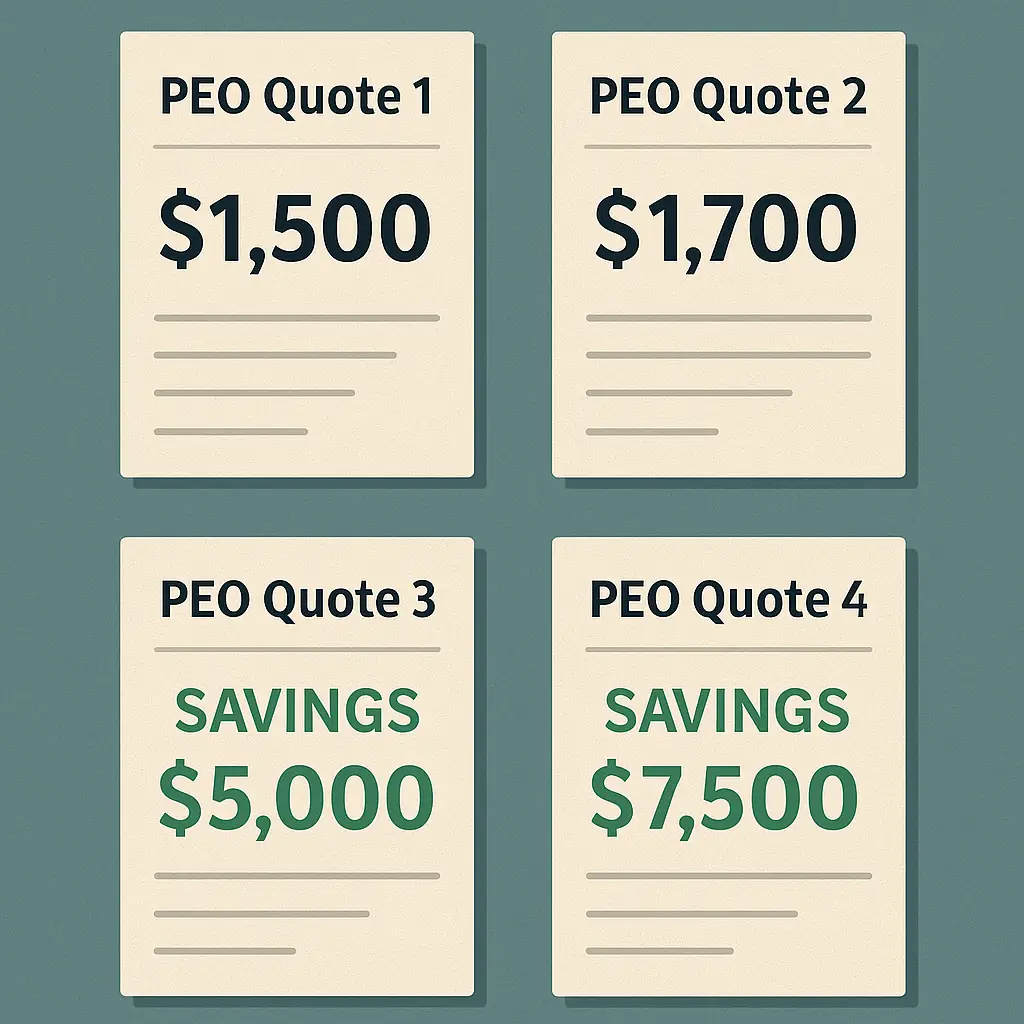
When you’re running a business, every dollar counts. So does every decision. That’s especially true when it comes to outsourcing your HR needs to a Professional Employer Organization (PEO). But here’s the kicker—choosing the right PEO isn’t just about picking a name you recognize. It’s about understanding the services, comparing prices, and ultimately getting a quote from multiple PEOs to ensure you’re making the smartest move.
Getting a quote from multiple PEOs means you’re actively comparing the service scope, pricing models, and value-added features from several providers to find what best suits your business. This isn’t a one-size-fits-all situation. PEOs vary widely in costs, capabilities, compliance support, and employee benefit options.
By requesting quotes from several providers, you’re arming yourself with knowledge. Not just about price, but also about what services you truly need—and which providers can deliver them without bloating your budget. It’s no longer just smart business. It’s essential strategy.
So, how do you start? You ask. You compare. You negotiate. And this blog is here to help you do all of that and more—efficiently, confidently, and without feeling overwhelmed. Let’s dive in.
Understanding PEO Services
When you decide to get a quote from multiple PEOs, it helps to start with the basics: What exactly is a PEO and how might one support your business? A PEO—short for professional employer organization—is a partner that handles many of the employment‑related administrative duties for your company.
These services often include payroll and tax filings, employee benefits, risk and compliance management, workers’ compensation, HR support, and so on. Essentially, the PEO enters into a co‑employment relationship: your employees are still doing the work for you, but the PEO handles many behind‑the‑scenes details.
Why does this matter? Because when you are able to offload time‑consuming, regulatory‑heavy tasks, you free up your team to focus on what matters most: growth, customer service, innovation. It’s a shift from “fire‑fighting HR issues” to “strategic workforce management.”
In my own experience working with small businesses, I’ve seen how a PEO can change things: one client reduced their payroll administrative hours by nearly 60 % once the PEO took over benefits enrollment, payroll tax filings, and compliance training. As a result, the internal HR team could pivot to recruiting and training instead of paperwork.
So understanding this service model is the first step. And once you have that clarity, it becomes far more meaningful when you truly compare quotes from multiple providers—because you know what you’re comparing.
Why Businesses Choose PEOs
When business owners explore the idea to get a quote from multiple PEOs, they’re often responding to pain points: rising HR costs, shifting regulatory demands, and the need to attract and retain talent. According to industry data, businesses that use a PEO grow faster, have lower turnover, and are less likely to go out of business.
Some of the key advantages include:
Cost efficiencies: By joining with a PEO, a smaller business can access group‑benefit rates that would otherwise be out of reach.
Compliance protection: Regulations change rapidly. PEOs bring expertise and systems that help companies stay ahead.
Time savings and focus: When payroll, benefits, and risk are handled elsewhere, you can devote more resources to core operations.
Improved employee experience: A good PEO gives your staff access to higher‑level benefits and services, boosting morale and retention.
In short, businesses choose PEOs not just to outsource tasks—they choose them to enable growth, stability, and agility.
What “Get a Quote from Multiple PEOs” Really Means
The phrase “get a quote from multiple PEOs” may sound straightforward, but it carries more weight than simply filling out a form. It means you are intentionally collecting offers from two or
more PEO providers, comparing them side by side, and making an informed decision rather than accepting the first available offer.
Practically speaking, this means:
Define your business needs upfront: How many employees? What benefits do you currently offer or want to offer? What compliance risks are you facing?
Reach out to multiple PEOs with the same scope so you can compare apples to apples.
Request standardized proposals: Ask each provider to deliver details on fees, services included, any add‑ons, and key performance metrics.
Compare side‑by‑side: Look at price, service breadth, technology, reporting, transition process, and contract terms.
Use tools to streamline the process (more on this later) so you aren’t reinventing the wheel every time you contact a new vendor.
When you adopt that mindset—of actively comparing multiple offers—you reduce risk, improve transparency, and strengthen your negotiating position. Asking “What will this cost me and what exactly am I getting?” becomes a strategic move, not just a checkbox.
How to Identify the Right PEO for Your Business
Getting the right PEO is about more than cost. If you’re going to get a quote from multiple PEOs, you should determine which features and provider characteristics truly matter for your business. Here are key factors to evaluate:
Business size & industry fit
A PEO that excels with small‑business retail may struggle with a manufacturing firm of 200 employees. Ensure the provider has experience in your industry and with your size.
Service scope and depth
What exactly is included in the quote? Does it include payroll tax filing, benefits administration, compliance oversight, workers’ comp, HR consulting? The broader the scope (if high‑quality), the greater the value—but also the higher the cost.
Technology and user experience
Your staff and your employees will experience the PEO’s technology daily—self‑service portals, mobile access, dashboards. A clunky system can impact adoption and satisfaction.
Reputation and accreditation
Check if the PEO is accredited (for example, through National Association of Professional Employer Organizations or other industry credentials). Accreditation offers extra peace of mind.
Pricing transparency
Look for transparent fee structures, no hidden costs, clear descriptions of what’s included, and how additional services will be priced.
Transition process and support
Switching to a PEO (or between PEOs) can be disruptive if not handled well. Good providers will walk you through the on‑boarding process and provide clear timelines.
Contract terms and flexibility
Look at the contract length, termination clause, service level agreements (SLAs), and how future growth is handled.
By applying these filters consistently across the quotes you gather, you’ll be better equipped to choose the right fit—not just the cheapest option.
The Benefits of Comparing Multiple PEO Quotes
Why go through extra work to get a quote from multiple PEOs instead of just picking one? The reasons are compelling:
Better pricing: When providers know they’re in competition, you often receive more favorable terms, incentives, or clearer scope.
Clearer benchmarks: Having several quotes lets you spot outliers—either unusually low pricing (which may come with hidden trade‑offs) or unusually high pricing (which may be over‑spec’d for your needs).
Opportunity to negotiate: One quote may highlight a feature you didn’t realize you needed; another may show how a small tweak could reduce costs.
Strategic confidence: When you compare multiple providers, you’re making a choice from options rather than settling by default. That builds trust in the decision.
Broader service discovery: Different PEOs may offer different strengths (for example, better technology, stronger benefits packages, better compliance support). Comparing lets you spot which strength matters most to you.
In my consulting practice, I’ve seen companies reduce their PEO cost by 20‑30 % simply by using a structured comparison process. In those cases, the cheapest wasn’t always best—but the best overall value became clear only when multiple quotes were placed side‑by‑side.
Top Features to Look for in a PEO Quote
When you request a quote, be sure it includes all the key components you’ll need to assess.
Here’s a checklist:
| Feature | Why It Matters |
|---|---|
| Service fee / cost per employee | Gives you the base cost and lets you compare. |
| Payroll processing details | Ensures they cover tax filings, direct deposit, and integrations. |
| Employee benefits package | Access to health, dental, vision, retirement—impacting retention. |
| Compliance & risk services | Helps avoid fines, audits, and regulatory surprises. |
| Workers’ compensation program | Matters especially in higher‑risk industries (construction, etc.) |
| Technology / self‑service access | Impacts user experience for employees and HR staff. |
| SLAs / performance guarantees | Gives you accountability and benchmarks. |
| On‑boarding / transition plan | Ensures smooth shift into the new relationship. |
| Contract terms (length, termination, exit costs) | You want flexibility and to avoid lock‑in surprises. |
| Hidden costs and extra fees | (e.g., implementation fees, add‑ons) These can erode value. |
When you verify that each quote has these components, you’ll be better situated to compare “apples to apples” rather than being misled by the lowest headline price.
Common Mistakes When Requesting PEO Quotes
Even with good intention, it’s easy to make mistakes when asking to get a quote from multiple PEOs. Here are typical pitfalls:
Requesting inconsistent scopes: If each provider gets a different definition of services, the comparisons won’t be valid.
Focusing only on cost: Choosing solely by lowest price may sacrifice service quality, technology, or future flexibility.
Neglecting transition planning: Forgetting to ask how the provider will onboard your company can lead to disruption.
Underestimating hidden fees: Implementation costs, add‑ons, or termination penalties may not be immediately obvious.
Ignoring technology and user experience: A low cost is less useful if the employees hate the portal or the data is hard to access.
Overlooking contract terms: Long commitments or difficult exit clauses can trap you in a poor arrangement.
Failing to benchmark internally: Not having a baseline for your HR cost and performance makes it harder to judge the value.
By being aware of these mistakes ahead of time, you’re more likely to navigate the quote process wisely and avoid regrets later.
PEO Pricing Models Explained
Understanding how PEO pricing works is key to getting meaningful quotes when you get a quote from multiple PEOs. Here are common pricing models:
Fixed fee per employee per month: You pay a set fee per employee each month, covering defined services.
Percentage of payroll: Some PEOs charge a percentage of your total payroll. Larger payrolls can mean higher fees unless well negotiated.
Tiered pricing: Fees vary by number of employees or service levels (basic vs. premium).
Add‑on pricing: Core services have one fee; additional services like international payroll, 401(k) management, or HR analytics may cost extra.
Bundled service models: Some PEOs bundle services like benefits, compliance, safety into a single package, while others break them out.
When you compare quotes from multiple providers, ensure you understand what model the quote is using, and how growth (more employees) or changes in payroll will impact the cost in future years.
How to Evaluate a PEO Proposal
Once you’ve collected proposals, how do you evaluate them effectively? Here are steps to follow:
Standardize the comparison: Create a table listing each provider and key metrics (fee, services, tech, SLAs, contract length, exit costs).
Score each provider by criteria such as service breadth, cost transparency, technology, references, fit with your industry.
Check for red flags: Unclear fees, unrealistic promises, lack of references, or poor tech.
Look for value beyond cost: Maybe one provider has higher fees but stronger benefits or a smoother transition—which could be worth the premium.
Calculate ROI: Estimate what you’ll save in HR hours, reduced turnover, better benefits, risk mitigation.
Negotiate: Use the proposal you like as leverage—show the other providers what you want and ask them to match or improve.
Plan for future growth: Make sure the provider can scale with you, both in services and cost structure.
When you use this evaluation process after you go to get a quote from multiple PEOs, you will be in a much stronger position to choose the right provider—not just the cheapest.
PEO Comparison Tools & Platforms
Here’s where the process gets smarter and more efficient. Instead of manually contacting each PEO and juggling multiple spreadsheets, you can use a dedicated platform to streamline everything. This is where PEO Marketplace comes into play.
PEO Marketplace is a hub designed to help small and medium‑sized businesses collect and compare multiple PEO quotes in one place. Because using PEO Marketplace means you submit your profile once, and you receive multiple customized quotes from vetted providers rather than contacting each individually, upon which you directly engage with each of your selected PEOs inside of a dedicated in app messaging platform so nothing falls through the cracks.
Benefits of using PEO Marketplace:
Time‑saving and efficient: One submission triggers quotes from several selected providers.
Transparent side‑by‑side comparison: You get standardized proposals broken down so you can easily see the differences.
Vetted providers: The marketplace filters for credible PEOs, helping you avoid low‑quality options.
Guided selection: Our platform includes a smart search to help pinpoint the exact PEOs that best fit your needs.
Better decision‑making: By focusing on apples‑to‑apples comparisons, you can make a more informed selection based on cost, service, and fit.
If you’re serious about getting a quote from multiple PEOs—and doing so without chaos—leveraging PEO Marketplace is a smart move.
Questions to Ask When Getting a PEO Quote
Before you commit to a proposal, make sure you ask some key questions of each provider. When you’re comparing several, these questions help you dig beneath the surface:
What exactly is included in your standard fee?
How do you handle payroll taxes and filings in all states where we operate?
What benefits are offered and how do our employees qualify?
Who is the employer of record, and how does co‑employment work in this case?
What’s your process for onboarding and transitioning a company like ours?
How do you manage workers’ compensation and safety training?
What technology will we use, and who is responsible for employee support?
What are the contract terms—length, renewal, termination fees?
Can you provide references from companies similar to ours?
How will you help us comply with changing labor and employment laws?
What happens if we grow from X to Y employees—does pricing change?
By asking these when you go to get a quote from multiple PEOs, you’ll be better prepared and less likely to encounter surprises.
Real‑World Case Studies: PEO Cost Comparisons
Consider this scenario: A mid‑sized manufacturing company with 75 employees wanted to improve its benefits offering and reduce the administrative burden on its in‑house HR team. They requested quotes from three PEOs—Provider A, Provider B, and Provider C.
Provider A offered the lowest fee but required the company to keep its existing benefits plan and limited HR support.
Provider B offered a mid‑tier fee, stronger benefits package, and better technology.
Provider C was the most expensive but included full HR consulting, talent management, and a dedicated account manager.
Upon evaluation, the company chose Provider B because the value (better benefits + smooth transition) outweighed the slightly higher cost compared to Provider A. Over the first year they reduced employee turnover by 8 %, increased overall employee satisfaction, and freed up their HR team to focus on process improvements.
This example underscores: when you get a quote from multiple PEOs, you don’t just focus on the bottom line—you focus on strategic value.
When to Avoid the Cheapest PEO Option
It might be tempting to pick the lowest‑priced quote when you’ve gone to get a quote from multiple PEOs. But lowest cost isn’t always best. Here’s why you should proceed cautiously:
The lowest cost may come with minimal services, outdated technology, limited benefits, or weak support.
Hidden fees or unclear scope may emerge later and raise your true cost.
A provider with weak experience in your industry or growth stage may become a liability in compliance or scalability.
Poor onboarding or inadequate tech support can create disruption, which can cost more in lost productivity.
In essence, choose value over price. A slightly higher fee that brings stronger support, better benefits, and smoother execution may offer a much higher return.
PEOs for Small vs. Large Businesses
The process to get a quote from multiple PEOs will differ depending on your company size. Here are considerations by business size:
Small businesses (say 10‑50 employees)
You may prioritize basic services: payroll, benefits, compliance.
Look for flexibility and cost‑effectiveness.
A marketplace solution can help you quickly gather quotes and compare without heavy overhead.
Medium to large businesses (50‑250+ employees)
You might need more advanced HR services: talent management, analytics, multi‑state compliance, international expansions.
Pricing will vary more dramatically; premium services matter.
The contract terms, scalability, and integration with your tech stack become mission‑critical.
Regardless of size, the goal remains the same: by comparing multiple quotes, you find the PEO that aligns with your current and future needs.
PEO Compliance and Legal Support
One of the most compelling reasons to partner with a PEO is compliance support. When you get a quote from multiple PEOs, you should assess how each provider handles risks and legal obligations. Key items to check:
Are they up to date with federal and state labor laws?
Do they have dedicated compliance specialists?
What liability protections do they offer (e.g., employment practices liability insurance)?
How do they handle audits, safety inspections, and workers’ comp claims?
What happens if there’s a wage‑and‑hour violation or OSHA issue?
Given the increasing complexity of employment law, this dimension can’t be ignored. A good PEO will help you sleep easier at night.
Bundled Services and Add‑ons to Consider
When you request quotes during the process to get a quote from multiple PEOs, you’ll probably see various “add‑ons” offerings. These might include:
Talent acquisition and recruiting support
Employee training and development
HR analytics and dashboards
Global payroll or multi‑country employer‑of‑record services
Retention programs and employee engagement tools
Enhanced employee benefit tiers (e.g., voluntary benefits, wellness programs)
It’s important to identify which of these you genuinely need, so you can compare quotes accurately, negotiate out unwanted extras, and avoid paying for services you won’t use.
HR Tech Stack Integration
Your HR technology ecosystem matters. When you’re ready to get a quote from multiple PEOs, assess how the provider’s tech will integrate with your current systems. Consider:
Whether the PEO’s portal connects with your payroll, time‑tracking, or ERP system.
Employee self‑service features: mobile access, onboarding flows, benefits enrollment.
Reporting and analytics: does the PEO provide actionable data?
Data security and migration: how will your existing employee data be transferred?
User experience and support: is there training, dedicated account support, and minimal disruption?
Poor technology fit can lead to headaches, despite a good cost. So prioritizing tech‑stack alignment is vital.
PEO Accreditation and Certifications
When you compare quotes, you’ll see providers touting certifications or memberships. These matter, so when you get a quote from multiple PEOs, make sure you verify:
Whether the PEO is a Certified Professional Employer Organization (CPEO) by the IRS.
Accreditation through industry bodies such as ESAC (Employer Services Assurance Corporation).
Evidence of financial stability, claims experience, client satisfaction.
References from businesses similar to yours (industry, size).
These credentials don’t guarantee perfection, but they reduce risk. They help you feel confident you’re working with a credible provider.
Understanding Termination Clauses in Contracts
Even before you sign, think ahead. When you’ve asked to get a quote from multiple PEOs, you should examine how you can exit later. Key contract terms to check:
Duration of the contract (12 months, 24 months, evergreen?).
Early termination fees or penalties.
Notice period for cancelation.
What happens if your company grows/shrinks dramatically?
Transition support when you switch to another provider or bring services in‑house.
What happens to your employees’ benefits or data when the agreement ends?
A good provider will have clear terms and support reasonable flexibility. Avoid being locked in without exit options.
Getting a Quote from Multiple PEOs in One Day
If you need to move quickly, you can gather multiple PEO quotes in a single day—if you follow the right process and use the right tools. Here’s how:
Use a PEO comparison platform like PEO Marketplace—submit your company profile and request quotes from multiple providers at once.
Prepare a standard information packet: your company size, industry, current payroll, benefits offered, growth plans, geographic footprint.
Set a clear timeline: indicate you’re requesting quotes by a certain date and expect them back in a short window.
Schedule review time: treat the proposals as a priority gathering so you can compare side‑by‑side promptly.
Follow up quickly: Ask clarifying questions right away to avoid delays.
Use a decision matrix: a simple table rating each provider on cost, service, tech, fit.
By doing this, you’ll reduce the “quote‑collection” timeframe from weeks to days—and that speed can help you seize opportunities (such as open enrollment deadlines or upcoming growth phases) with less disruption.
How to Negotiate with PEO Providers
Once you’ve collected several quotes via your process to get a quote from multiple PEOs, you’re in a position to negotiate. Here are tactics:
Highlight competitor quotes: If one provider offered better pricing or features, show it to others and ask if they can match or beat it.
Ask for bundling: See if you can bundle payroll + benefits + compliance at a better rate.
Clarify scalability: Negotiate growth thresholds—what happens when you add employees? Can pricing stay locked-in?
Ask for performance guarantees: For instance, guarantee a certain service level or response time.
Negotiate transition costs: Ask the provider to absorb part of your onboarding or implementation cost.
Lock‑in terms: See if you can lock your fee for a year or avoid escalation clauses.
Seek exit flexibility: Negotiate a trial period or short term so you’re not locked in if things change.
Remember—they know you are comparing apples and oranges unless you make it clear you are doing so. Having multiple bids gives you leverage.
Tracking ROI on PEO Services
Signing with a PEO is not the end—it’s the beginning of a relationship. After you get a quote from multiple PEOs and choose one, you still need to track value. To measure ROI:
Track HR hours saved: How many hours did your internal HR team spend on payroll, benefits, compliance before vs. after?
Monitor cost reductions: Are you paying less per employee for benefits, workers’ comp, or payroll processing now?
Watch employee retention: Did turnover decline? Did engagement improve?
Measure growth support: Did the PEO enable you to hire or expand faster with less risk?
Check service quality: How often did you need to contact the PEO with issues? Were they handled timely?
Evaluate scalability: When you grew (or shrank), did the PEO’s cost and support adapt smoothly?
Tracking these metrics helps you justify the decision and refine your ongoing partnership.
Switching PEOs Without Interrupting Operations
Sometimes the PEO you select initially isn’t the long‑term fit. If you’ve already used a structured approach—i.e., you got a quote from multiple PEOs and documented your process—you’ll be better prepared to switch if needed. Here’s how to do it smoothly:
Give proper notice per your contract.
Align termination date with your payroll cycle so there’s no gap.
Ensure benefits transition seamlessly for employees (avoid coverage lapses).
Transfer data and records to the new provider ahead of time.
Communicate with employees: explain the change so there’s minimal confusion.
Review final reconciliation: make sure fees, payroll taxes, workers’ comp experience are closed out cleanly.
Update internal processes: ensure that HR and payroll staff know the new workflow.
Switching doesn’t have to be chaotic—when you’ve done the homework ahead of time, it can be a strategic move to improve service or savings.
PEO Industry Trends
As you consider how to get a quote from multiple PEOs, it’s helpful to know where the industry is headed. Here are some key trends:
Technology and automation: More PEOs are offering advanced platforms, analytics, AI‑driven insights for HR and workforce planning.
Remote & multi‑state compliance: With more distributed workforces, PEOs are expanding services to cover multi‑state and international employees.
Enhanced employee benefits and wellbeing: The war for talent is driving better benefit offerings, wellness programs, and employee experience services.
Marketplace models: Platforms like PEO Marketplace are making it easier to compare and select providers—reducing friction in the market.
Focus on data & insights: Businesses expect more than basic services—they expect their PEO to provide strategic insights around workforce, retention, productivity.
Industry specialization: Some PEOs are specializing by industry (construction, manufacturing, non‑profit) to provide tailored expertise.
By being aware of these trends, when you go to get a quote from multiple PEOs, you’ll ask the right questions about what’s coming next—not just what’s needed today.
Final Checklist Before Signing a PEO Contract
Before you sign, here’s a checklist to run through—especially important after you’ve made the effort to get a quote from multiple PEOs:
Service scope clearly defined and aligned with what you need.
Pricing model transparent and scalable.
Technology and user experience tested or demoed.
Onboarding/transition plan in writing.
Contract term, termination rights, and fees understood.
Performance metrics and SLAs specified.
Compliance and risk management capabilities confirmed.
References and accreditation verified.
Future growth/expansion scenario addressed.
Data security, privacy, and transition plan included.
Communication plan for employees in place.
Internal HR roles and responsibilities clarified (your side vs. the PEO).
Ticking those boxes gives you confidence that you’re entering a partnership—not merely outsourcing tasks.
FAQs
What is the advantage to get a quote from multiple PEOs?
Comparing several quotes helps you identify the best pricing, services, and contract terms. It ensures you’re not overpaying and helps you see the full range of options.
How many PEO quotes should I get?
Ideally at least two or three, so you can see meaningful differences in cost, service, and provider fit.
How quickly can I get multiple PEO quotes?
With a platform like PEO Marketplace, you can often receive several competitive quotes in 24–48 hours.
What should I compare when reviewing PEO proposals?
You should compare cost, services included, technology, transition plan, contract length/termination, accreditation, client references, and scalability.
Can I negotiate PEO fees once I’ve got multiple quotes?
Yes—having competitive quotes gives you leverage. You can ask providers to match or improve based on what you’ve gathered.
My business is small (10 employees). Does it make sense to get a quote from multiple PEOs?
Absolutely. Even small businesses benefit from comparing providers—the right fit can help you access better benefits, save time, and scale faster.
Conclusion
In the landscape of today’s business world, to get a quote from multiple PEOs is more than just a smart move—it’s a strategic one. When you commit to comparing multiple providers, you gain clarity, confidence, and a stronger negotiating position. You’re not just buying HR outsourcing—you’re choosing a partner for growth, compliance, and stability.
Using tools like PEO Marketplace makes the quote‑collection and comparison process far less daunting, turning what could be weeks of research into a streamlined, efficient process. By applying the frameworks and checklists above—defining your needs, collecting standardized quotes, evaluating service breadth, and assessing value beyond cost—you place your business in control.
Don’t let HR obligations distract your leadership team. Instead, let a well‑matched PEO handle the administrative heavy lifting, while you focus on strategy, market expansion, and talent development. And when you’ve taken the time to get a quote from multiple PEOs, you’ll know you made the right choice—not just the easy one.