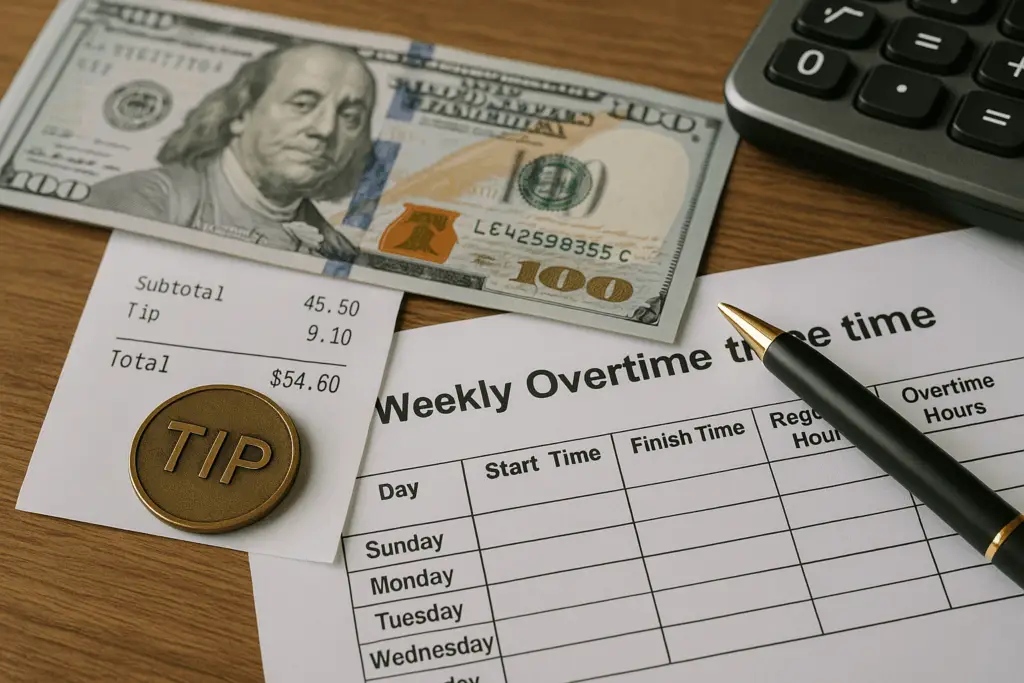
The One Big Beautiful Bill Act: Overtime & Tips
The One Big Beautiful Bill Act is now law. Two provisions matter most for employers with tipped or hourly workforces:
(1) a temporary deduction for qualified tips (up to $25,000 per year)
(2) a temporary deduction for the premium portion of FLSA §7 overtime (up to $12,500, or $25,000 MFJ). Both apply retroactively to January 1, 2025 and run through 2028; phase-outs apply at higher incomes. Employees claim these deductions on their individual returns, regardless of whether they itemize. TaxAct BlogTurboTax
Important for 2025 payroll: The IRS says no changes to withholding or the Form W-2 for 2025. Keep reporting/wage withholding as usual this year—but start tracking (from 1/1/2025) what counts as “qualified tips” and FLSA §7 overtime premium so employees can substantiate deductions and you’re ready for new W-2 codes expected for 2026. IRSLittler Mendelson P.C.
What counts?
Qualified tips: limited to occupations that “customarily and regularly” received tips on or before 12/31/2024; the IRS will publish an official list by Oct 2, 2025 and require payors to furnish related information statements. Watch for details on which tip types qualify. IRS
Qualified overtime: only the FLSA §7 premium (the “half” in time-and-a-half) required by federal law—not shift differentials, holiday premiums, bonuses, or state-only overtime extras. H&R Block Tax preparation company
New employer credit: The law expands the §45B FICA tip credit beyond restaurants to beauty industry employers (salons/spas/barbershops), allowing a general business credit roughly equal to the employer FICA paid on tips (subject to usual 45B rules). You still remit FICA; the credit offsets income-tax liability (non-refundable; carryback/forward available). Pro Beauty AssociationIRS
Broader context: The Act also contains health-policy changes (Medicaid/ACA, nutrition programs) that states and providers are flagging as significant; these are outside payroll but relevant to benefits planning. ASTHO
What employers should do now
Inventory your pay codes: confirm how FLSA §7 overtime and tip income are captured; map “qualified” vs “non-qualified.”
Backfill from 1/1/2025 so workers can substantiate deductions.
Coordinate with your payroll/HRIS to add tracking fields and year-end extracts aligned to anticipated 2026 W-2 codes.
Prepare employee FAQs explaining that 2025 paychecks won’t reflect the deductions; workers claim them at filing time.
If bandwidth is tight, consider a PEO that already handles tipped/hourly complexity and can stand up compliant tracking/reporting. IRS
Bottom Line
The One Big Beautiful Bill Act doesn’t change how you pay workers today, but it changes how those wages must be tracked and reported. The deductions will be valuable to employees, and the expanded tip credit could reduce your income tax liability.
The catch? Retroactivity. Employers who don’t start tracking now will face year-end headaches, amended filings, and frustrated employees.
The good news: with the right payroll structure — or by partnering with a PEO — you can absorb these changes smoothly and even turn them into a competitive advantage in recruiting and retention.
FAQs Employers Are Already Asking
Is this tax change optional?
No. The new deductions and expanded credits are part of federal law, effective retroactively to January 1, 2025. Employers must comply.
Which industries need to act the fastest?
Restaurants, bars, hotels, salons, barbershops, and any business with high concentrations of tipped or hourly workers. Multi-unit operators are especially exposed.
Can I wait for the IRS to issue more instructions?
You shouldn’t. While the IRS will publish the official tipped occupations list by October 2, 2025, the law is already in effect. Delaying could mean missing critical tracking windows and filing amended returns later.
Do I need to refile past pay periods?
In many cases, yes. At minimum, you’ll need accurate W-2 reporting aligned to the law’s definitions when forms are issued in 2026. Without proper tracking now, amended W-2s could be unavoidable.
Does this impact my FICA taxes?
Yes. Employers eligible for the expanded §45B FICA tip credit can offset their income-tax liability, but only if they accurately track qualified tips. Remember, you still remit payroll taxes as usual—the credit applies against your federal income-tax bill.
Key Deadlines to Watch
January 1, 2025 — Retroactive start date for qualified tips and overtime tracking.
October 2, 2025 — IRS publishes official list of qualifying tipped occupations.
December 2025 — Payroll/HRIS systems should be updated to prepare for year-end reporting.
Early 2026 — Employees file 2025 returns and claim new deductions.
2026 W-2 cycle — New reporting codes (TP for tips, TT for overtime) expected to appear.